Instituto Cajal, IC-CSIC, Avda. Doctor Arce 37, E-28002, Madrid, Spain.
Present address: School of Biomedical Sciences, Li Ka Shing Faculty of Medicine, The University of Hong Kong, Pokfulam, Hong Kong SAR, China.
BMC Biol. 2021 Mar 11;19(1):43. doi: 10.1186/s12915-021-00967-9.
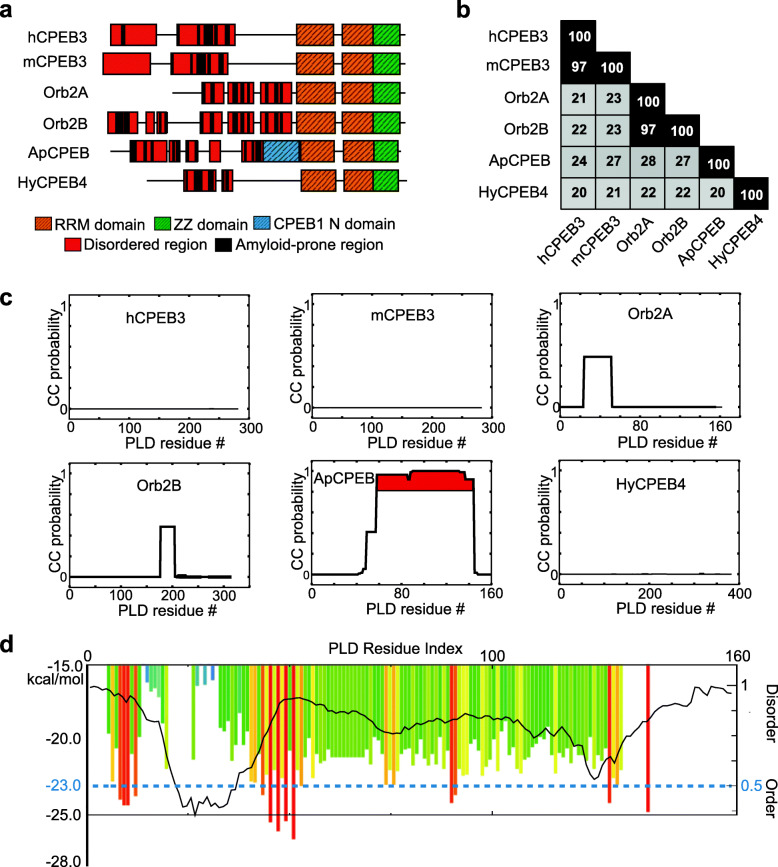
Amyloids are ordered, insoluble protein aggregates, characterized by a cross-β sheet quaternary structure in which molecules in a β-strand conformation are stacked along the filament axis via intermolecular interactions. While amyloids are typically associated with pathological conditions, functional amyloids have also been identified and are present in a wide variety of organisms ranging from bacteria to humans. The cytoplasmic polyadenylation element-binding (CPEB) prion-like protein is an mRNA-binding translation regulator, whose neuronal isoforms undergo activity-dependent aggregation, a process that has emerged as a plausible biochemical substrate for memory maintenance. CPEB aggregation is driven by prion-like domains (PLD) that are divergent in sequence across species, and it remains unknown whether such divergent PLDs follow a similar aggregating assembly pathway. Here, we describe the amyloid-like features of the neuronal Aplysia CPEB (ApCPEB) PLD and compare them to those of the Drosophila ortholog, Orb2 PLD.
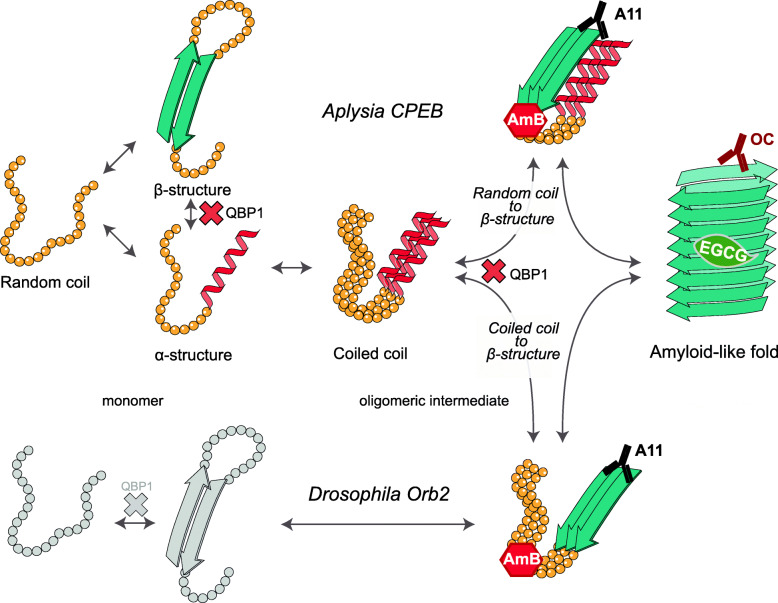
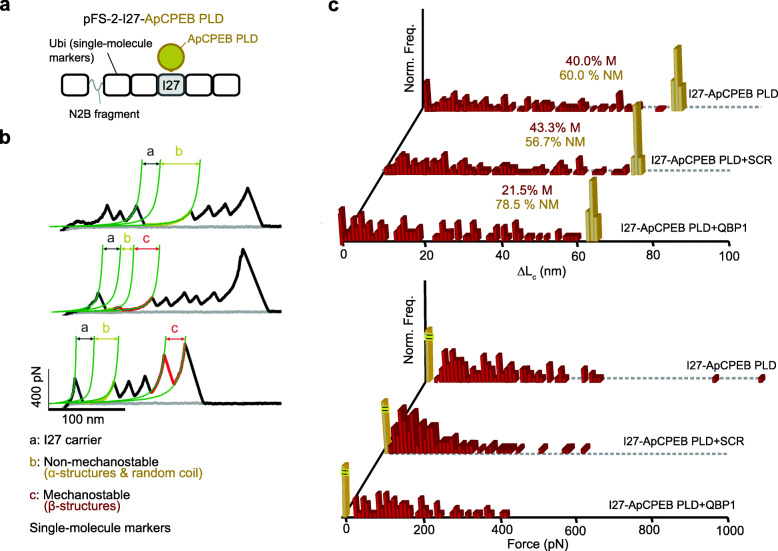
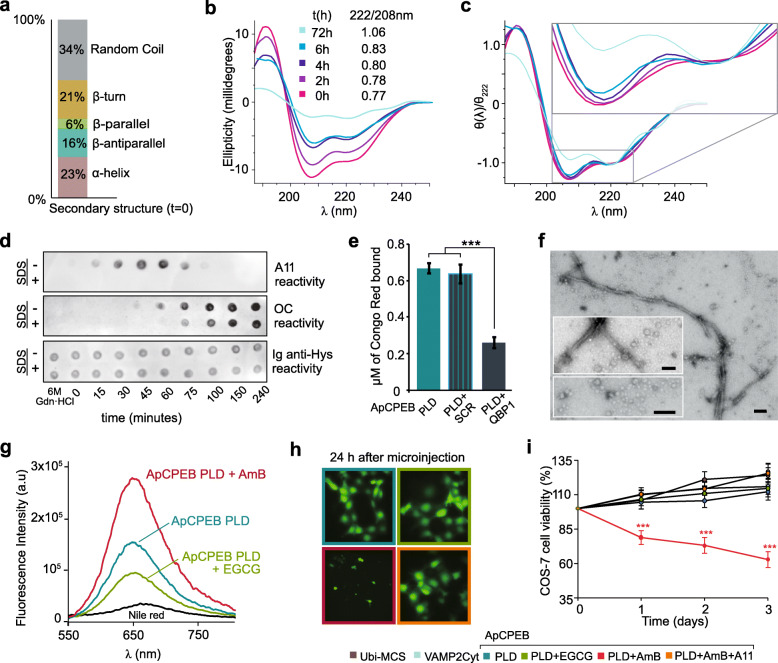
Using in vitro single-molecule and bulk biophysical methods, we find transient oligomers and mature amyloid-like filaments that suggest similarities in the late stages of the assembly pathway for both ApCPEB and Orb2 PLDs. However, while prior to aggregation the Orb2 PLD monomer remains mainly as a random coil in solution, ApCPEB PLD adopts a diversity of conformations comprising α-helical structures that evolve to coiled-coil species, indicating structural differences at the beginning of their amyloid assembly pathways.
Our results indicate that divergent PLDs of CPEB proteins from different species retain the ability to form a generic amyloid-like fold through different assembly mechanisms.
淀粉样蛋白是有序的、不溶性的蛋白质聚集体,其特征是具有交叉-β片层四级结构,其中β-链构象的分子通过分子间相互作用沿纤维轴堆叠。虽然淀粉样蛋白通常与病理状况有关,但也已经确定了功能性淀粉样蛋白,并存在于从细菌到人类等各种生物体中。细胞质多聚腺苷酸化元件结合(CPEB)朊病毒样蛋白是一种 mRNA 结合翻译调节剂,其神经元同工型经历活性依赖性聚集,这一过程已成为记忆维持的合理生化底物。CPEB 聚集由朊病毒样结构域(PLD)驱动,这些结构域在物种间序列上存在差异,目前尚不清楚这种不同的 PLD 是否遵循类似的聚集组装途径。在这里,我们描述了神经元 Aplysia CPEB(ApCPEB)PLD 的淀粉样特征,并将其与果蝇同源物 Orb2 PLD 进行了比较。
使用体外单分子和批量生物物理方法,我们发现了瞬时寡聚物和成熟的淀粉样纤维,这表明 ApCPEB 和 Orb2 PLD 的组装途径的晚期阶段存在相似之处。然而,在聚集之前,Orb2 PLD 单体在溶液中主要保持为无规卷曲,而 ApCPEB PLD 则采用多种构象,包括α-螺旋结构,这些结构演变为卷曲螺旋物种,表明其淀粉样组装途径的起始阶段存在结构差异。
我们的结果表明,来自不同物种的 CPEB 蛋白的不同 PLD 通过不同的组装机制保留了形成通用淀粉样折叠的能力。