Nygård Merethe, Eichele Tom, Løberg Else-Marie, Jørgensen Hugo A, Johnsen Erik, Kroken Rune A, Berle Jan Øystein, Hugdahl Kenneth
Department of Biological and Medical Psychology, University of Bergen Bergen, Norway.
Front Hum Neurosci. 2012 May 31;6:149. doi: 10.3389/fnhum.2012.00149. eCollection 2012.
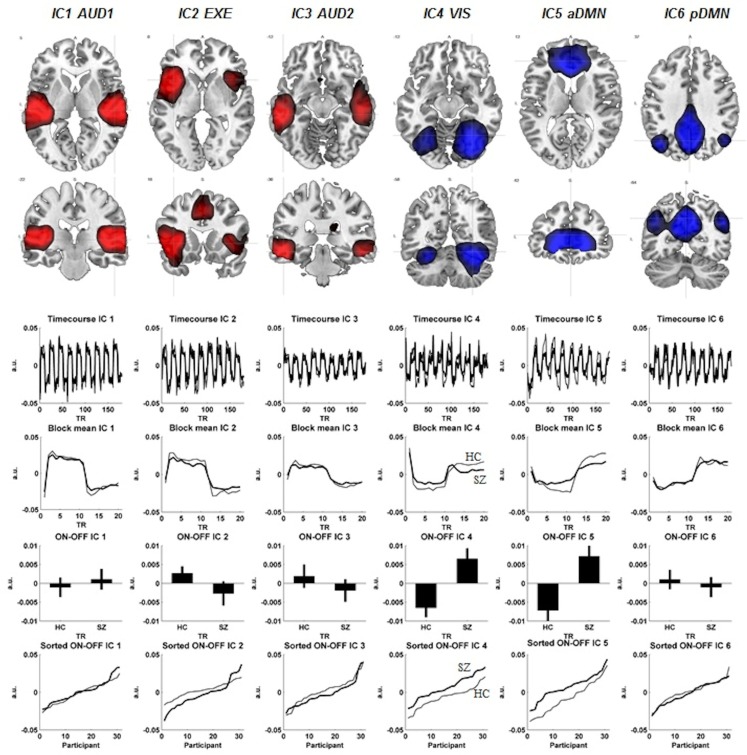
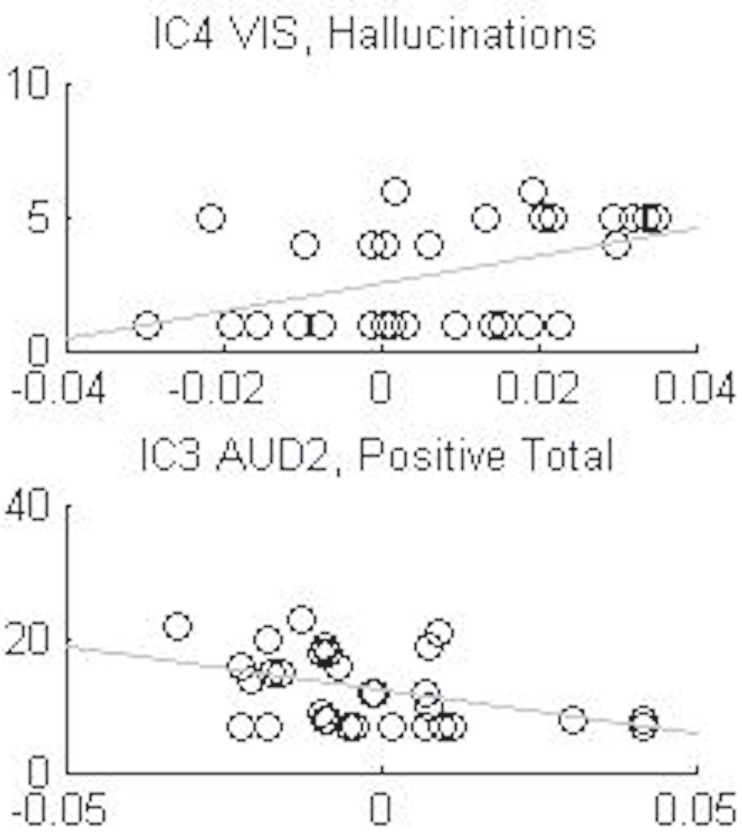
Recent research suggests that the cerebral correlates of cognitive deficits in schizophrenia are nested in the activity of widespread, inter-regional networks rather than being restricted to any specific brain location. One of the networks that have received focus lately is the default mode network. Parts of this network have been reported as hyper-activated in schizophrenia patients (SZ) during rest and during task performance compared to healthy controls (HC), although other parts have been found to be hypo-activated. In contrast to this network, task-positive networks have been reported as hypo-activated compared in SZ during task performance. However, the results are mixed, with, e.g., the dorsolateral prefrontal cortex showing both hyper- and hypo-activation in SZ. In this study we were interested in signal increase and decrease differences between a group of SZ and HC in cortical networks, assuming that the regulatory dynamics of alternating task-positive and task-negative neuronal processes are aberrant in SZ. We compared 31 SZ to age- and gender-matched HC, and used fMRI and independent component analysis (ICA) in order to identify relevant networks. We selected the independent components (ICs) with the largest signal intensity increases (STG, insula, supplementary motor cortex, anterior cingulate cortex, and MTG) and decreases (fusiform gyri, occipital lobe, PFC, cingulate, precuneus, and angular gyrus) in response to a dichotic auditory cognitive task. These ICs were then tested for group differences. Our findings showed deficient up-regulation of the executive network and a corresponding deficit in the down-regulation of the anterior default mode, or effort network during task performance in SZ when compared with HC. These findings may indicate a deficit in the dynamics of alternating task-dependent and task-independent neuronal processes in SZ. The results may cast new light on the mechanisms underlying cognitive deficits in schizophrenia, and may be of relevance for diagnostics and new treatments.
近期研究表明,精神分裂症认知缺陷的大脑关联嵌套于广泛的区域间网络活动中,而非局限于任何特定的脑区。最近受到关注的网络之一是默认模式网络。与健康对照者(HC)相比,该网络的部分区域在精神分裂症患者(SZ)休息和任务执行期间被报道为过度激活,尽管也发现其他部分区域激活不足。与该网络相反,任务阳性网络在SZ任务执行期间被报道为激活不足。然而,结果并不一致,例如,背外侧前额叶皮质在SZ中既表现出过度激活又表现出激活不足。在本研究中,我们关注一组SZ和HC在皮质网络中信号增强和减弱的差异,假设在SZ中交替的任务阳性和任务阴性神经元过程的调节动态存在异常。我们将31名SZ与年龄和性别匹配的HC进行比较,并使用功能磁共振成像(fMRI)和独立成分分析(ICA)来识别相关网络。我们选择了在双耳听觉认知任务中信号强度增加最大(颞上回、脑岛、辅助运动皮层、前扣带回皮层和颞中回)和降低最大(梭状回、枕叶、前额叶皮质、扣带回、楔前叶和角回)的独立成分(ICs)。然后对这些ICs进行组间差异测试。我们的研究结果表明,与HC相比,SZ在任务执行期间执行网络的上调不足,以及前默认模式或努力网络的下调相应不足。这些发现可能表明SZ中交替的任务依赖和任务独立神经元过程的动态存在缺陷。这些结果可能为精神分裂症认知缺陷的潜在机制提供新的线索,并且可能与诊断和新治疗方法相关。