Hahn Britta, Harvey Alexander N, Gold James M, Ross Thomas J, Stein Elliot A
University of Maryland School of Medicine, Maryland Psychiatric Research Center, P.O. Box 21247, Baltimore, MD 21228, USA.
National Institute on Drug Abuse - Intramural Research Program, Neuroimaging Research Branch, 251 Bayview Blvd, Suite 200, Baltimore, MD 21224, USA.
Schizophr Res. 2017 Jul;185:190-196. doi: 10.1016/j.schres.2017.01.001. Epub 2017 Jan 7.
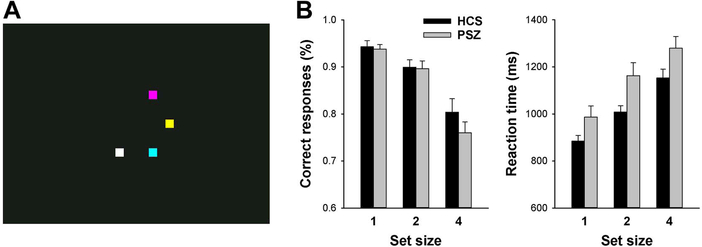
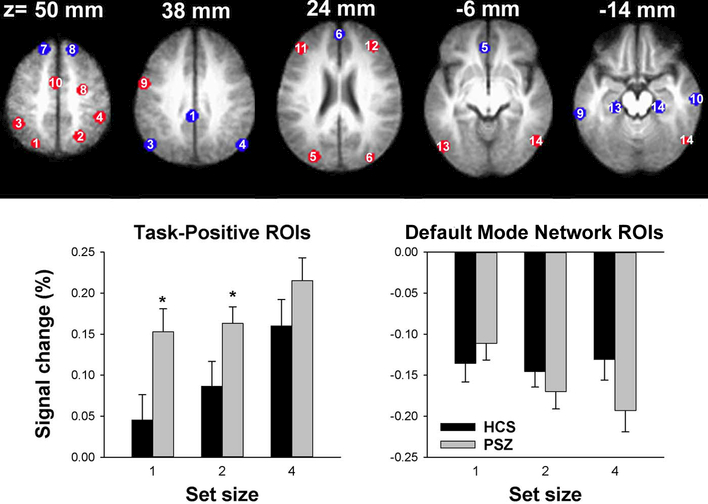
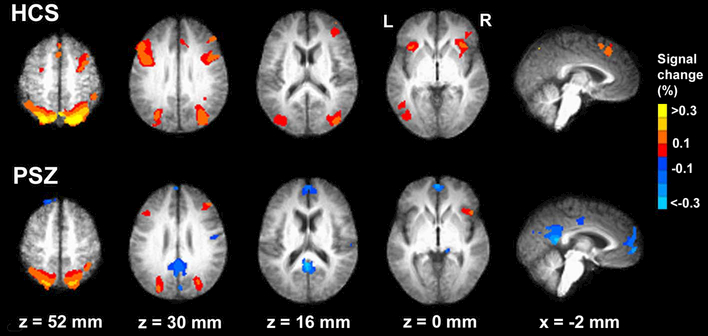
Schizophrenia is associated with impairment in a range of cognitive functions. Neuroimaging studies have reported lower, but also higher, task-induced activation accompanying impaired performance. Differences in task-load and the ability of people with schizophrenia (PSZ) to stay engaged in the cognitive operations probed appear to underlie such discrepancies. Similarly, task-induced deactivation of the default mode network (DMN) was weaker in PSZ relative to healthy control subjects (HCS) in most studies, but some reported greater deactivation. An inability to stay engaged in the cognitive operations could account for these discrepancies, too, as it would lead to more time off-task and consequently less deactivation of DMN functions. The present study employed a change detection paradigm with small to moderate set sizes (SSs) of 1, 2, and 4 items. Task training prior to fMRI scanning abolished the group difference in no-response trials. Task-positive regions of interest (ROIs) displayed greater activation with increasing SS in both groups. PSZ showed greater activation relative to HCS at SSs 1 and 2. DMN ROIs displayed greater deactivation with increasing SS in PSZ, but not in HCS, and PSZ tended to hyperdeactivate DMN regions at SS 4. No hypodeactivation was observed in PSZ. In conclusion, when minimizing differences in task-engagement, PSZ tend to over-recruit task-positive regions during low-load operations, and hyperdeactivate DMN functions at higher load, perhaps reflecting heightened non-specific vigilance or effort when dealing with cognitive challenges. This speaks against an inability to down-regulate task-independent thought processes as a primary mechanism underlying cognitive impairment in schizophrenia.
精神分裂症与一系列认知功能受损有关。神经影像学研究报告称,在表现受损的情况下,任务诱发的激活水平较低,但也有较高的情况。任务负荷的差异以及精神分裂症患者(PSZ)参与所探究认知操作的能力差异似乎是造成这种差异的原因。同样,在大多数研究中,与健康对照受试者(HCS)相比,PSZ中任务诱发的默认模式网络(DMN)失活较弱,但也有一些研究报告称失活程度更大。无法持续参与认知操作也可能是造成这些差异的原因,因为这会导致更多的非任务时间,从而减少DMN功能的失活。本研究采用了一种变化检测范式,设置了1、2和4项的小到中等规模集(SS)。功能磁共振成像扫描前的任务训练消除了无反应试验中的组间差异。两组中,随着SS增加,任务阳性感兴趣区域(ROI)的激活程度都更高。在SS为1和2时,PSZ相对于HCS表现出更大的激活。在PSZ中,随着SS增加,DMN ROI的失活程度更大,但在HCS中并非如此,并且在SS为4时,PSZ倾向于过度失活DMN区域。在PSZ中未观察到失活不足。总之,当尽量减少任务参与度的差异时,PSZ在低负荷操作期间倾向于过度募集任务阳性区域,而在高负荷时过度失活DMN功能,这可能反映出在应对认知挑战时非特异性警觉或努力的增强。这与无法下调与任务无关的思维过程作为精神分裂症认知障碍的主要潜在机制的观点相悖。