Tomioka Haruaki, Tatano Yutaka, Maw Win Win, Sano Chiaki, Kanehiro Yuichi, Shimizu Toshiaki
Department of Microbiology and Immunology, Shimane University School of Medicine, Izumo, Shimane 693-8501, Japan.
Clin Dev Immunol. 2012;2012:635451. doi: 10.1155/2012/635451. Epub 2012 May 15.
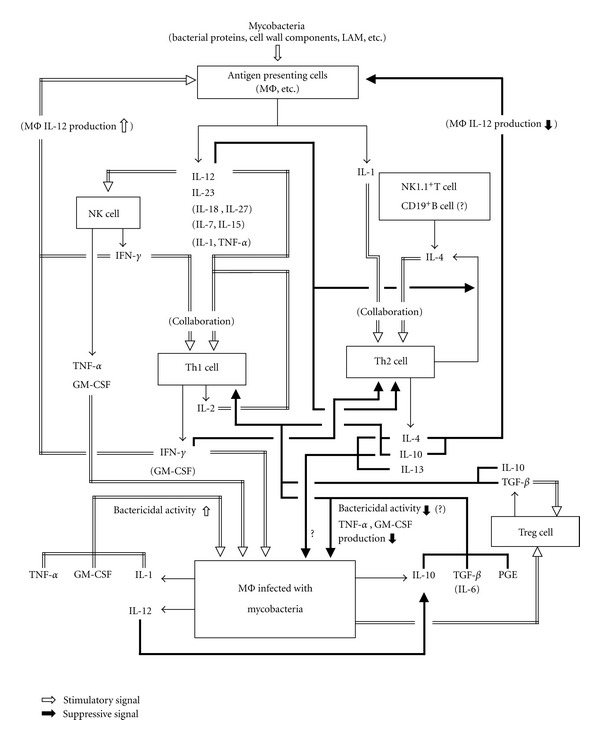
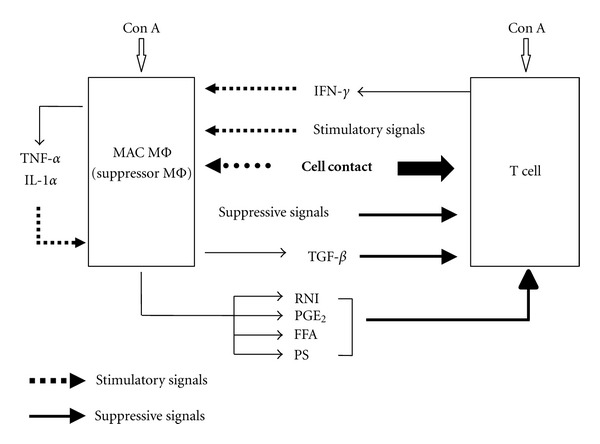
In the advanced stages of mycobacterial infections, host immune systems tend to change from a Th1-type to Th2-type immune response, resulting in the abrogation of Th1 cell- and macrophage-mediated antimicrobial host protective immunity. Notably, this type of immune conversion is occasionally associated with the generation of certain types of suppressor macrophage populations. During the course of Mycobacterium tuberculosis (MTB) and Mycobacterium avium-intracellulare complex (MAC) infections, the generation of macrophages which possess strong suppressor activity against host T- and B-cell functions is frequently encountered. This paper describes the immunological properties of M1- and M2-type macrophages generated in tumor-bearing animals and those generated in hosts with certain microbial infections. In addition, this paper highlights the immunological and molecular biological characteristics of suppressor macrophages generated in hosts with mycobacterial infections, especially MAC infection.
在分枝杆菌感染的晚期阶段,宿主免疫系统往往会从Th1型免疫反应转变为Th2型免疫反应,导致Th1细胞和巨噬细胞介导的抗微生物宿主保护性免疫被废除。值得注意的是,这种类型的免疫转换偶尔与某些类型的抑制性巨噬细胞群体的产生有关。在结核分枝杆菌(MTB)和鸟分枝杆菌-胞内分枝杆菌复合体(MAC)感染过程中,经常会遇到对宿主T细胞和B细胞功能具有强大抑制活性的巨噬细胞的产生。本文描述了荷瘤动物中产生的M1型和M2型巨噬细胞以及某些微生物感染宿主中产生的巨噬细胞的免疫学特性。此外,本文还重点介绍了分枝杆菌感染宿主,尤其是MAC感染宿主中产生的抑制性巨噬细胞的免疫学和分子生物学特征。