Department of Surgery, Maastricht University Medical Center, Maastricht, The Netherlands.
PLoS One. 2012;7(5):e37439. doi: 10.1371/journal.pone.0037439. Epub 2012 May 29.
Impaired microcirculation during endotoxemia correlates with a disturbed arginine-nitric oxide (NO) metabolism and is associated with deteriorating organ function. Improving the organ perfusion in endotoxemia, as often seen in patients with severe infection or systemic inflammatory response syndrome (SIRS) is, therefore, an important therapeutic target. We hypothesized that supplementation of the arginine precursor citrulline rather than arginine would specifically increase eNOS-induced intracellular NO production and thereby improve the microcirculation during endotoxemia.
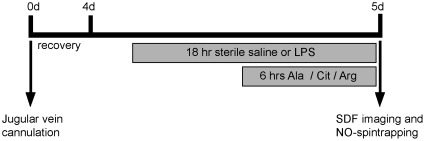
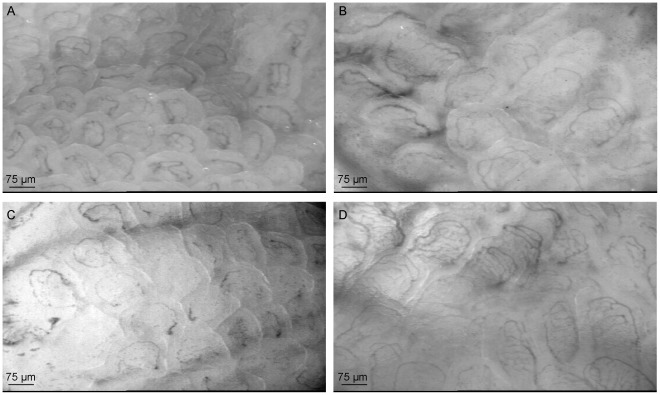
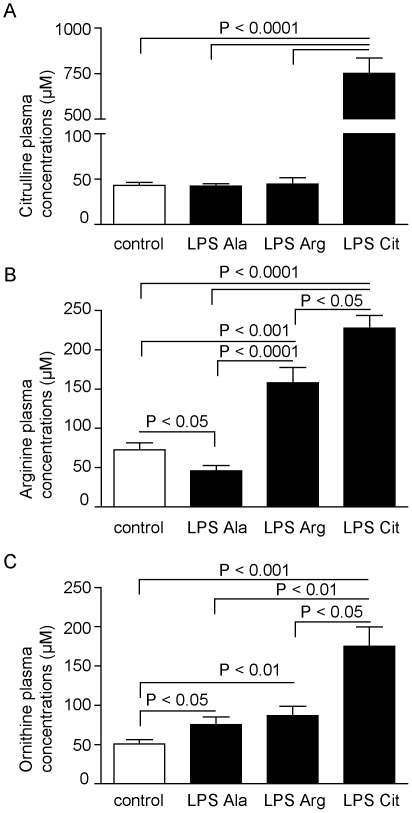
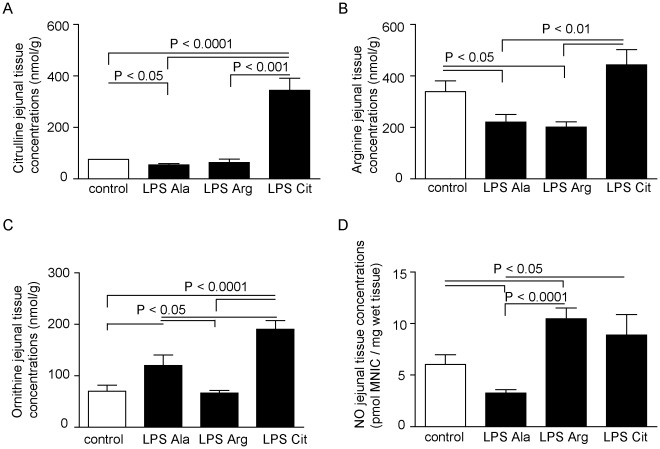
METHODOLOGY/PRINCIPAL FINDINGS: To study the effects of L-Citrulline and L-Arginine supplementation on jejunal microcirculation, intracellular arginine availability and NO production in a non-lethal prolonged endotoxemia model in mice. C57/Bl6 mice received an 18 hrs intravenous infusion of endotoxin (LPS, 0.4 µg • g bodyweight(-1) • h(-1)), combined with either L-Citrulline (6.25 mg • h-1), L-Arginine (6.25 mg • h(-1)), or L-Alanine (isonitrogenous control; 12.5 mg • h(-1)) during the last 6 hrs. The control group received an 18 hrs sterile saline infusion combined with L-Alanine or L-Citrulline during the last 6 hrs. The microcirculation was evaluated at the end of the infusion period using sidestream dark-field imaging of jejunal villi. Plasma and jejunal tissue amino-acid concentrations were measured by HPLC, NO tissue concentrations by electron-spin resonance spectroscopy and NOS protein concentrations using Western blot.
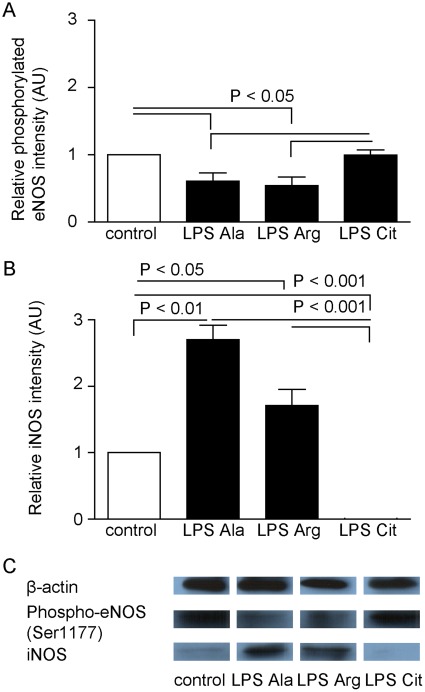
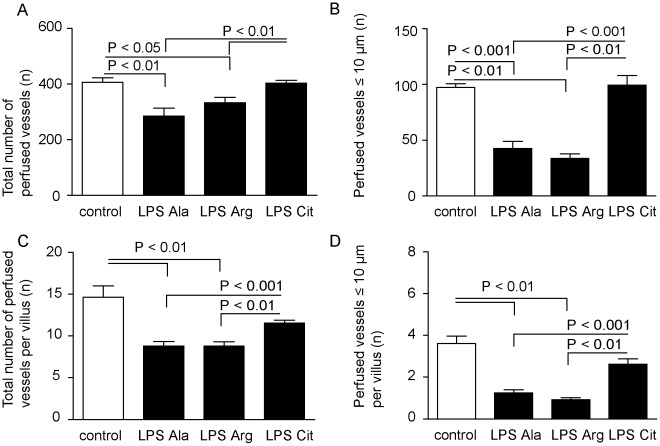
CONCLUSION/SIGNIFICANCE: L-Citrulline supplementation during endotoxemia positively influenced the intestinal microvascular perfusion compared to L-Arginine-supplemented and control endotoxemic mice. L-Citrulline supplementation increased plasma and tissue concentrations of arginine and citrulline, and restored intracellular NO production in the intestine. L-Arginine supplementation did not increase the intracellular arginine availability. Jejunal tissues in the L-Citrulline-supplemented group showed, compared to the endotoxemic and L-Arginine-supplemented endotoxemic group, an increase in degree of phosphorylation of eNOS (Ser 1177) and a decrease in iNOS protein level. In conclusion, L-Citrulline supplementation during endotoxemia and not L-Arginine reduced intestinal microcirculatory dysfunction and increased intracellular NO production, likely via increased intracellular citrulline and arginine availability.
内毒素血症期间微循环受损与精氨酸-一氧化氮(NO)代谢紊乱有关,并与器官功能恶化有关。因此,改善内毒素血症中的器官灌注,如严重感染或全身炎症反应综合征(SIRS)患者中常见的那样,是一个重要的治疗目标。我们假设补充精氨酸前体瓜氨酸而不是精氨酸会特异性增加 eNOS 诱导的细胞内 NO 产生,从而改善内毒素血症期间的微循环。
方法/主要发现:在非致死性延长内毒素血症模型中,我们研究了 L-瓜氨酸和 L-精氨酸补充对内毒素血症小鼠空肠微循环、细胞内精氨酸可用性和 NO 产生的影响。C57/Bl6 小鼠接受 18 小时静脉内内毒素(LPS,0.4 µg • g 体重(-1)• h(-1))输注,同时在最后 6 小时内输注 L-瓜氨酸(6.25 mg • h-1)、L-精氨酸(6.25 mg • h(-1))或 L-丙氨酸(等氮对照;12.5 mg • h(-1))。对照组在最后 6 小时内接受 18 小时无菌生理盐水输注,并与 L-丙氨酸或 L-瓜氨酸一起输注。在输注期结束时,使用空肠绒毛的侧流暗场成像评估微循环。通过 HPLC 测量血浆和空肠组织氨基酸浓度,通过电子自旋共振光谱测量组织 NO 浓度,并通过 Western blot 测量 NOS 蛋白浓度。
结论/意义:与 L-精氨酸补充和对照内毒素血症小鼠相比,内毒素血症期间补充 L-瓜氨酸可对内毒素血症的肠道微血管灌注产生积极影响。L-瓜氨酸补充增加了血浆和组织中的精氨酸和瓜氨酸浓度,并恢复了肠道细胞内的 NO 产生。L-精氨酸补充并没有增加细胞内精氨酸的可用性。与内毒素血症和 L-精氨酸补充的内毒素血症组相比,L-瓜氨酸补充组的空肠组织中 eNOS(Ser 1177)的磷酸化程度增加,iNOS 蛋白水平降低。总之,内毒素血症期间补充 L-瓜氨酸而不是 L-精氨酸可减少肠道微循环功能障碍并增加细胞内 NO 产生,可能是通过增加细胞内瓜氨酸和精氨酸的可用性。