Department of Biology, University of Milan, Milan, Italy.
PLoS One. 2012;7(5):e37467. doi: 10.1371/journal.pone.0037467. Epub 2012 May 22.
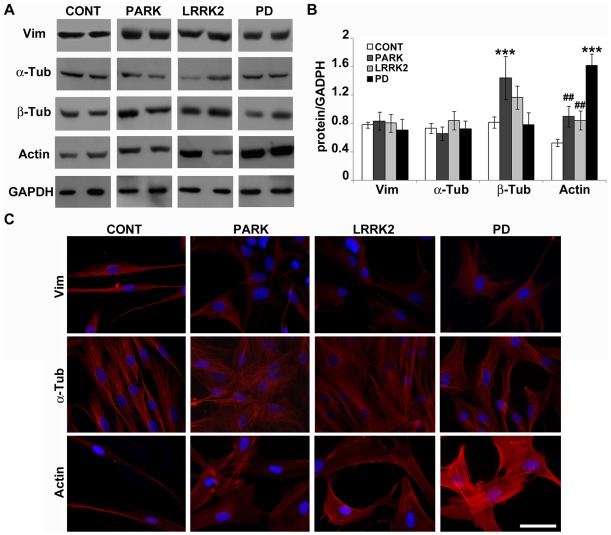
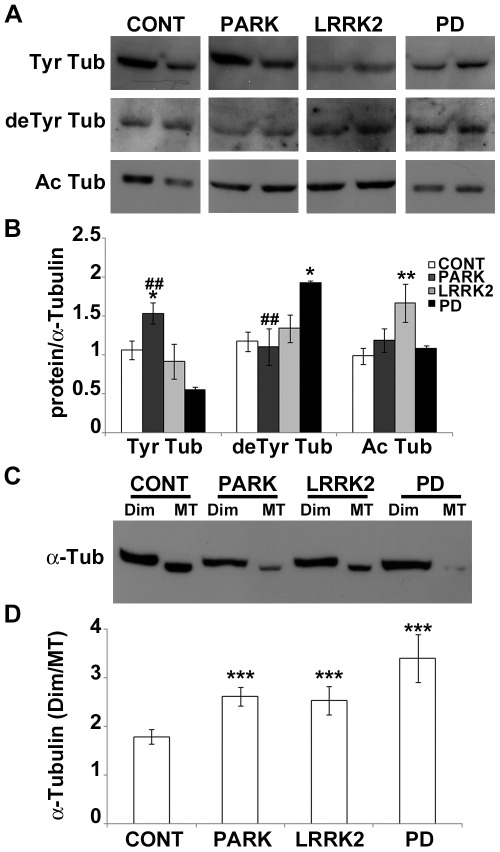
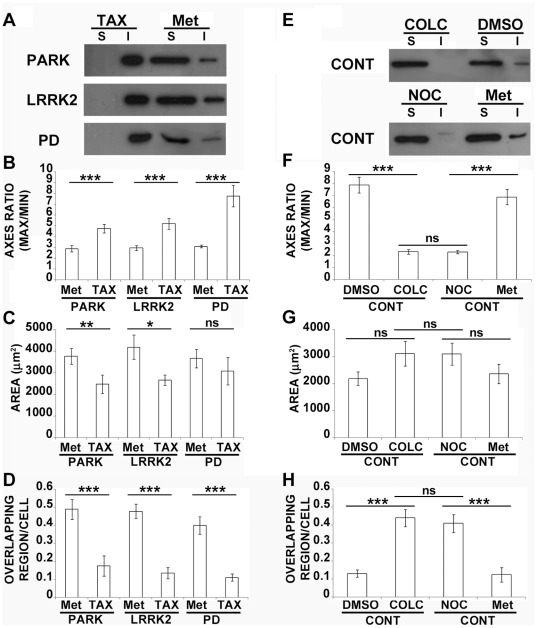
Data from both toxin-based and gene-based models suggest that dysfunction of the microtubule system contributes to the pathogenesis of Parkinson's disease, even if, at present, no evidence of alterations of microtubules in vivo or in patients is available. Here we analyze cytoskeleton organization in primary fibroblasts deriving from patients with idiopathic or genetic Parkinson's disease, focusing on mutations in parkin and leucine-rich repeat kinase 2. Our analyses reveal that genetic and likely idiopathic pathology affects cytoskeletal organization and stability, without any activation of autophagy or apoptosis. All parkinsonian fibroblasts have a reduced microtubule mass, represented by a higher fraction of unpolymerized tubulin in respect to control cells, and display significant changes in microtubule stability-related signaling pathways. Furthermore, we show that the reduction of microtubule mass is so closely related to the alteration of cell morphology and behavior that both pharmacological treatment with microtubule-targeted drugs, and genetic approaches, by transfecting the wild type parkin or leucine-rich repeat kinase 2, restore the proper microtubule stability and are able to rescue cell architecture. Taken together, our results suggest that microtubule destabilization is a point of convergence of genetic and idiopathic forms of parkinsonism and highlight, for the first time, that microtubule dysfunction occurs in patients and not only in experimental models of Parkinson's disease. Therefore, these data contribute to the knowledge on molecular and cellular events underlying Parkinson's disease and, revealing that correction of microtubule defects restores control phenotype, may offer a new therapeutic target for the management of the disease.
来自基于毒素和基于基因的模型的数据表明,微管系统的功能障碍导致帕金森病的发病机制,即使目前尚无体内或患者微管改变的证据。在这里,我们分析了源自特发性或遗传性帕金森病患者的原代成纤维细胞中的细胞骨架组织,重点研究了 parkin 和富含亮氨酸重复激酶 2 的突变。我们的分析表明,遗传和可能的特发性病理学影响细胞骨架组织和稳定性,而不会引起自噬或细胞凋亡的任何激活。所有帕金森病成纤维细胞的微管质量都降低,与对照细胞相比,未聚合的微管蛋白比例更高,并且与微管稳定性相关的信号通路发生显著变化。此外,我们表明,微管质量的降低与细胞形态和行为的改变密切相关,用微管靶向药物进行药理学治疗,以及通过转染野生型 parkin 或富含亮氨酸重复激酶 2 的基因方法,恢复适当的微管稳定性并能够挽救细胞结构。总之,我们的结果表明,微管不稳定是遗传和特发性帕金森病形式的交汇点,并首次表明微管功能障碍不仅发生在帕金森病的实验模型中,也发生在患者中。因此,这些数据有助于了解帕金森病的分子和细胞事件,并揭示出纠正微管缺陷可恢复对照表型,可能为该疾病的治疗提供新的治疗靶点。