Jeong Seong Jin, Kim Hyeon June, Lee Young Ju, Lee Jeong Keun, Lee Byung Ki, Choo Young Min, Oh Jong Jin, Lee Sang Cheol, Jeong Chang Wook, Yoon Cheol Yong, Hong Sung Kyu, Byun Seok-Soo, Lee Sang Eun
Department of Urology, Seoul National University Bundang Hospital, Seongnam, Korea.
Korean J Urol. 2012 May;53(5):342-8. doi: 10.4111/kju.2012.53.5.342. Epub 2012 May 18.
To identify the prevalence and clinical features of detrusor underactivity (DU) in elderly men and women presenting with lower urinary tract symptoms (LUTS).
We reviewed 1,179 patients aged over 65 years who had undergone a urodynamic study for LUTS with no neurological or anatomical conditions. DU was defined as a bladder contractility index <100 and a maximal flow rate (Qmax) ≤12 ml/s combined with a detrusor pressure at Qmax ≤10 cmH(2)O for men and women, respectively.
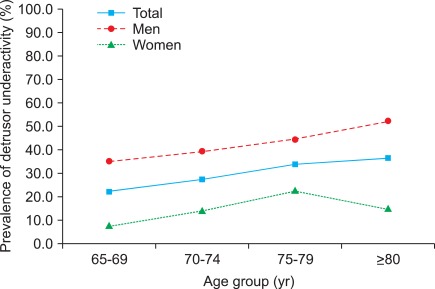
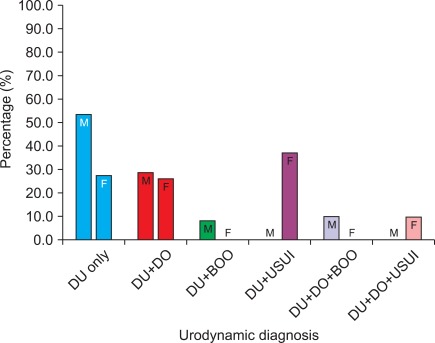
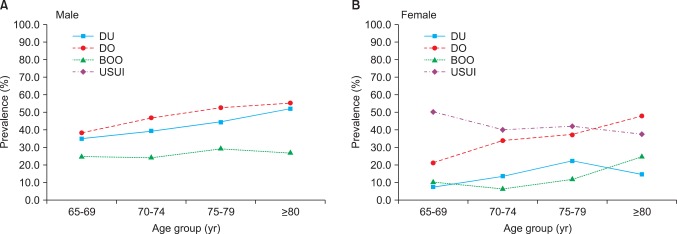
Of the patients, 40.2% of men and 13.3% of women were classified as having DU (p<0.001). Types of clinical symptoms were not significantly different between patients with and without DU. In men, whereas the prevalence of bladder outlet obstruction (BOO) was constant across the age spectrum, the prevalence of DU and detrusor overactivity (DO) increased with age, and 46.5% of men with DU also had DO or BOO. In women, the prevalence of DU also increased with age, and the trend was more remarkable in women aged over 70 years. DU was accompanied by DO or urodynamic stress urinary incontinence (USUI) in 72.6% of the women with DU. Women with DU were found to have lower cystometric capacity and exhibited a greater incidence of reduced compliance than did women without DU.
DU was a common mechanism underlying LUTS in the elderly population, especially in men. One half of the men and three quarters of the women with DU also had other pathologies such as DO, BOO, or USUI.
确定出现下尿路症状(LUTS)的老年男性和女性中逼尿肌活动低下(DU)的患病率及临床特征。
我们回顾了1179例65岁以上因LUTS接受尿动力学检查且无神经或解剖学疾病的患者。DU定义为膀胱收缩力指数<100,男性和女性的最大尿流率(Qmax)分别≤12 ml/s,且Qmax时逼尿肌压力分别≤10 cmH₂O。
患者中,40.2%的男性和13.3%的女性被归类为患有DU(p<0.001)。有DU和无DU的患者临床症状类型无显著差异。在男性中,膀胱出口梗阻(BOO)的患病率在各年龄组中保持不变,而DU和逼尿肌过度活动(DO)的患病率随年龄增加,46.5%患有DU的男性同时患有DO或BOO。在女性中,DU的患病率也随年龄增加,且在70岁以上女性中这种趋势更为明显。72.6%患有DU的女性同时伴有DO或尿动力学压力性尿失禁(USUI)。发现患有DU的女性膀胱容量较低,与无DU的女性相比顺应性降低的发生率更高。
DU是老年人群尤其是男性LUTS的常见潜在机制。患有DU的男性中有一半、女性中有四分之三还患有其他病理状况,如DO、BOO或USUI。