Department of Biological Sciences, Graduate School of Science and Engineering, Tokyo Metropolitan University, 1–1 Minami-Osawa, Hachioji-shi, Tokyo 192–0397, Japan.
Microbes Environ. 2012;27(4):374-81. doi: 10.1264/jsme2.me11350. Epub 2012 May 17.
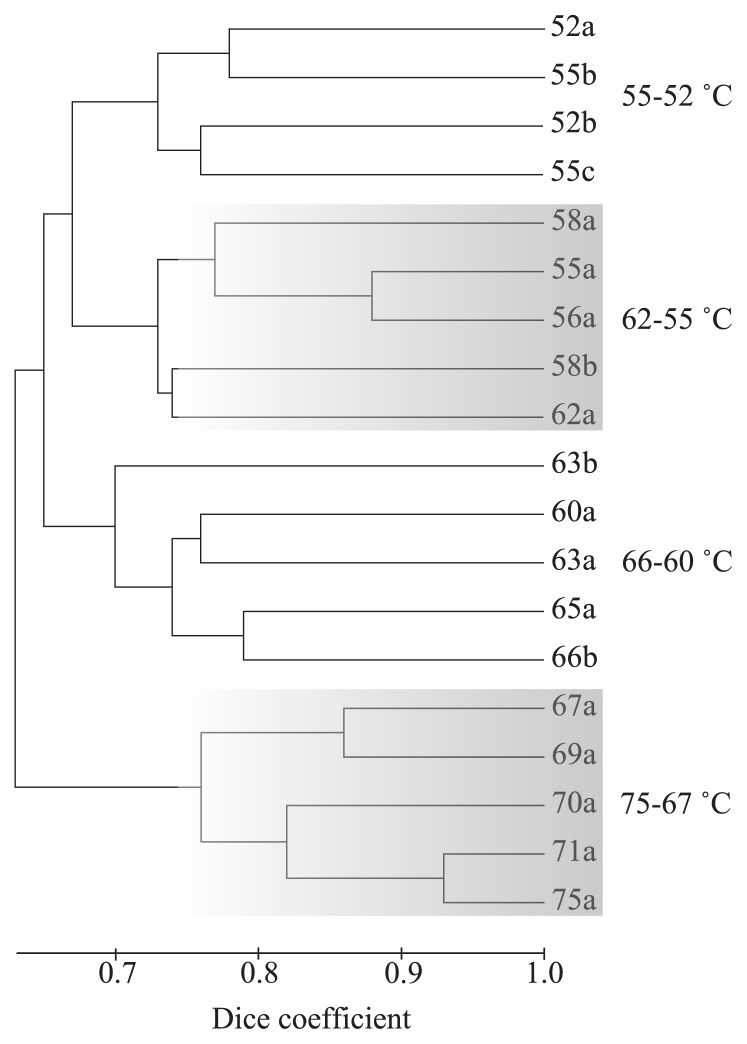
To better understand the biogeography and relationship between temperature and community structure within microbial mats, the bacterial diversity of mats at a slightly alkaline, sulfide-containing hot spring was explored. Microbial mats that developed at temperatures between 75-52°C were collected from an area of approximately 1 m(2) in Nakabusa, Nagano, Japan. Bacterial 16S rRNA genes from these samples were examined by terminal restriction fragment length polymorphism (T-RFLP) and clone library analysis. T-RFLP profiles revealed 66 unique fragments (T-RFs). Based on total T-RFs observed in environmental profiles and clone libraries, a temperature effect on diversity was determined, with complexity in the community increasing as temperature decreased. The T-RF pattern indicated four distinct community assemblages related to temperature. Members of the Aquificales and particularly the sulfur-oxidizing bacterium Sulfurihydrogenibium were present at all temperatures and were the dominant component of mats taken at 75-67°C. Sulfide oxidation, which persisted throughout the temperature gradient, was the presumed dominant pathway of primary production above 67°C. As temperature decreased, successive additions of anoxygenic and oxygenic phototrophs increased primary productivity, allowing for diversification of the community.
为了更好地了解微生物席内温度与群落结构之间的生物地理学关系,我们探索了日本长野县中宫温泉一处略呈碱性且含硫化物的热泉中微生物席的细菌多样性。从约 1 平方米的区域中采集了温度在 75-52°C 之间的微生物席样本。通过末端限制性片段长度多态性(T-RFLP)和克隆文库分析,对这些样本中的细菌 16S rRNA 基因进行了检测。T-RFLP 图谱显示了 66 个独特的片段(T-RFs)。根据环境图谱和克隆文库中观察到的总 T-RFs,确定了温度对多样性的影响,随着温度降低,群落的复杂性增加。T-RF 模式表明存在与温度相关的四个不同的群落组合。泉古菌门和特别是硫氧化菌硫磺氢杆菌属的成员存在于所有温度下,是 75-67°C 采集的微生物席的主要组成部分。在整个温度梯度中持续存在的硫化物氧化,是 67°C 以上初级生产的主要途径。随着温度降低,兼性和需氧光合生物的连续添加增加了初级生产力,使群落多样化。