Department of Nutrition and Health Promotion, Faculty for Human Development, Hiroshima Jogakuin University, 4-13-1 Ushita-higashi Higashi-ku, Hiroshima, 732-0063, Japan.
Nutr J. 2012 Jun 7;11:39. doi: 10.1186/1475-2891-11-39.
The finding reported in a previous paper - alkalization of urine facilitates uric acid excretion - is contradictory to what one might expect to occur: because food materials for the alkalization of urine contain fewer purine bodies than those for acidification, less uric acid in alkaline urine should have been excreted than in acid urine. To make clear what component of uric acid excretion mechanisms is responsible for this unexpected finding, we simultaneously collected data for the concentration of both creatinine and uric acid in serum as well as in urine, in order to calculate both uric acid and creatinine clearances.
Within the framework of the Japanese government's health promotion program, we made recipes which consisted of protein-rich and less vegetable-fruit food materials for H + -load (acidic diet) and others composed of less protein and more vegetable-fruit rich food materials (alkaline diet). This is a crossover study within some limitations. Healthy female students, who had no medical problems at the regular physical examination provided by the university, were enrolled in this consecutive 5-day study for each test. From whole-day collected urine, total volume, pH, organic acid, creatinine, uric acid, titratable acid and all cations (Na+,K+,Ca2+,Mg2+,NH4+) and anions (Cl-,SO42-,PO4-) necessary for the estimation of acid-base balance were measured. In the early morning before breakfast of the 1st, 3rd and 5th experimental day, we sampled 5 mL of blood to estimate the creatinine and uric acid concentration in serum.
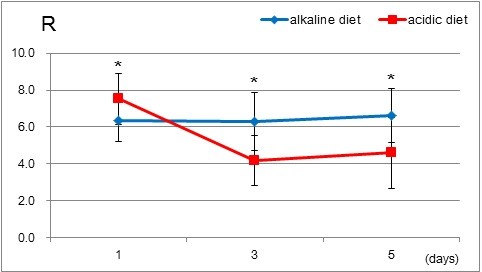
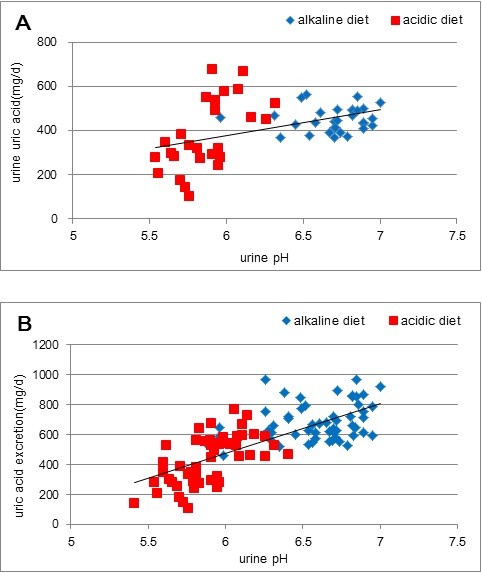
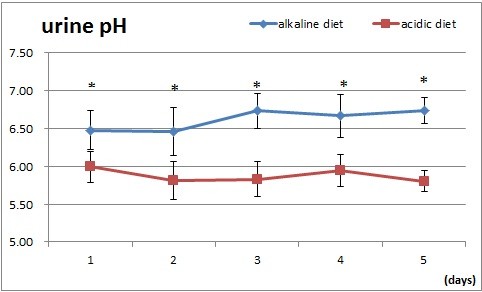
Urine pH reached a steady state 3 days after switching from ordinary daily diets to specified regimens. The amount of acid generated ([SO42-] + organic acid - gut alkali)was linearly related with the excretion of acid (titratable acid + [NH4+] - [HCO3-]), indicating that H + in urine is generated by the metabolic degradation of food materials. Uric acid and excreted urine pH retained a linear relationship, as reported previously. Among the five factors which are associated with calculating clearances for both uric acid and creatinine, we identified a conspicuous difference between acidic and alkaline diets in the uric acid concentration in serum as well as in urine; uric acid in the serum was higher in the acidic group than in the alkaline group, while uric acid in the urine in the acidic group was lower than that in the alkaline group. These changes of uric acid in acidic urine and in serum were reflected in the reduction of its clearance. From these observations, it is considered that uric acid may be reabsorbed more actively in acidic urine than in alkaline urine.
We conclude that alkalization of urine by eating nutritionally well-designed alkaline -prone food is effective for removing uric acid from the body.
之前的一篇论文报告指出,尿液碱化有利于尿酸排泄,这与人们的预期相悖:因为尿液碱化所需的食物材料所含的嘌呤体比酸化所需的食物材料少,因此碱性尿液中应该排泄出比酸性尿液中更少的尿酸。为了明确尿酸排泄机制中的哪个环节导致了这一意外发现,我们同时收集了血清和尿液中肌酐和尿酸的浓度数据,以便计算尿酸和肌酐的清除率。
在日本政府的健康促进计划框架内,我们制定了富含蛋白质和较少蔬菜-水果食物的食谱,用于 H+负荷(酸性饮食),以及其他富含蛋白质和较多蔬菜-水果的食谱(碱性饮食)。这是一项在一定限制内的交叉研究。在大学提供的常规体检中没有任何健康问题的健康女学生被纳入了这项连续 5 天的研究,每个测试都进行了。从全天收集的尿液中,我们测量了总尿量、pH 值、有机酸、肌酐、尿酸、可滴定酸和所有用于估计酸碱平衡的阳离子(Na+、K+、Ca2+、Mg2+、NH4+)和阴离子(Cl-、SO42-、PO42-)。在第 1、3 和 5 天实验日的早餐前清晨,我们抽取 5 毫升血液,以估计血清中的肌酐和尿酸浓度。
在从普通日常饮食切换到特定饮食方案后 3 天,尿液 pH 值达到稳定状态。生成的酸量([SO42-]+有机酸-肠道碱)与酸的排泄量(可滴定酸+[NH4+]-[HCO3-])呈线性关系,表明尿液中的 H+是由食物材料的代谢降解产生的。尿酸和排泄的尿液 pH 值保持线性关系,如前所述。在与尿酸和肌酐清除率计算相关的五个因素中,我们发现酸性和碱性饮食在血清和尿液中尿酸浓度方面存在显著差异;酸性组血清尿酸高于碱性组,而酸性组尿液尿酸低于碱性组。酸性尿液和血清中尿酸的这些变化反映在其清除率的降低上。从这些观察结果来看,尿酸在酸性尿液中的重吸收可能比在碱性尿液中更活跃。
我们的结论是,通过食用营养设计合理的碱性倾向食物使尿液碱化,可有效从体内排出尿酸。