Department of Genetic Medicine, Weill Cornell Medical College, New York, NY, USA.
BMC Med Genomics. 2012 Jun 7;5:21. doi: 10.1186/1755-8794-5-21.
Mucus hypersecretion contributes to the morbidity and mortality of smoking-related lung diseases, especially chronic obstructive pulmonary disease (COPD), which starts in the small airways. Despite progress in animal studies, the genes and their expression pattern involved in mucus production and secretion in human airway epithelium are not well understood. We hypothesized that comparison of the transcriptomes of the small airway epithelium of individuals that express high vs low levels of MUC5AC, the major macromolecular component of airway mucus, could be used as a probe to identify the genes related to human small airway mucus production/secretion.
Flexible bronchoscopy and brushing were used to obtain small airway epithelium (10th to 12th order bronchi) from healthy nonsmokers (n=60) and healthy smokers (n=72). Affymetrix HG-U133 plus 2.0 microarrays were used to assess gene expression. Massive parallel sequencing (RNA-Seq) was used to verify gene expression of small airway epithelium from 5 nonsmokers and 6 smokers.
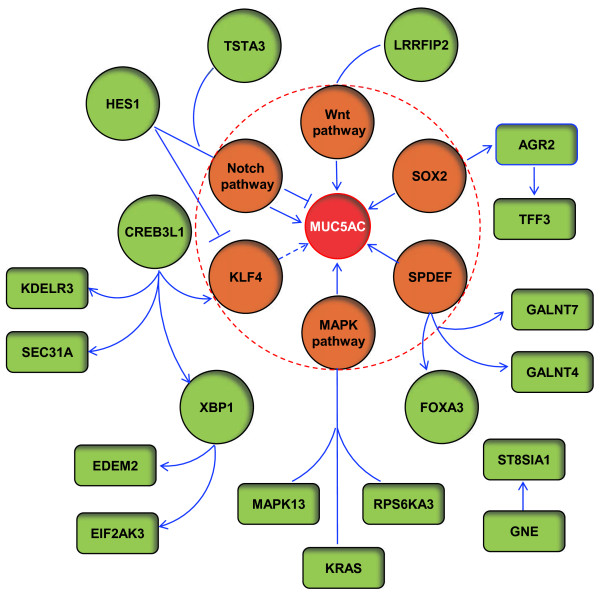
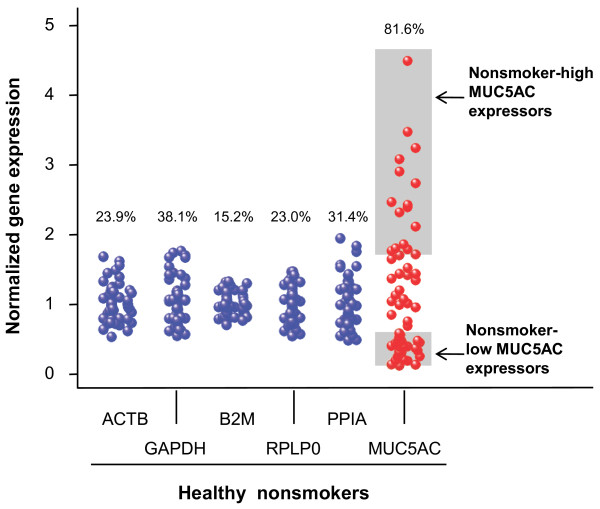
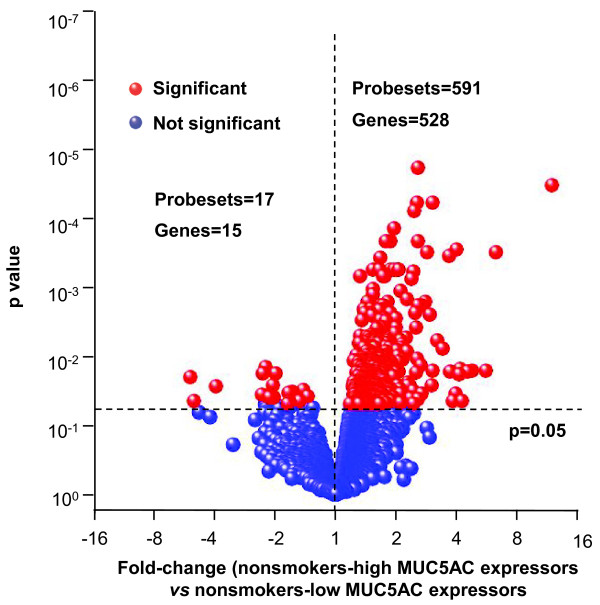
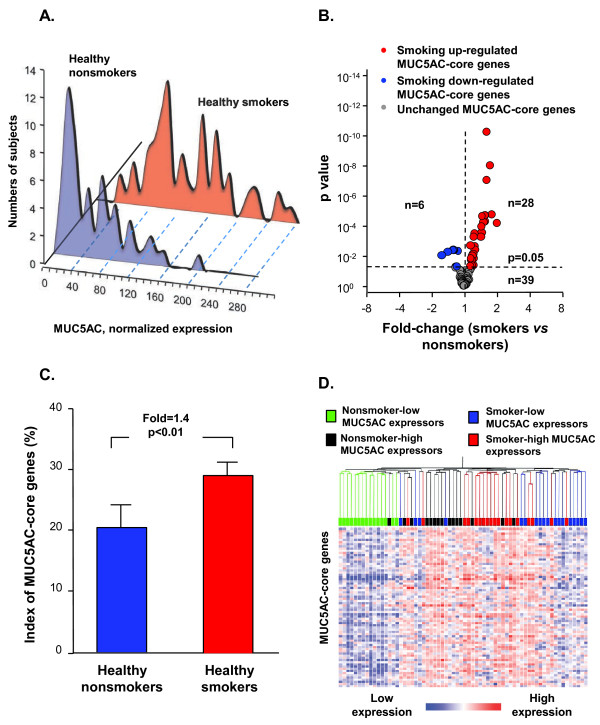
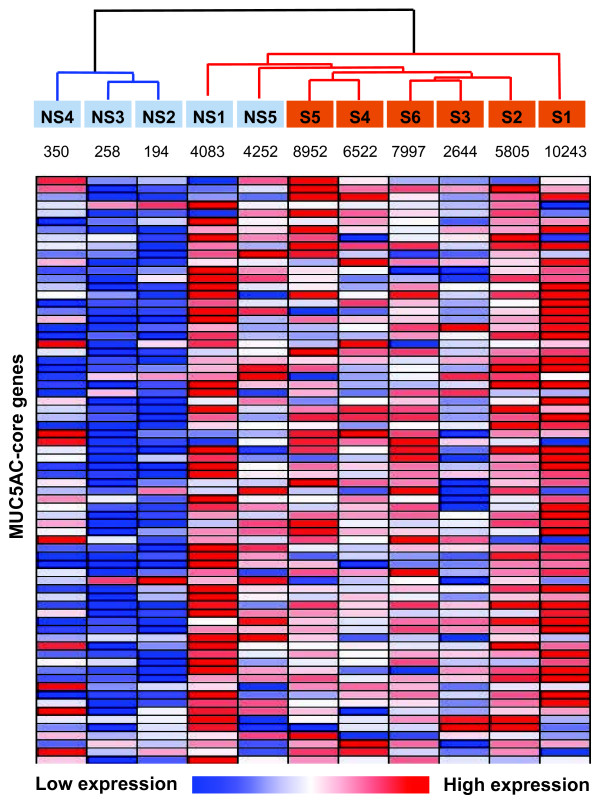
MUC5AC expression varied 31-fold among the healthy nonsmokers. Genome-wide comparison between healthy nonsmokers (n = 60) grouped as "high MUC5AC expressors" vs "low MUC5AC expressors" identified 528 genes significantly up-regulated and 15 genes significantly down-regulated in the high vs low expressors. This strategy identified both mucus production and secretion related genes under control of a network composed of multiple transcription factors. Based on the literature, genes in the up-regulated list were used to identify a 73 "MUC5AC-associated core gene" list with 9 categories: mucus component; mucus-producing cell differentiation-related transcription factor; mucus-producing cell differentiation-related pathway or mediator; post-translational modification of mucin; vesicle transport; endoplasmic reticulum stress-related; secretory granule-associated; mucus secretion-related regulator and mucus hypersecretory-related ion channel. As a validation cohort, we assessed the MUC5AC-associated core gene list in the small airway epithelium of an independent set of healthy smokers (n = 72). There was up-regulation of MUC5AC in the small airway epithelium of smokers (2.3-fold, p < 10-8) associated with a coordinated up-regulation of MUC5AC-associated core gene expression pattern in the small airway epithelium of smokers (p < 0.01). Deep sequencing confirmed these observations.
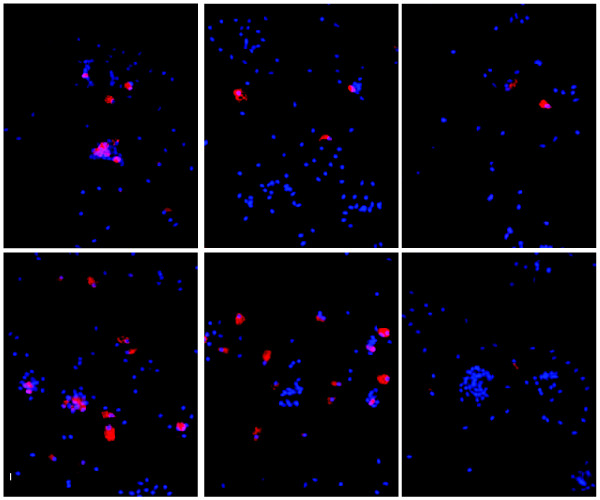
The identification of the genes associated with increased airway mucin production in humans should be useful in understanding the pathogenesis of airway mucus hypersecretion and identifying therapeutic targets. AUTHOR SUMMARY: Mucus hypersecretion contributes to the morbidity and mortality of smoking-related lung diseases, especially chronic obstructive pulmonary disease (COPD), which starts in the small airways. Little is known about the gene networks associated with the synthesis and secretion of mucins in the human small airway epithelium. Taking advantage of the knowledge that MUC5AC is a major mucin secreted by the small airway epithelium, the expression of MUC5AC in small airway epithelium is highly regulated at the transcriptional level and our observation that healthy nonsmokers have variable numbers of MUC5AC+ secretory cells in the human small airway epithelium, we compared genome-wide gene expression of the small airway epithelium of high vs low MUC5AC expressors from 60 nonsmokers to identify the genes associated with MUC5AC expression. This novel strategy enabled identification of a 73 "MUC5AC-associated core gene" list with 9 categories, which control a series of processes from mucin biosynthesis to mucus secretion. The coordinated gene expression pattern of MUC5AC-associated core genes were corroborated in an independent cohort of 72 healthy smokers. Deep sequencing of small airway epithelium RNA confirmed these observations. This finding will be useful in identifying therapeutic targets to treat small airway mucus hypersecretion.
黏液高分泌是与吸烟相关肺部疾病(尤其是起始于小气道的慢性阻塞性肺疾病)发病率和死亡率升高的原因之一。尽管在动物研究方面取得了进展,但人类气道上皮细胞中参与黏液产生和分泌的基因及其表达模式仍未得到很好的理解。我们假设,比较高表达和低表达 MUC5AC(气道黏液的主要高分子成分)的个体小气道上皮细胞的转录组,可作为探针来鉴定与人类小气道黏液产生/分泌相关的基因。
使用柔性支气管镜和刷检从小气道(10 至 12 级支气管)中获取健康不吸烟者(n=60)和健康吸烟者(n=72)的小气道上皮细胞。使用 Affymetrix HG-U133 plus 2.0 微阵列评估基因表达。使用大规模平行测序(RNA-Seq)来验证 5 名不吸烟者和 6 名吸烟者小气道上皮细胞的基因表达。
健康不吸烟者的 MUC5AC 表达差异高达 31 倍。在健康不吸烟者(n=60)中进行全基因组比较,分为“高 MUC5AC 表达者”和“低 MUC5AC 表达者”,发现有 528 个基因显著上调,15 个基因显著下调,高表达者中上调基因显著多于低表达者。这种策略确定了受多个转录因子组成的网络调控的黏液产生和分泌相关基因。根据文献,上调基因列表中的基因被用于鉴定一个由 9 个类别组成的 73 个“MUC5AC 相关核心基因”列表:黏液成分;黏液产生细胞分化相关转录因子;黏液产生细胞分化相关途径或介质;黏蛋白的翻译后修饰;囊泡运输;内质网应激相关;分泌颗粒相关;黏液分泌相关调节剂和黏液高分泌相关离子通道。作为验证队列,我们评估了 72 名健康吸烟者小气道上皮细胞中的 MUC5AC 相关核心基因列表。吸烟者小气道上皮细胞中 MUC5AC 的表达增加(2.3 倍,p<10-8),同时吸烟者小气道上皮细胞中 MUC5AC 相关核心基因表达模式也呈协调上调(p<0.01)。深度测序证实了这些观察结果。
鉴定与人类气道黏液高分泌相关的基因对于理解气道黏液高分泌的发病机制和确定治疗靶点应该是有用的。作者总结:黏液高分泌是与吸烟相关肺部疾病(尤其是起始于小气道的慢性阻塞性肺疾病)发病率和死亡率升高的原因之一。对于与人类小气道上皮细胞中黏蛋白合成和分泌相关的基因网络,我们知之甚少。利用 MUC5AC 是小气道上皮细胞分泌的主要黏蛋白这一知识,MUC5AC 在转录水平上受到高度调控,并且我们观察到健康不吸烟者的小气道上皮细胞中 MUC5AC+分泌细胞数量存在差异,我们比较了 60 名不吸烟者中高表达和低表达 MUC5AC 的小气道上皮细胞的全基因组基因表达,以鉴定与 MUC5AC 表达相关的基因。这种新策略使我们能够鉴定出一个由 9 个类别组成的 73 个“MUC5AC 相关核心基因”列表,这些基因控制着从黏蛋白生物合成到黏液分泌的一系列过程。在 72 名健康吸烟者的独立队列中,验证了 MUC5AC 相关核心基因的协调基因表达模式。小气道上皮细胞 RNA 的深度测序证实了这些观察结果。这一发现将有助于确定治疗小气道黏液高分泌的治疗靶点。