Experimental Immunology Group, Department of Immunopharmacology, Novo Nordisk A/S, Novo Nordisk Park 1, 2760 Måløv, Denmark.
Arthritis Res Ther. 2012 Jun 7;14(3):R134. doi: 10.1186/ar3867.
Rheumatoid arthritis (RA) is a chronic progressive, inflammatory and destructive autoimmune disease, characterised by synovial joint inflammation and bone erosion. To better understand the pathophysiology and underlying immune mechanisms of RA various models of arthritis have been developed in different inbred strains of mice. Establishment of arthritis models with components of adaptive immunity in the C57BL/6J strain of mice has been difficult, and since most genetically modified mice are commonly bred on this background, there is a need to explore new ways of obtaining robust models of arthritis in this strain. This study was undertaken to establish and characterise a novel murine model of arthritis, the delayed-type hypersensitivity (DTH)-arthritis model, and evaluate whether disease can be treated with compounds currently used in the treatment of RA.
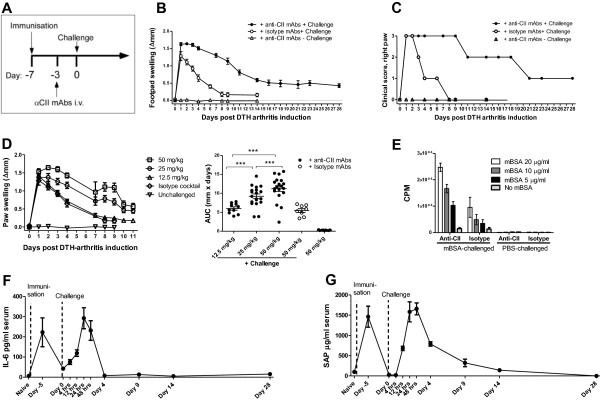
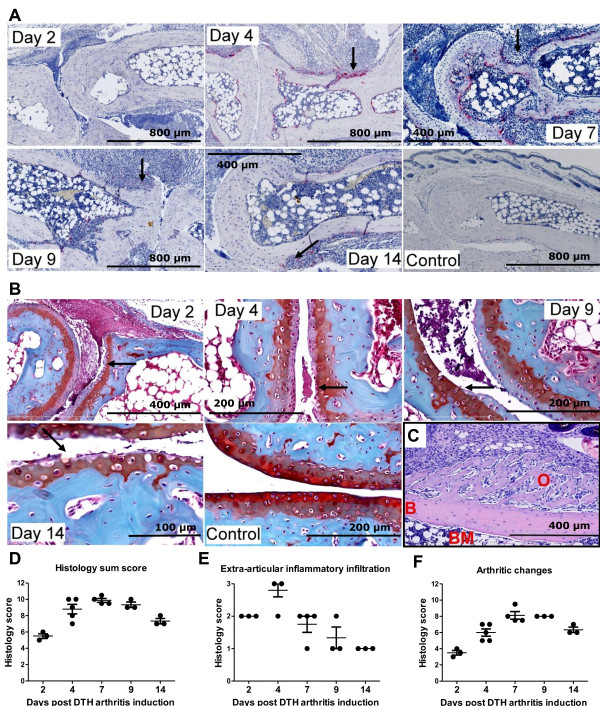
DTH-arthritis was induced by eliciting a classical DTH reaction in one paw with methylated bovine serum albumin (mBSA), with the modification that a cocktail of type II collagen monoclonal antibodies was administered between the immunisation and challenge steps. Involved cell subsets and inflammatory mediators were analysed, and tissue sections evaluated histopathologically. Disease was treated prophylactically and therapeutically with compounds used in the treatment of RA.
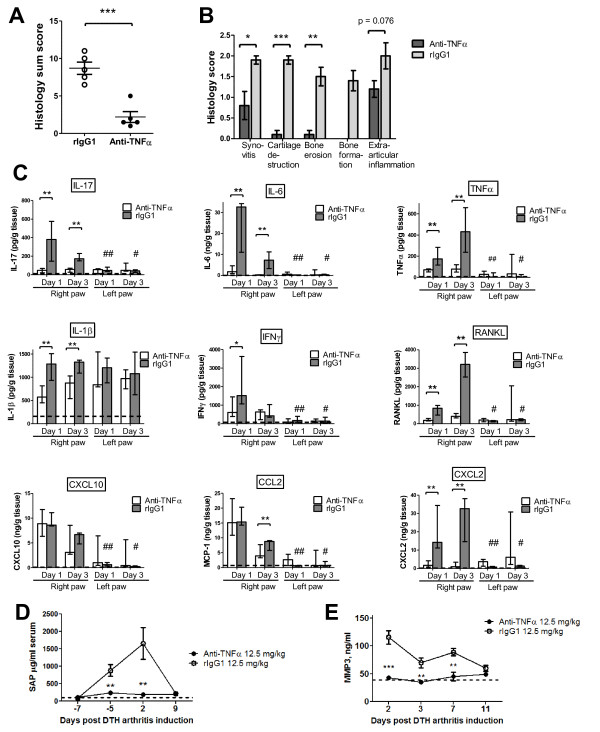
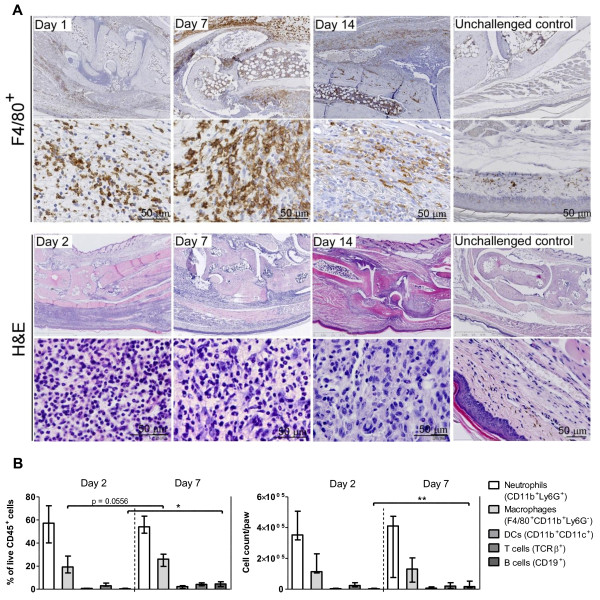
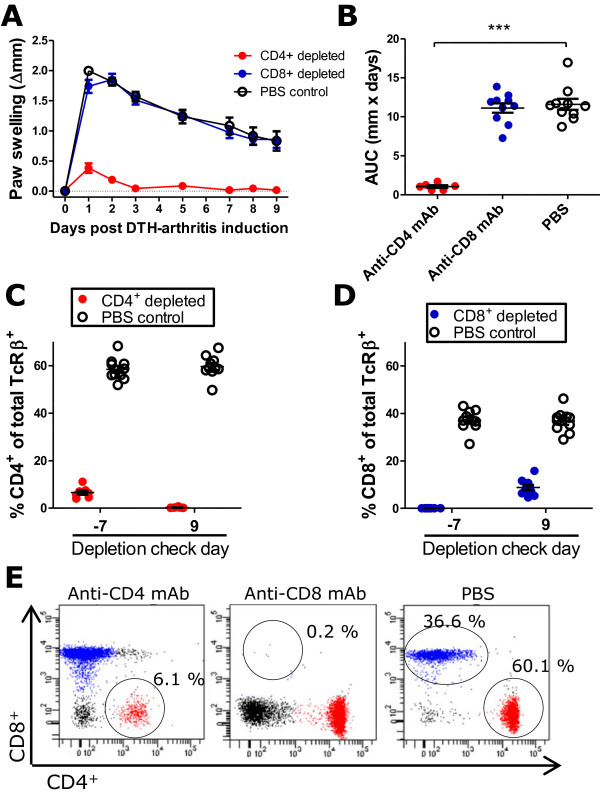
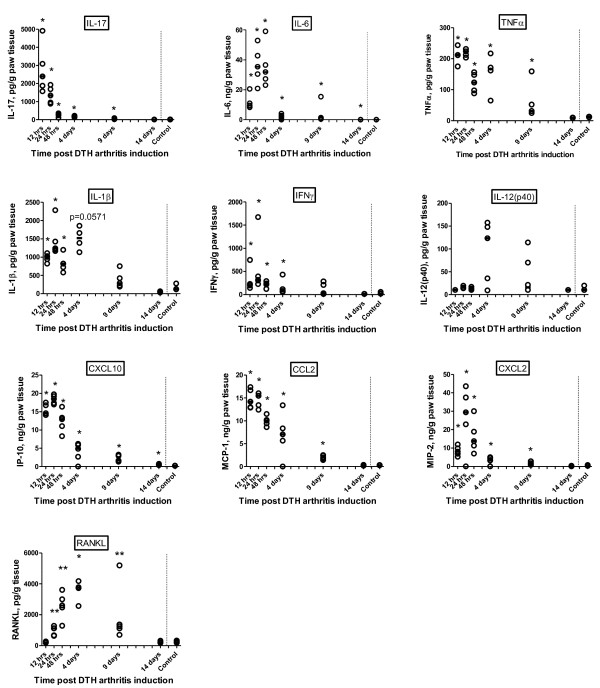
We demonstrate that DTH-arthritis could be induced in C57BL/6 mice with paw swelling lasting for at least 28 days and that disease induction was dependent on CD4+ cells. We show that macrophages and neutrophils were heavily involved in the observed pathology and that a clear profile of inflammatory mediators associated with these cell subsets was induced locally. In addition, inflammatory markers were observed systemically. Furthermore, we demonstrate that disease could be both prevented and treated.
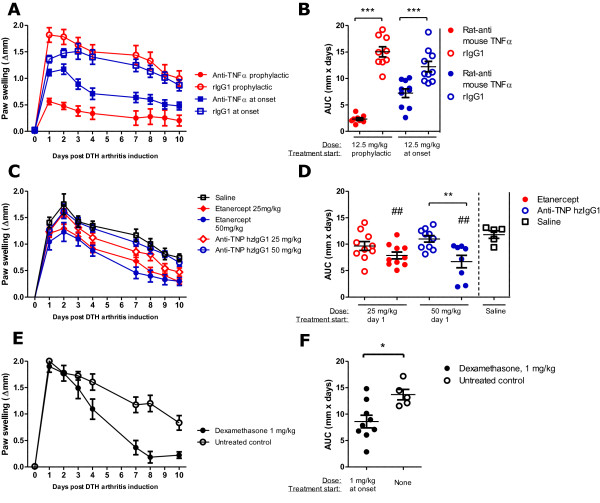
Our findings indicate that DTH-arthritis shares features with both collagen-induced arthritis (CIA) and human RA. DTH-arthritis is dependent on CD4+ cells for induction and can be successfully treated with TNFα-blocking biologics and dexamethasone. On the basis of our findings we believe that the DTH-arthritis model could hold potential in the preclinical screening of novel drugs targeting RA. The model is highly reproducible and has a high incidence rate with synchronised onset and progression, which strengthens its potential.
类风湿关节炎(RA)是一种慢性进行性、炎症性和破坏性自身免疫性疾病,其特征为滑膜关节炎症和骨侵蚀。为了更好地了解 RA 的病理生理学和潜在免疫机制,已经在不同近交系小鼠中开发了各种关节炎模型。在 C57BL/6J 小鼠中建立具有适应性免疫成分的关节炎模型一直很困难,而且由于大多数基因修饰小鼠通常在这种背景下繁殖,因此需要探索在这种品系中获得强大关节炎模型的新方法。本研究旨在建立和表征一种新的关节炎模型,即迟发型超敏反应(DTH)-关节炎模型,并评估是否可以用目前用于治疗 RA 的化合物来治疗疾病。
通过在一只爪子中用甲基化牛血清白蛋白(mBSA)引发经典 DTH 反应来诱导 DTH-关节炎,修改之处在于在免疫和挑战步骤之间给予 II 型胶原单克隆抗体鸡尾酒。分析了涉及的细胞亚群和炎症介质,并进行了组织学评估。用治疗 RA 的化合物进行预防性和治疗性治疗疾病。
我们证明 DTH-关节炎可以在 C57BL/6 小鼠中诱导,爪子肿胀至少持续 28 天,并且疾病诱导依赖于 CD4+细胞。我们表明,巨噬细胞和中性粒细胞大量参与了观察到的病理学,并且局部诱导了与这些细胞亚群相关的明确炎症介质谱。此外,还观察到炎症标志物在系统中。此外,我们证明疾病既可以预防又可以治疗。
我们的发现表明,DTH-关节炎与胶原诱导性关节炎(CIA)和人类 RA 具有共同特征。DTH-关节炎的诱导依赖于 CD4+细胞,并且可以用 TNFα 阻断生物制剂和地塞米松成功治疗。基于我们的发现,我们认为 DTH-关节炎模型可能在 RA 的新型药物的临床前筛选中具有潜力。该模型具有高度可重复性和高发生率,同步发作和进展,这增强了其潜力。