Tissue Injury and Repair Group, Clinical and Surgical Sciences, University of Edinburgh-MRC Centre for Regenerative Medicine, Royal Infirmary of Edinburgh, 51 Little France Crescent, Edinburgh, UK.
Br J Cancer. 2012 Jun 26;107(1):143-9. doi: 10.1038/bjc.2012.239. Epub 2012 Jun 7.
Degradation of the extracellular matrix is fundamental to tumour development, invasion and metastasis. Several protease families have been implicated in the development of a broad range of tumour types, including oesophago-gastric (OG) adenocarcinoma. The aim of this study was to analyse the expression levels of all core members of the cancer degradome in OG adenocarcinoma and to investigate the relationship between expression levels and tumour/patient variables associated with poor prognosis.
Comprehensive expression profiling of the protease families (matrix metalloproteinases (MMPs), members of the ADAM metalloproteinase-disintegrin family (ADAMs)), their inhibitors (tissue inhibitors of metalloproteinase), and molecules involved in the c-Met signalling pathway, was performed using quantitative real-time reverse transcription polymerase chain reaction in a cohort of matched malignant and benign peri-tumoural OG tissue (n=25 patients). Data were analysed with respect to clinico-pathological variables (tumour stage and grade, age, sex and pre-operative plasma C-reactive protein level).
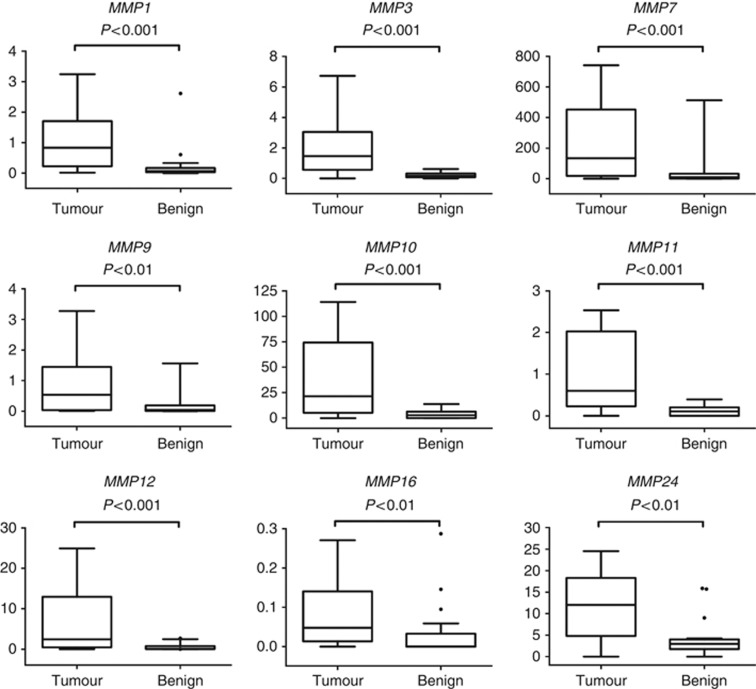
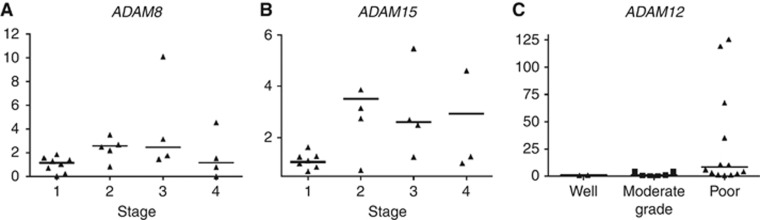
Gene expression of MMP1, 3, 7, 9, 10, 11, 12, 16 and 24 was upregulated by factors >4-fold in OG adenocarcinoma samples compared with matched benign tissue (P<0.01). Expression of ADAM8 and ADAM15 correlated significantly with tumour stage (P=0.048 and P=0.044), and ADAM12 expression correlated with tumour grade (P=0.011).
This study represents the first comprehensive quantitative analysis of the expression of proteases and their inhibitors in human OG adenocarcinoma. These findings implicate elevated ADAM8, 12 and 15 mRNA expression as potential prognostic molecular markers.
细胞外基质的降解是肿瘤发展、侵袭和转移的基础。几种蛋白酶家族与广泛的肿瘤类型的发展有关,包括食管-胃(OG)腺癌。本研究的目的是分析 OG 腺癌中癌症降解组的所有核心成员的表达水平,并研究表达水平与与预后不良相关的肿瘤/患者变量之间的关系。
使用定量实时逆转录聚合酶链反应,在 25 名患者的匹配恶性和良性围肿瘤 OG 组织中,对蛋白酶家族(基质金属蛋白酶(MMPs)、ADAM 金属蛋白酶-解整合素家族成员(ADAMs))、其抑制剂(金属蛋白酶组织抑制剂)和参与 c-Met 信号通路的分子进行全面表达谱分析。数据根据临床病理变量(肿瘤分期和分级、年龄、性别和术前血浆 C 反应蛋白水平)进行分析。
与匹配的良性组织相比,OG 腺癌样本中 MMP1、3、7、9、10、11、12、16 和 24 的基因表达上调了 4 倍以上(P<0.01)。ADAM8 和 ADAM15 的表达与肿瘤分期显著相关(P=0.048 和 P=0.044),ADAM12 的表达与肿瘤分级相关(P=0.011)。
本研究代表了人类 OG 腺癌中蛋白酶及其抑制剂表达的首次全面定量分析。这些发现表明升高的 ADAM8、12 和 15 mRNA 表达可能是潜在的预后分子标志物。