National Institutes of Health-International Center for Excellence in Research, Chennai, India.
PLoS Negl Trop Dis. 2012;6(6):e1681. doi: 10.1371/journal.pntd.0001681. Epub 2012 Jun 5.
Infection with Wuchereria bancrofti can cause severe disease characterized by subcutaneous fibrosis and extracellular matrix remodeling. Matrix metalloproteinases (MMPs) are a family of enzymes governing extracellular remodeling by regulating cellular homeostasis, inflammation, and tissue reorganization, while tissue-inhibitors of metalloproteinases (TIMPs) are endogenous regulators of MMPs. Homeostatic as well as inflammation-induced balance between MMPs and TIMPs is considered critical in mediating tissue pathology.
To elucidate the role of MMPs and TIMPs in filarial pathology, we compared the plasma levels of a panel of MMPs, TIMPs, other pro-fibrotic factors, and cytokines in individuals with chronic filarial pathology with (CP Ag+) or without (CP Ag-) active infection to those with clinically asymptomatic infections (INF) and in those without infection (endemic normal [EN]). Markers of pathogenesis were delineated based on comparisons between the two actively infected groups (CP Ag+ compared to INF) and those without active infection (CP Ag- compared to EN).
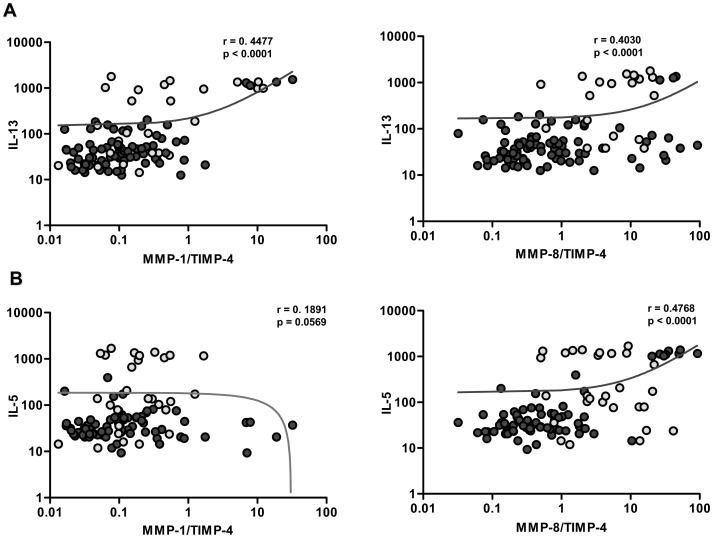
Our data reveal that an increase in circulating levels of MMPs and TIMPs is characteristic of the filarial disease process per se and not of active infection; however, filarial disease with active infection is specifically associated with increased ratios of MMP1/TIMP4 and MMP8/TIMP4 as well as with pro-fibrotic cytokines (IL-5, IL-13 and TGF-β). Our data therefore suggest that while filarial lymphatic disease is characterized by a non-specific increase in plasma MMPs and TIMPs, the balance between MMPs and TIMPs is an important factor in regulating tissue pathology during active infection.
班氏丝虫感染可导致严重疾病,其特征为皮下纤维化和细胞外基质重塑。基质金属蛋白酶(MMPs)是一类通过调节细胞内稳态、炎症和组织重排来控制细胞外重塑的酶,而金属蛋白酶组织抑制剂(TIMPs)则是 MMPs 的内源性调节剂。MMPs 和 TIMPs 之间的内稳态以及炎症诱导的平衡被认为在介导组织病理学方面至关重要。
为了阐明 MMPs 和 TIMPs 在丝虫病病理学中的作用,我们比较了慢性丝虫病患者(CP Ag+)或无活动性感染(CP Ag-)与有临床无症状感染(INF)和无感染(地方性正常[EN])患者的一系列 MMPs、TIMPs、其他促纤维化因子和细胞因子的血浆水平。基于两个活动性感染组(CP Ag+与 INF 相比)与无活动性感染组(CP Ag-与 EN 相比)之间的比较,确定了发病机制的标志物。
我们的数据表明,循环 MMPs 和 TIMPs 水平的增加是丝虫病过程本身的特征,而不是活动性感染的特征;然而,活动性感染的丝虫病与 MMP1/TIMP4 和 MMP8/TIMP4 比值的增加以及促纤维化细胞因子(IL-5、IL-13 和 TGF-β)的增加有关。因此,我们的数据表明,虽然丝虫性淋巴病的特征是血浆 MMPs 和 TIMPs 非特异性增加,但 MMPs 和 TIMPs 之间的平衡是调节活动性感染期间组织病理学的一个重要因素。