Institute for Medical Microbiology, Immunology and Parasitology, University Hospital Bonn, Bonn, Germany.
German Center for Infection Research (DZIF), Partner Site Bonn-Cologne, Bonn, Germany.
Front Immunol. 2022 Oct 31;13:983812. doi: 10.3389/fimmu.2022.983812. eCollection 2022.
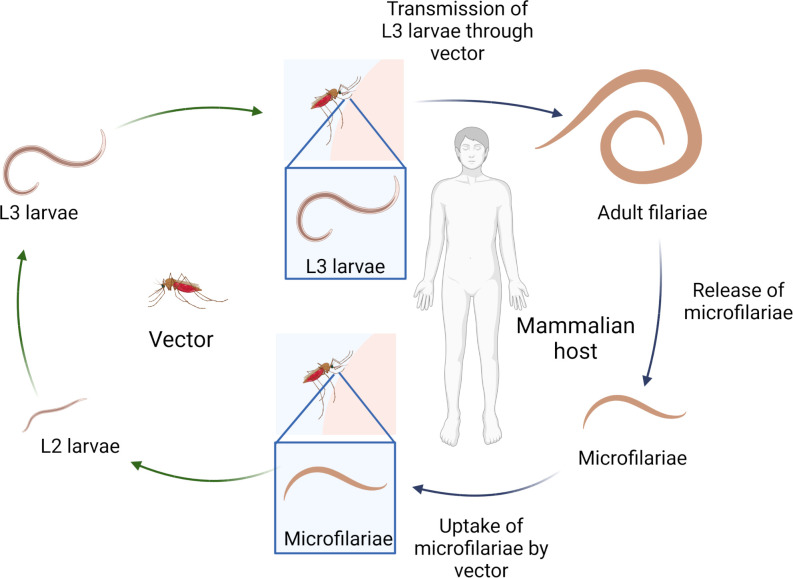
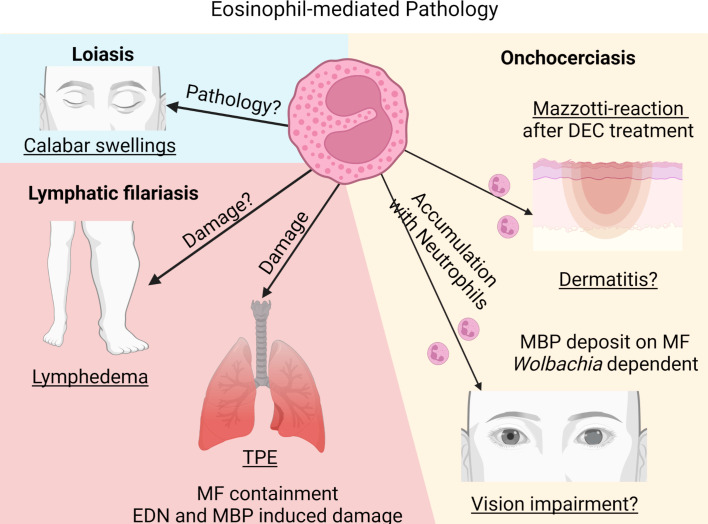
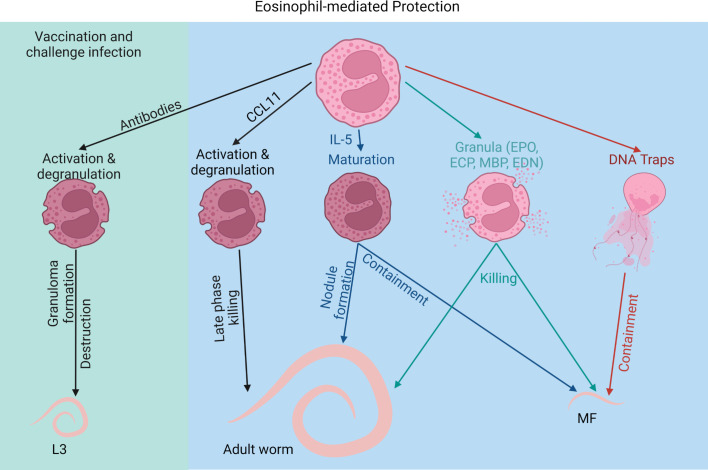
Filariae are parasitic roundworms, which can cause debilitating diseases such as lymphatic filariasis and onchocerciasis. Lymphatic filariasis, also known as elephantiasis, and onchocerciasis, commonly referred to as river blindness, can lead to stigmatizing pathologies and present a socio-economic burden for affected people and their endemic countries. Filariae typically induce a type 2 immune response, which is characterized by cytokines, i.e., IL-4, IL-5 and IL-13 as well as type 2 immune cells including alternatively activated macrophages, innate lymphoid cells and Th2 cells. However, the hallmark characteristic of filarial infections is a profound eosinophilia. Eosinophils are innate immune cells and pivotal in controlling helminth infections in general and filarial infections in particular. By modulating the function of other leukocytes, eosinophils support and drive type 2 immune responses. Moreover, as primary effector cells, eosinophils can directly attack filariae through the release of granules containing toxic cationic proteins with or without extracellular DNA traps. At the same time, eosinophils can be a driving force for filarial pathology as observed during tropical pulmonary eosinophilia in lymphatic filariasis, in dermatitis in onchocerciasis patients as well as adverse events after treatment of onchocerciasis patients with diethylcarbamazine. This review summarizes the latest findings of the importance of eosinophil effector functions including the role of eosinophil-derived proteins in controlling filarial infections and their impact on filarial pathology analyzing both human and experimental animal studies.
丝虫是寄生的圆形蠕虫,可引起象皮病和盘尾丝虫病等使人衰弱的疾病。象皮病,也称为象皮病,盘尾丝虫病,通常称为河盲症,可导致使人感到羞耻的病理,并给受影响的人和流行国家带来社会经济负担。丝虫通常会引起 2 型免疫反应,其特征是细胞因子,即 IL-4、IL-5 和 IL-13 以及 2 型免疫细胞,包括替代性激活的巨噬细胞、先天淋巴细胞和 Th2 细胞。然而,丝虫感染的标志特征是严重的嗜酸性粒细胞增多症。嗜酸性粒细胞是先天免疫细胞,在控制寄生虫感染特别是丝虫感染方面起着关键作用。通过调节其他白细胞的功能,嗜酸性粒细胞支持和驱动 2 型免疫反应。此外,作为主要效应细胞,嗜酸性粒细胞可以通过释放含有毒性阳离子蛋白的颗粒直接攻击丝虫,这些颗粒带有或不带细胞外 DNA 陷阱。同时,嗜酸性粒细胞可能是丝虫病理学的驱动力,如在淋巴丝虫病中的热带肺嗜酸性粒细胞增多症、盘尾丝虫病患者的皮炎以及用乙胺嗪治疗盘尾丝虫病患者后的不良事件中观察到的那样。这篇综述总结了嗜酸性粒细胞效应功能的最新发现,包括嗜酸性粒细胞衍生蛋白在控制丝虫感染中的作用及其对丝虫病理学的影响,同时分析了人类和实验动物研究。