Department of Medicine, University of Alberta, 2F1,26 Walter C, Mackenzie Health Sciences Centre, 8440-112th Street, Edmonton, AB T6G 2B7, Canada.
BMC Health Serv Res. 2012 Jun 8;12:139. doi: 10.1186/1472-6963-12-139.
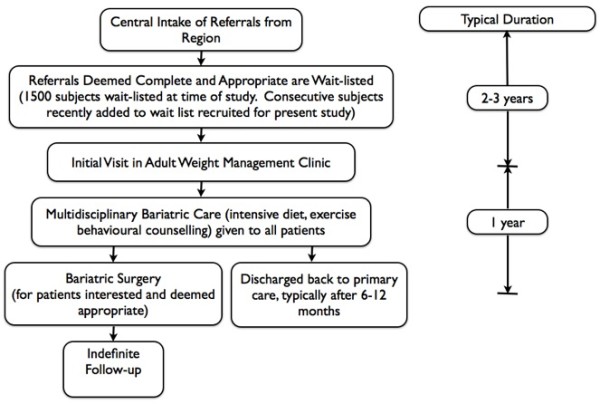
Protracted, multi-year wait times exist for bariatric care in Canada. Our objective was to examine wait-listed patients' health status and perceptions regarding the consequences of prolonged wait times using a cross-sectional study design nested within a prospective cohort.
150 consecutive consenting subjects wait-listed for multi-disciplinary bariatric assessment in a population-based medical/surgical bariatric program were surveyed. Health status was measured using a visual analogue scale (VAS). A Waiting List Impact Questionnaire (WLIQ) examined employment, physical stress, social support, frustration, quality of life, and satisfaction with care. Multivariable linear regression analysis adjusted for age, sex and BMI identified independent predictors of lower VAS scores.
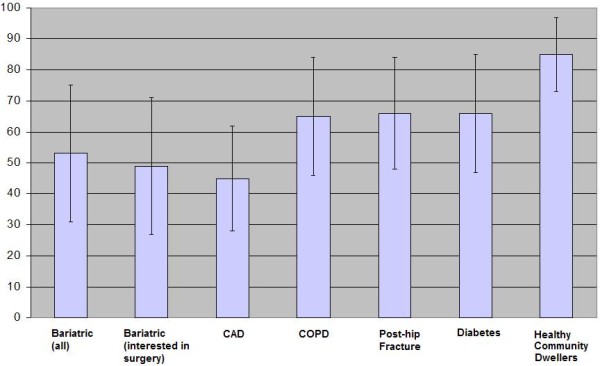
136 (91%) subjects were women, mean age was 43 years (SD 9), mean BMI was 49.4 (SD 8.3) kg/m2 and average time wait-listed was 64 days (SD 76). The mean VAS score was 53/100 (SD 22). According to the WLIQ, 47% of subjects agreed/strongly agreed that waiting affected their quality of life, 65% described wait times as 'concerning' and 81% as 'frustrating'. 86% reported worsening of physical symptoms over time. Nevertheless, only 31% were dissatisfied/very dissatisfied with their overall medical care. Independent predictors of lower VAS scores were higher BMI (beta coefficient 0.42; p = 0.03), unemployment (13.7; p = 0.01) and depression (10.3; p = 0.003).
Patients wait-listed for bariatric care self-reported very impaired health status and other adverse consequences, attributing these to protracted waits. These data may help benchmark the level of health impairment in this population, understand the physical and mental toll of waiting, and assist with wait list management.
Clinicaltrials.gov NCT00850356.
在加拿大,接受减重治疗需要经历漫长的、多年的等待。我们的目的是通过一项嵌套在前瞻性队列研究中的横断面研究,检查等待名单上的患者的健康状况以及他们对长时间等待的后果的看法。
对参加一项基于人群的医学/外科减重评估计划的 150 名连续同意的等待多学科减重评估的患者进行了调查。使用视觉模拟量表(VAS)测量健康状况。等待清单影响问卷(WLIQ)评估了就业、身体压力、社会支持、挫折感、生活质量和对护理的满意度。多变量线性回归分析调整了年龄、性别和 BMI,以确定 VAS 评分较低的独立预测因素。
136 名(91%)患者为女性,平均年龄为 43 岁(标准差 9),平均 BMI 为 49.4(标准差 8.3)kg/m2,平均等待时间为 64 天(标准差 76)。VAS 评分的平均值为 53/100(标准差 22)。根据 WLIQ,47%的患者同意/强烈同意等待影响了他们的生活质量,65%的患者认为等待时间“令人担忧”,81%的患者认为等待时间“令人沮丧”。86%的患者报告随着时间的推移身体症状恶化。然而,只有 31%的患者对他们的整体医疗护理不满意/非常不满意。VAS 评分较低的独立预测因素是较高的 BMI(β系数 0.42;p=0.03)、失业(13.7;p=0.01)和抑郁(10.3;p=0.003)。
等待减重治疗的患者自我报告健康状况非常受损,还有其他不良后果,他们将这些归咎于漫长的等待。这些数据可以帮助确定该人群的健康受损程度,了解等待带来的身体和心理负担,并有助于管理等待名单。
Clinicaltrials.gov NCT00850356。