Gagliardi Anna R, Yip Cindy Y Y, Irish Jonathan, Wright Frances C, Rubin Barry, Ross Heather, Green Robin, Abbey Susan, McAndrews Mary Pat, Stewart Donna E
Toronto General Hospital Research Institute, University Health Network, Toronto, Canada.
University of British Columbia, Vancouver, Canada.
Health Expect. 2021 Jun;24(3):978-990. doi: 10.1111/hex.13241. Epub 2021 Mar 26.
Waiting for procedures delayed by COVID-19 may cause anxiety and related adverse consequences.
To synthesize research on the mental health impact of waiting and patient-centred mitigation strategies that could be applied in the COVID-19 context.
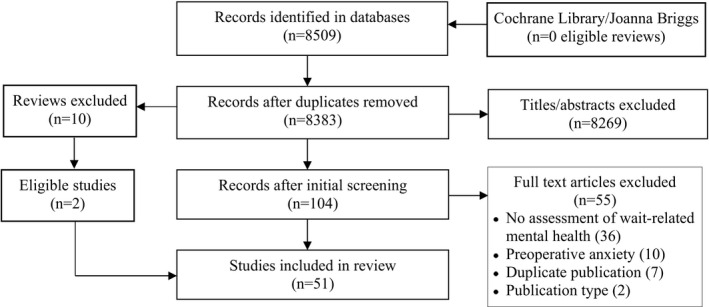
Using a scoping review approach, we searched 9 databases for studies on waiting lists and mental health and reported study characteristics, impacts and intervention attributes and outcomes.
We included 51 studies that focussed on organ transplant (60.8%), surgery (21.6%) or cancer management (13.7%). Most patients and caregivers reported anxiety, depression and poor quality of life, which deteriorated with increasing wait time. The impact of waiting on mental health was greater among women and new immigrants, and those of younger age, lower socio-economic status, or with less-positive coping ability. Six studies evaluated educational strategies to develop coping skills: 2 reduced depression (2 did not), 1 reduced anxiety (2 did not) and 2 improved quality of life (2 did not). In contrast, patients desired acknowledgement of concerns, peer support, and periodic communication about wait-list position, prioritization criteria and anticipated procedure date.
Findings revealed patient-centred strategies to alleviate the mental health impact of waiting for procedures. Ongoing research should explore how to optimize the impact of those strategies for diverse patients and caregivers, particularly in the COVID-19 context.
Six patients and four caregivers waiting for COVID-19-delayed procedures helped to establish eligibility criteria, plan data extraction and review a draft and final report.
等待因2019冠状病毒病而推迟的手术可能会引发焦虑及相关不良后果。
综合关于等待的心理健康影响以及可应用于2019冠状病毒病背景下的以患者为中心的缓解策略的研究。
采用范围综述方法,我们在9个数据库中搜索关于等候名单与心理健康的研究,并报告研究特征、影响以及干预属性和结果。
我们纳入了51项研究,这些研究聚焦于器官移植(60.8%)、手术(21.6%)或癌症管理(13.7%)。大多数患者及照料者报告有焦虑、抑郁及生活质量差的情况,且随着等待时间的增加而恶化。等待对心理健康的影响在女性、新移民以及年龄较小、社会经济地位较低或应对能力不太积极的人群中更大。六项研究评估了培养应对技能的教育策略:两项减轻了抑郁(两项未减轻),一项减轻了焦虑(两项未减轻),两项改善了生活质量(两项未改善)。相比之下,患者希望对其担忧予以确认、获得同伴支持,以及就等候名单位置、优先排序标准和预期手术日期进行定期沟通。
研究结果揭示了以患者为中心的策略,以减轻等待手术的心理健康影响。正在进行的研究应探索如何优化这些策略对不同患者及照料者的影响,尤其是在2019冠状病毒病背景下。
六名等待因2019冠状病毒病而推迟手术的患者和四名照料者协助确定了纳入标准、规划数据提取并审阅了报告初稿和终稿。