State Key Laboratory of Agricultural Microbiology, Huazhong Agricultural University, Hubei, Wuhan 430070, China.
Microb Cell Fact. 2012 Jun 11;11:75. doi: 10.1186/1475-2859-11-75.
Microbial laccases are highly useful in textile effluent dye biodegradation. However, the bioavailability of cellularly expressed or purified laccases in continuous operations is usually limited by mass transfer impediment or enzyme regeneration difficulty. Therefore, this study develops a regenerable bacterial surface-displaying system for industrial synthetic dye decolorization, and evaluates its effects on independent and continuous operations.
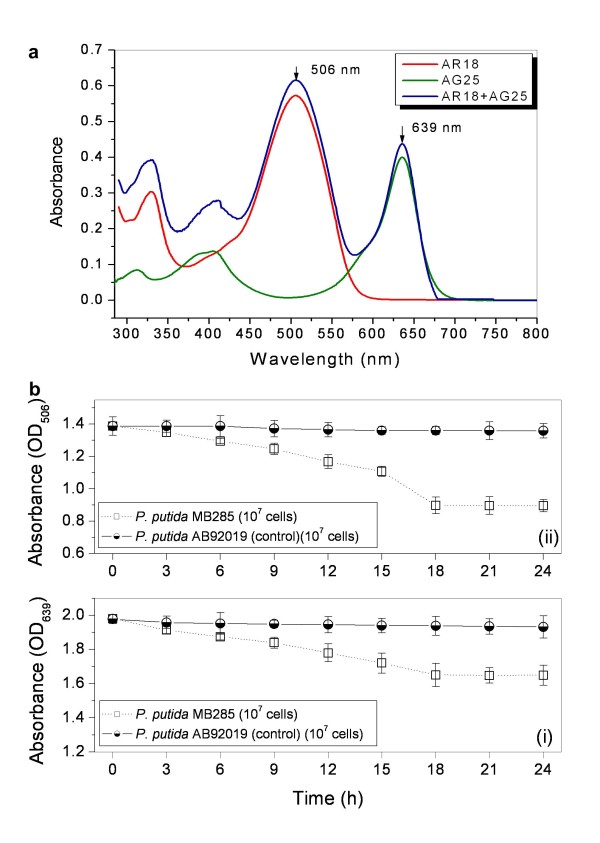
A bacterial laccase (WlacD) was engineered onto the cell surface of the solvent-tolerant bacterium Pseudomonas putida to construct a whole-cell biocatalyst. Ice nucleation protein (InaQ) anchor was employed, and the ability of 1 to 3 tandemly aligned N-terminal repeats to direct WlacD display were compared. Immobilized WlacD was determined to be surface-displayed in functional form using Western blot analysis, immunofluorescence microscopy, flow cytometry, and whole-cell enzymatic activity assay. Engineered P. putida cells were then applied to decolorize the anthraquinone dye Acid Green (AG) 25 and diazo-dye Acid Red (AR) 18. The results showed that decolorization of both dyes is Cu(2+)- and mediator-independent, with an optimum temperature of 35°C and pH of 3.0, and can be stably performed across a temperature range of 15°C to 45°C. A high activity toward AG25 (1 g/l) with relative decolorization values of 91.2% (3 h) and 97.1% (18 h), as well as high activity to AR18 (1 g/l) by 80.5% (3 h) and 89.0% (18 h), was recorded. The engineered system exhibited a comparably high activity compared with those of separate dyes in a continuous three-round shake-flask decolorization of AG25/AR18 mixed dye (each 1 g/l). No significant decline in decolorization efficacy was noted during first two-rounds but reaction equilibriums were elongated, and the residual laccase activity eventually decreased to low levels. However, the decolorizing capacity of the system was easily retrieved via a subsequent 4-h cell culturing.
This study demonstrates, for the first time, the methodology by which the engineered P. putida with surface-immobilized laccase was successfully used as regenerable biocatalyst for biodegrading synthetic dyes, thereby opening new perspectives in the use of biocatalysis in industrial dye biotreatment.
微生物漆酶在纺织废水染料生物降解中具有很高的应用价值。然而,细胞内表达或纯化的漆酶在连续操作中的生物利用度通常受到传质障碍或酶再生困难的限制。因此,本研究开发了一种可再生的细菌表面展示系统,用于工业合成染料脱色,并评估了其在独立和连续操作中的效果。
将一种细菌漆酶(WlacD)工程改造到溶剂耐受细菌铜绿假单胞菌的细胞表面,构建了全细胞生物催化剂。采用冰核蛋白(InaQ)锚定,比较了 1 到 3 个串联排列的 N 端重复序列指导 WlacD 展示的能力。通过 Western blot 分析、免疫荧光显微镜、流式细胞术和全细胞酶活性测定,确定固定化 WlacD 以功能形式表面展示。然后,将工程化的铜绿假单胞菌细胞应用于蒽醌染料酸性绿(AG)25 和偶氮染料酸性红(AR)18 的脱色。结果表明,两种染料的脱色均不依赖 Cu(2+)和介体,最适温度为 35°C,pH 值为 3.0,可在 15°C 至 45°C 的温度范围内稳定运行。对 AG25(1g/l)具有高活性,相对脱色值为 91.2%(3h)和 97.1%(18h),对 AR18(1g/l)具有高活性,脱色率为 80.5%(3h)和 89.0%(18h)。与单独染料在 AG25/AR18 混合染料(各 1g/l)的连续三轮摇瓶脱色中相比,该工程系统表现出相当高的活性。在前两轮中,脱色效率没有明显下降,但反应平衡延长,残余漆酶活性最终降低到较低水平。然而,通过随后的 4 小时细胞培养,很容易恢复脱色能力。
本研究首次证明了将表面固定化漆酶的工程化铜绿假单胞菌用作可再生生物催化剂用于生物降解合成染料的方法,从而为工业染料生物处理中的生物催化开辟了新的前景。