Pennington Biomedical Research Center, Louisiana State University System, Baton Rouge, Louisiana, USA.
Diabetes Care. 2012 Aug;35(8):1633-7. doi: 10.2337/dc12-0329. Epub 2012 Jun 11.
We evaluated the effects of mixed meals differing in glycemic index (GI) and carbohydrate content on postprandial serum glucose and insulin response, hunger, and satiety over the course of a 12-h day.
In this randomized crossover trial, 26 overweight or obese adults received four diets in random order (high GI, high carbohydrate [HGI-HC]; high GI, low carbohydrate [HGI-LC]; low GI, high carbohydrate [LGI-HC]; and low GI, low carbohydrate [LGI-LC]). All meals were prepared by a metabolic kitchen. Participants received breakfast, lunch, and dinner over the course of a 12-h day. Primary outcomes were postprandial serum glucose and insulin quantified as area under the curve. Hunger, fullness, and satiety were assessed by visual analog scale.
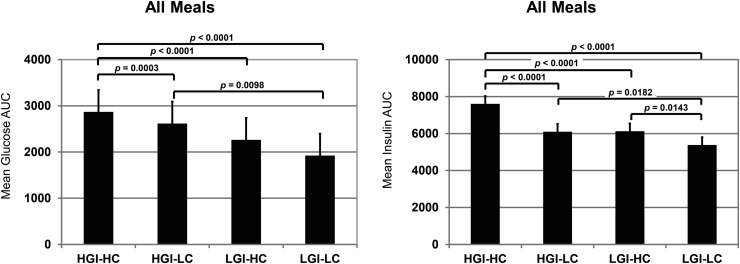
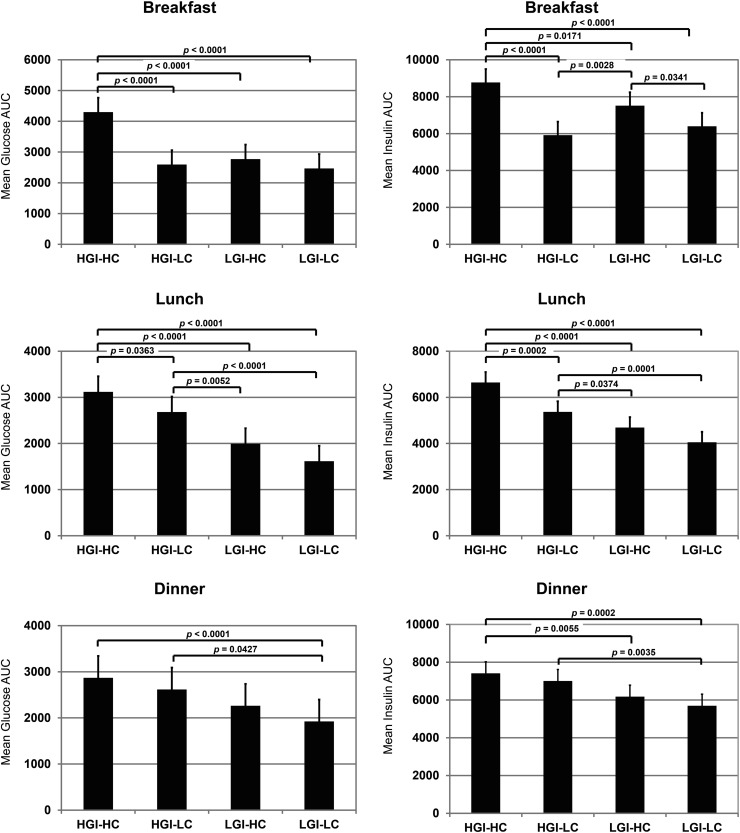
The HGI-LC, LGI-HC, and LGI-LC diets significantly reduced glucose and insulin area under the curve compared with the HGI-HC diet (P < 0.001 for all comparisons). There were no significant differences in ratings of hunger, fullness, or satiety between the different dietary treatments.
Reducing the GI or carbohydrate content of mixed meals reduces postprandial glycemia and insulinemia, and these changes can be sustained over the course of an entire day. However, there were no differences in subjective hunger and satiety ratings between the diets. These results demonstrate that maintaining a low GI or glycemic load diet is an effective method of controlling serum glucose and insulin levels.
我们评估了不同血糖生成指数(GI)和碳水化合物含量的混合膳食对餐后血清葡萄糖和胰岛素反应、饥饿感和饱腹感的影响,持续时间为 12 小时。
在这项随机交叉试验中,26 名超重或肥胖成年人以随机顺序接受四种饮食(高 GI、高碳水化合物[HGI-HC];高 GI、低碳水化合物[HGI-LC];低 GI、高碳水化合物[LGI-HC];和低 GI、低碳水化合物[LGI-LC])。所有膳食均由代谢厨房准备。参与者在 12 小时的白天内接受早餐、午餐和晚餐。主要结局是餐后血清葡萄糖和胰岛素的曲线下面积。通过视觉模拟量表评估饥饿感、饱腹感和饱腹感。
与 HGI-HC 饮食相比,HGI-LC、LGI-HC 和 LGI-LC 饮食显著降低了葡萄糖和胰岛素的曲线下面积(所有比较均 P < 0.001)。不同饮食处理之间的饥饿感、饱腹感或饱腹感评分没有显着差异。
降低混合膳食的 GI 或碳水化合物含量可降低餐后血糖和胰岛素血症,这些变化可持续一整天。然而,饮食之间的主观饥饿感和饱腹感评分没有差异。这些结果表明,维持低 GI 或血糖负荷饮食是控制血清葡萄糖和胰岛素水平的有效方法。