Alimentary Pharmabiotic Centre, University College Cork, Cork, Ireland.
Gut Microbes. 2012 Jul-Aug;3(4):394-7. doi: 10.4161/gmic.20984. Epub 2012 Jun 12.
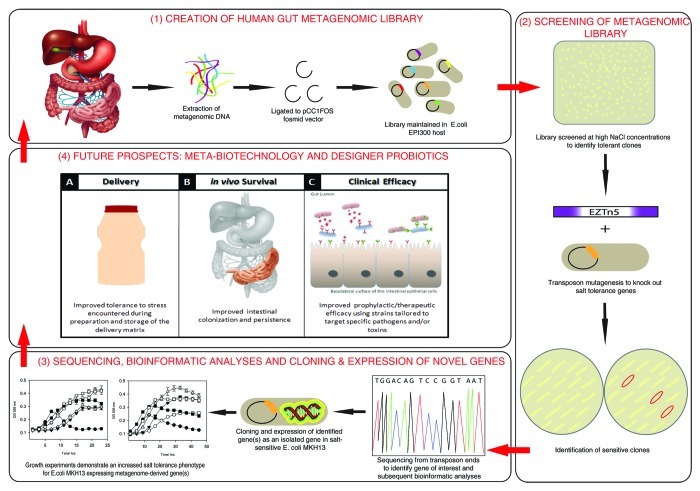
With the rapid advances in sequencing technologies in recent years, the human genome is now considered incomplete without the complementing microbiome, which outnumbers human genes by a factor of one hundred. The human microbiome, and more specifically the gut microbiome, has received considerable attention and research efforts over the past decade. Many studies have identified and quantified "who is there?," while others have determined some of their functional capacity, or "what are they doing?" In a recent study, we identified novel salt-tolerance loci from the human gut microbiome using combined functional metagenomic and bioinformatics based approaches. Herein, we discuss the identified loci, their role in salt-tolerance and their importance in the context of the gut environment. We also consider the utility and power of functional metagenomics for mining such environments for novel genes and proteins, as well as the implications and possible applications for future research.
近年来,随着测序技术的飞速发展,如果没有微生物组作为补充,人类基因组现在被认为是不完整的,微生物组的数量是人类基因数量的 100 倍。在过去的十年中,人类微生物组,特别是肠道微生物组,受到了相当多的关注和研究。许多研究已经确定并量化了“有谁在那里?”,而其他研究则确定了它们的一些功能能力,或者“它们在做什么?”在最近的一项研究中,我们使用组合功能宏基因组学和基于生物信息学的方法,从人类肠道微生物组中鉴定出了新的耐盐性基因座。在此,我们讨论了所鉴定的基因座,它们在耐盐性中的作用以及它们在肠道环境中的重要性。我们还考虑了功能宏基因组学在挖掘此类环境中的新型基因和蛋白质方面的实用性和力量,以及对未来研究的影响和可能的应用。