Department of Epidemiology, Medical Statistics and Environmental health, Faculty of Public Health, College of Medicine, University of Ibadan, Ibadan, Nigeria.
BMC Public Health. 2012 Jun 12;12:430. doi: 10.1186/1471-2458-12-430.
Childhood mortality rate is high in Nigeria. There is dearth of information on the comparison of childhood mortality probability and its causal factors in the Northern and Southern Nigeria. This study was designed to fill these gaps.
Nigeria Demographic and Health Survey, 2008 data was used. The first part of this study focused on women aged 15-49 who ever given birth to a child (n = 23,404), irrespective of the survival status of the child and the second part utilized all women aged 15-49 (N = 33,385). The outcome variable was experienced childhood mortality. Data was analyzed using Chi-square, logistic regression and Brass logit model.
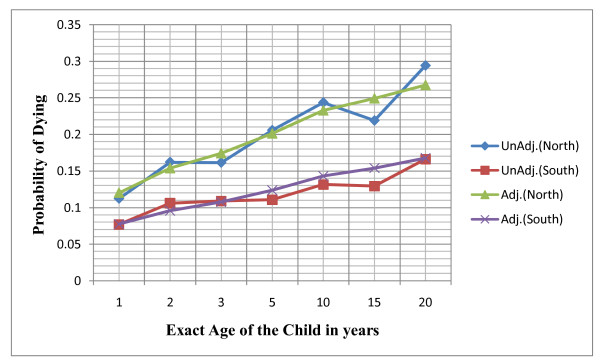
Results showed that similar patterns of children's death were observed in the two regions, but variation existed. Childhood mortality experienced was more pronounced in the North than the South, even when the potential confounding variables were used as control. Levels of education and wealth index showed an inverse relationship with childhood death in the regions (p < 0.05). The gap in childhood mortality experienced between the poorest and richest was wider in the North than the South. There was no significant difference in the risk of childhood mortality experienced by women in the urban and rural areas in the North (p > 0.05), but the difference was significant in the South (p < 0.05). The life-table mortality levels were lower in the North than the South, an indication of higher previous childhood mortality experience in the North than in the South. Across all childhood ages, the smoothed childhood mortality probabilities were consistently higher in the North than the South.
Childhood mortality is higher in the Northern than Southern Nigeria. Improving women's education, particularly in the North will alleviate childhood mortality in Nigeria.
尼日利亚儿童死亡率较高。关于尼日利亚北部和南部儿童死亡率概率及其因果因素的比较,信息匮乏。本研究旨在填补这些空白。
使用 2008 年尼日利亚人口与健康调查数据。本研究的第一部分侧重于曾生育过子女的 15-49 岁妇女(n=23404),无论子女的生存状况如何,第二部分则利用了所有 15-49 岁妇女(N=33385)。结果变量是经历过的儿童死亡。使用卡方检验、逻辑回归和 Brass 对数模型对数据进行分析。
结果表明,两个地区儿童死亡模式相似,但存在差异。北部的儿童死亡率高于南部,即使使用潜在混杂变量作为对照。教育水平和财富指数与两个地区的儿童死亡呈负相关(p<0.05)。北部最贫困和最富裕人群之间经历儿童死亡的差距大于南部。北部城乡妇女经历儿童死亡的风险没有显著差异(p>0.05),但南部有显著差异(p<0.05)。生命表死亡率水平北部低于南部,表明北部以前的儿童死亡率高于南部。在所有儿童年龄中,北部的 smoothed 儿童死亡率概率始终高于南部。
尼日利亚北部的儿童死亡率高于南部。提高妇女教育水平,特别是在北部,将减轻尼日利亚的儿童死亡率。