Nephrologisches Zentrum; Medizinische Klinik und Poliklinik IV; Klinikum der Universität; München, Germany.
Organogenesis. 2012 Apr-Jun;8(2):29-40. doi: 10.4161/org.20342. Epub 2012 Apr 1.
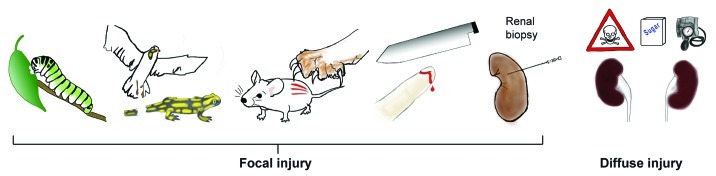
Renal biopsies commonly display tissue remodeling with a combination of many different findings. In contrast to trauma, kidney remodeling largely results from intrinsic responses, but why? Distinct danger response programs were positively selected throughout evolution to survive traumatic injuries and to regenerate tissue defects. These are: (1) clotting to avoid major bleeding, (2) immunity to control infection, (3) epithelial repair and (4) mesenchymal repair. Collateral damages are acceptable for the sake of host survival but causes for kidney injury commonly affect the kidneys in a diffuse manner. This way, coagulation, inflammation, deregulated epithelial healing or fibrosis contribute to kidney remodeling. Here, I focus on how these ancient danger response programs determine renal pathology mainly because they develop in a deregulated manner, either as insufficient or overshooting processes that modulate each other. From a therapeutic point of view, immunopathology can be prevented by suppressing sterile renal inflammation, a useless atavism with devastating consequences. In addition, it appears as an important goal for the future to promote podocyte and tubular epithelial cell repair, potentially by stimulating the differentiation of their newly discovered intrarenal progenitor cells. By contrast, it is still unclear whether selectively targeting renal fibrogenesis can preserve or bring back lost renal parenchyma, which would be required to maintain or improve kidney function. Thus, renal pathology results from ancient danger responses that evolved because of their evolutional benefits upon trauma. Understanding these causalities may help to shape the search for novel treatments for kidney disease patients.
肾脏活检通常显示组织重塑,伴有多种不同的发现。与创伤不同,肾脏重塑主要源于内在反应,但原因是什么呢?在整个进化过程中,为了在创伤后幸存下来并再生组织缺陷,不同的危险反应程序被积极选择。这些是:(1) 凝血以避免大出血,(2) 免疫以控制感染,(3) 上皮修复和(4) 间充质修复。为了宿主的生存, collateral damages 是可以接受的,但导致肾脏损伤的常见原因通常以弥漫的方式影响肾脏。这样,凝血、炎症、上皮修复失调或纤维化都会导致肾脏重塑。在这里,我主要关注这些古老的危险反应程序如何决定肾脏病理学,因为它们以失调的方式发展,要么是不足的过程,要么是过度的过程,相互调节。从治疗的角度来看,可以通过抑制无菌性肾炎症来预防免疫病理学,这是一种无用的返祖现象,会产生毁灭性的后果。此外,促进足细胞和肾小管上皮细胞修复似乎是未来的一个重要目标,可能通过刺激其新发现的肾内祖细胞的分化来实现。相比之下,选择性针对肾纤维化是否能保留或恢复丢失的肾实质仍不清楚,这对于维持或改善肾功能是必要的。因此,肾脏病理学是由古老的危险反应引起的,这些反应是由于它们在创伤后的进化优势而进化而来的。了解这些因果关系可能有助于寻找治疗肾脏疾病患者的新方法。