Department of General Surgery, Huashan Hospital, Fudan University, Shanghai, P.R. China.
Int J Mol Med. 2012 Sep;30(3):487-94. doi: 10.3892/ijmm.2012.1022. Epub 2012 Jun 11.
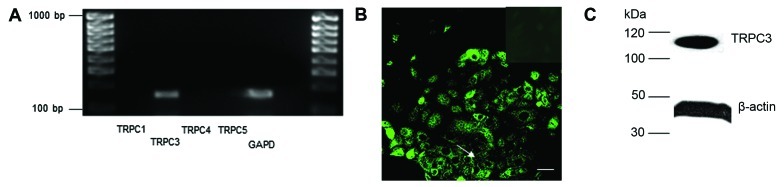
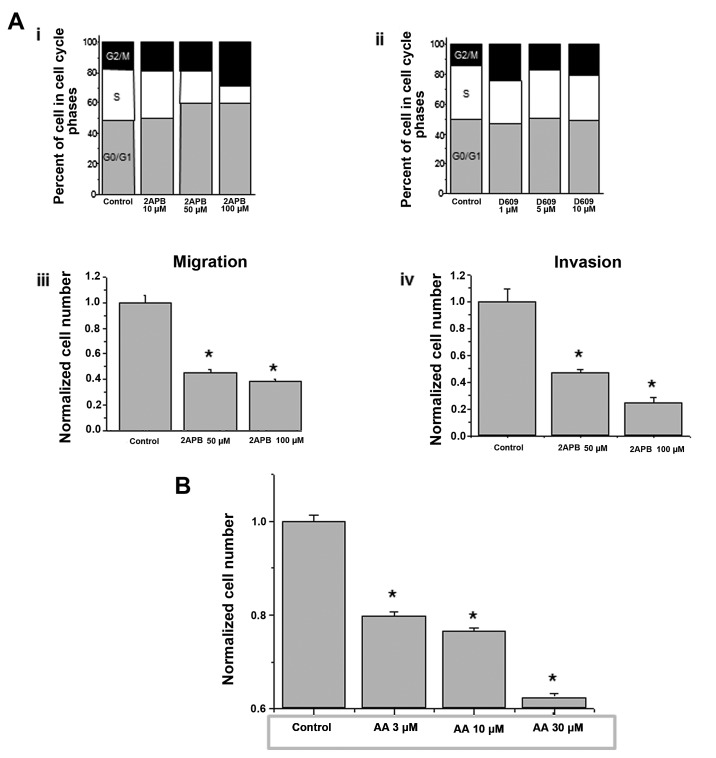
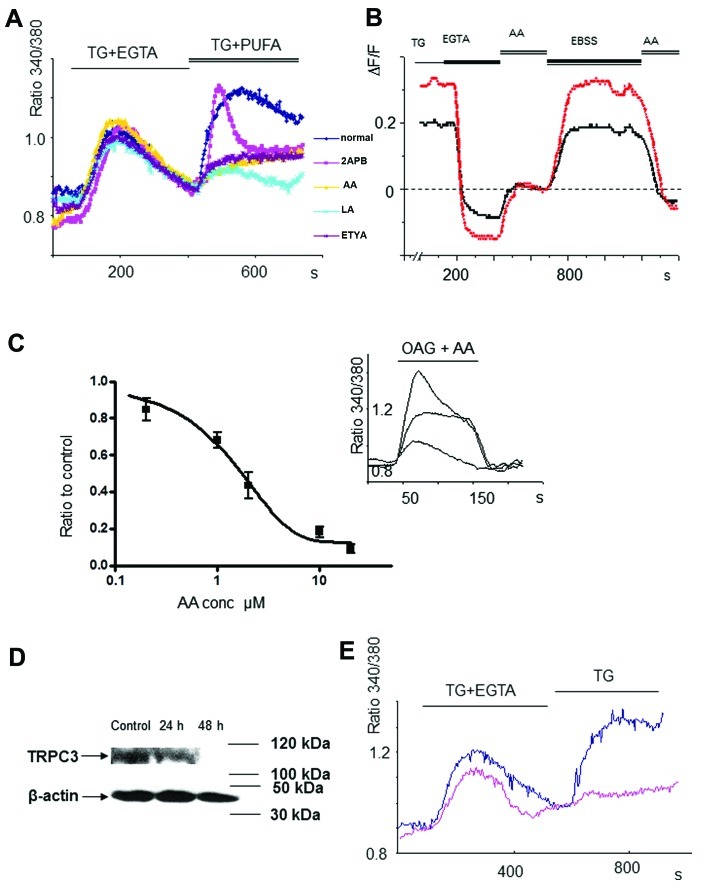
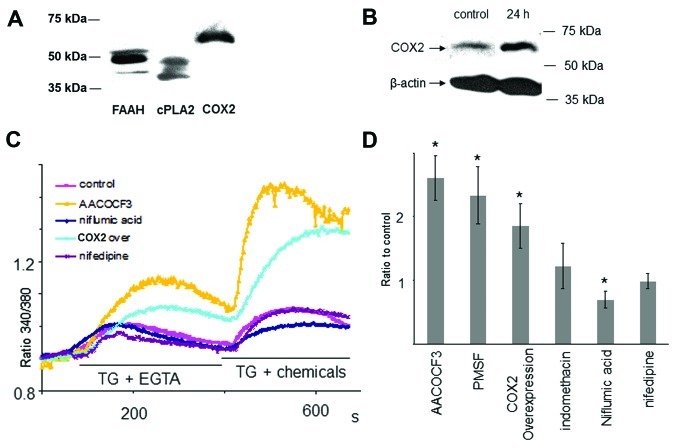
Breast cancer is the most frequent cancer in women. Evidence suggests that the polyunsaturated fatty acids (PUFAs), eicosapentaenoic acid (EPA), and docosahexaenoic acid (DHA) affect breast cancer proliferation, differentiation and prognosis. However, the mechanism still remains unclear. In this study, the expression of transient receptor potential canonical (TRPC)3 was detected throughout the cell cytoplasm and at the cell surface of MCF-7 cells. Ca(2+) entry was induced in these cells via activated TRPC3 by either the diacylglycerol analogue (OAG) or by intracellular Ca(2+) store depletion. TRPC-mediated Ca(2+) entry was inhibited by PUFAs including arachidonic acid (AA) and linolenic acid (LA) but not saturated fatty acids. Overexpression of the PUFA degradation enzyme, cyclooxygenase 2 (COX2), enhanced capacitative Ca(2+) entry. In addition, inhibition of COX2 reduced Ca(2+). Nevertheless, inhibition of TRPC reduced the cell cycle S phase and cell migration, implicating a functional role for TRP-mediated Ca(2+) entry in cell proliferation and invasion. Exogenous PUFA as well as a TRPC3 antagonist consistently attenuated breast cancer cell proliferation and migration, suggesting a mechanism in which PUFA restrains the breast cancer partly via its inhibition of TRPC channels. Additionally, our results also suggest that TRPC3 appears as a new mediator of breast cancer cell migration/invasion and represents a potential target for a new class of anticancer agent.
乳腺癌是女性最常见的癌症。有证据表明,多不饱和脂肪酸(PUFAs),二十碳五烯酸(EPA)和二十二碳六烯酸(DHA)会影响乳腺癌的增殖、分化和预后。然而,其具体机制仍不清楚。在这项研究中,我们检测到 MCF-7 细胞的细胞质和细胞膜表面均有瞬时受体电位经典型(TRPC)3 的表达。通过激活二酰基甘油类似物(OAG)或细胞内钙库耗竭,TRPC3 可诱导这些细胞中的 Ca2+内流。PUFAs(包括花生四烯酸(AA)和亚油酸(LA))而非饱和脂肪酸可抑制 TRPC 介导的 Ca2+内流。PUFA 降解酶环氧化酶 2(COX2)的过表达增强了电容性 Ca2+内流。此外,COX2 的抑制减少了 [Ca2+]i。然而,TRPC 的抑制减少了细胞周期 S 期和细胞迁移,这表明 TRP 介导的 Ca2+内流在细胞增殖和侵袭中发挥了功能作用。外源性 PUFAs 以及 TRPC3 拮抗剂一致减弱了乳腺癌细胞的增殖和迁移,这表明 PUFAs 通过抑制 TRPC 通道部分抑制乳腺癌的发生。此外,我们的结果还表明,TRPC3 似乎是乳腺癌细胞迁移/侵袭的新介质,并且代表了一类新型抗癌药物的潜在靶标。