Zhao Hua, Shen Jie, Ye Yuanqing, Wu Xifeng, Esteva Francisco J, Tripathy Debasish, Chow Wong-Ho
Department of Epidemiology, The University of Texas MD Anderson Cancer Center, Houston, TX, 77030, United States; Department of Family Medicine and Population Health, School of Medicine, Virginia Commonwealth University, Richmond, VA, 23284, United States.
Department of Epidemiology, The University of Texas MD Anderson Cancer Center, Houston, TX, 77030, United States; Department of Family Medicine and Population Health, School of Medicine, Virginia Commonwealth University, Richmond, VA, 23284, United States.
Cancer Epidemiol. 2020 Dec;69:101826. doi: 10.1016/j.canep.2020.101826. Epub 2020 Sep 30.
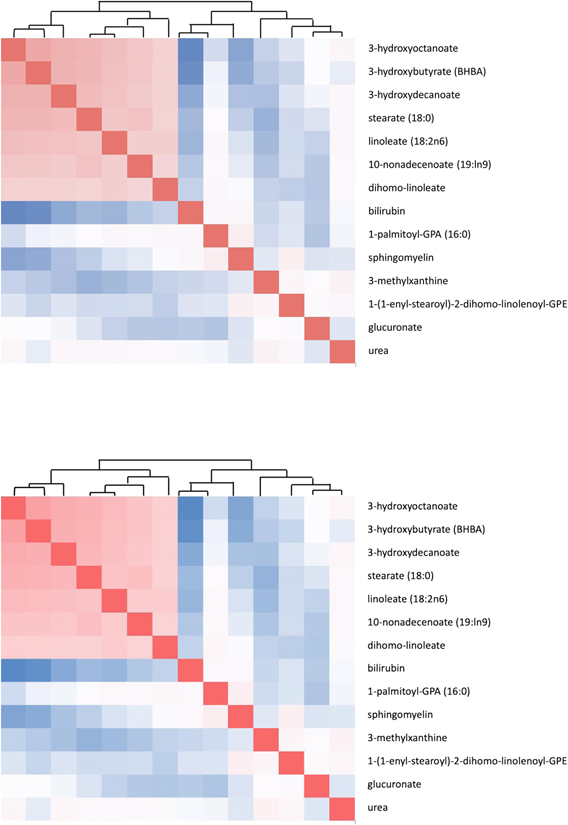
In our previous breast cancer case control study in Hispanics, we found 14 metabolites whose levels differed between cases and controls. To validate the results, we carried out a nested case control study of 100 incident breast cancer and 100 matched healthy women identified from the Mano-A-Mano Mexican American Cohort study. With the adjustment of parity, education, birth place, language acculturation, BMI category, smoking, drinking, physical activity, and sitting time, 4 metabolites were associated with breast cancer risk: 3-hydroxyoctanoate (Odds ratio (OR) = 1.51, 95% confidence interval (CI): 1.10, 3.47), 3-hydroxybutyrate (BHBA) (OR = 1.42, 95%CI: 1.01, 3.72), linoleate (18:2n6) (OR = 1.39, 95% CI: 1.07, 4.04), and bilirubin (OR = 0.54, 95%CI: 0.42, 0.95). Then, we used 3 non-redundant metabolites, namely 3-hydroxyoctanoate, linoleate (18:2n6), and bilirubin, to generate a metabolic risk score. Increased metabolites risk score was associated with a 1.67-fold increased risk of breast cancer (OR = 1.67, 95%CI: 1.32, 3.94). And the significant association was more evident among those who were diagnosed with cancer earlier during the follow-up (≤ 5 years) than their counterparts. In conclusion, we identified four significant metabolites which may help elucidate metabolic pathways that contribute to breast carcinogenesis. Our findings warrant further replication efforts.
在我们之前针对西班牙裔人群开展的乳腺癌病例对照研究中,我们发现了14种病例组与对照组之间水平存在差异的代谢物。为了验证研究结果,我们从“手拉手”墨西哥裔美国人队列研究中选取了100例新发乳腺癌患者和100例匹配的健康女性进行巢式病例对照研究。在对产次、教育程度、出生地、语言文化适应、体重指数类别、吸烟、饮酒、身体活动和久坐时间进行调整后,有4种代谢物与乳腺癌风险相关:3-羟基辛酸(比值比(OR)=1.51,95%置信区间(CI):1.10,3.47)、3-羟基丁酸(BHBA)(OR = 1.42,95%CI:1.01,3.72)、亚油酸(18:2n6)(OR = 1.39,95% CI:1.07,4.04)和胆红素(OR = 0.54,95%CI:0.42,0.95)。然后,我们使用3种非冗余代谢物,即3-羟基辛酸、亚油酸(18:2n6)和胆红素,来生成一个代谢风险评分。代谢物风险评分升高与乳腺癌风险增加1.67倍相关(OR = 1.67,95%CI:1.32,3.94)。而且这种显著关联在随访期间较早(≤5年)被诊断出癌症的人群中比其对应人群更为明显。总之,我们鉴定出了四种重要的代谢物,它们可能有助于阐明促成乳腺癌发生的代谢途径。我们的研究结果值得进一步开展重复研究。