Genetics of Complex Traits, Peninsula Medical School, University of Exeter, Exeter, United Kingdom.
PLoS Genet. 2012 May;8(5):e1002741. doi: 10.1371/journal.pgen.1002741. Epub 2012 May 31.
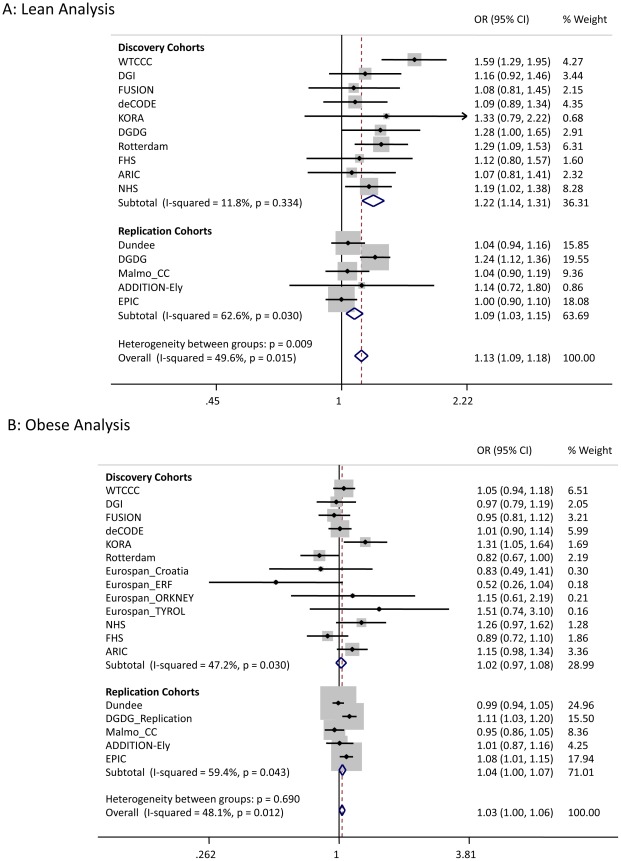
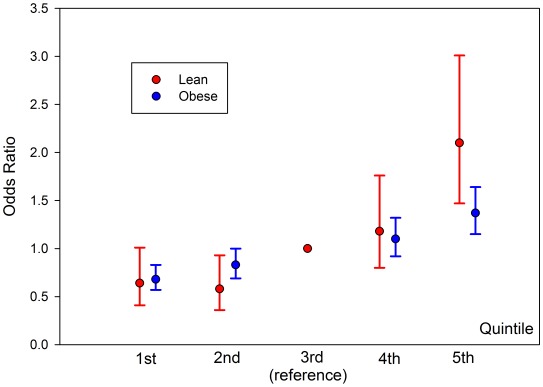
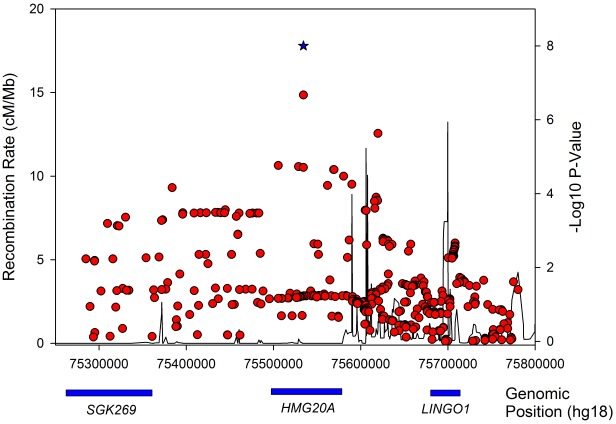
Common diseases such as type 2 diabetes are phenotypically heterogeneous. Obesity is a major risk factor for type 2 diabetes, but patients vary appreciably in body mass index. We hypothesized that the genetic predisposition to the disease may be different in lean (BMI<25 Kg/m²) compared to obese cases (BMI≥30 Kg/m²). We performed two case-control genome-wide studies using two accepted cut-offs for defining individuals as overweight or obese. We used 2,112 lean type 2 diabetes cases (BMI<25 kg/m²) or 4,123 obese cases (BMI≥30 kg/m²), and 54,412 un-stratified controls. Replication was performed in 2,881 lean cases or 8,702 obese cases, and 18,957 un-stratified controls. To assess the effects of known signals, we tested the individual and combined effects of SNPs representing 36 type 2 diabetes loci. After combining data from discovery and replication datasets, we identified two signals not previously reported in Europeans. A variant (rs8090011) in the LAMA1 gene was associated with type 2 diabetes in lean cases (P = 8.4×10⁻⁹, OR = 1.13 [95% CI 1.09-1.18]), and this association was stronger than that in obese cases (P = 0.04, OR = 1.03 [95% CI 1.00-1.06]). A variant in HMG20A--previously identified in South Asians but not Europeans--was associated with type 2 diabetes in obese cases (P = 1.3×10⁻⁸, OR = 1.11 [95% CI 1.07-1.15]), although this association was not significantly stronger than that in lean cases (P = 0.02, OR = 1.09 [95% CI 1.02-1.17]). For 36 known type 2 diabetes loci, 29 had a larger odds ratio in the lean compared to obese (binomial P = 0.0002). In the lean analysis, we observed a weighted per-risk allele OR = 1.13 [95% CI 1.10-1.17], P = 3.2×10⁻¹⁴. This was larger than the same model fitted in the obese analysis where the OR = 1.06 [95% CI 1.05-1.08], P = 2.2×10⁻¹⁶. This study provides evidence that stratification of type 2 diabetes cases by BMI may help identify additional risk variants and that lean cases may have a stronger genetic predisposition to type 2 diabetes.
常见疾病,如 2 型糖尿病,在表型上存在异质性。肥胖是 2 型糖尿病的主要危险因素,但患者的体重指数差异很大。我们假设,疾病的遗传易感性在瘦(BMI<25kg/m²)和肥胖(BMI≥30kg/m²)患者中可能不同。我们使用两种公认的超重或肥胖定义标准,进行了两项病例对照全基因组研究。我们使用了 2112 名瘦 2 型糖尿病患者(BMI<25kg/m²)或 4123 名肥胖患者(BMI≥30kg/m²)和 54412 名未分层对照者。在 2881 名瘦患者或 8702 名肥胖患者和 18957 名未分层对照者中进行了复制。为了评估已知信号的影响,我们测试了代表 36 个 2 型糖尿病位点的 SNP 的个体和联合效应。在将发现和复制数据集的数据结合后,我们确定了两个以前在欧洲人中没有报道过的信号。LAMA1 基因中的一个变体(rs8090011)与瘦患者的 2 型糖尿病相关(P=8.4×10⁻⁹,OR=1.13[95%CI1.09-1.18]),这种关联强于肥胖患者(P=0.04,OR=1.03[95%CI1.00-1.06])。HMG20A 中的一个变体——以前在南亚人中发现,但在欧洲人中没有发现——与肥胖患者的 2 型糖尿病相关(P=1.3×10⁻⁸,OR=1.11[95%CI1.07-1.15]),尽管这种关联并不比瘦患者更强(P=0.02,OR=1.09[95%CI1.02-1.17])。对于 36 个已知的 2 型糖尿病位点,29 个在瘦患者中的比值比在肥胖患者中更大(二项式 P=0.0002)。在瘦患者的分析中,我们观察到加权每个风险等位基因的 OR=1.13[95%CI1.10-1.17],P=3.2×10⁻¹⁴。这大于在肥胖患者分析中拟合的相同模型,其中 OR=1.06[95%CI1.05-1.08],P=2.2×10⁻¹⁶。这项研究提供了证据,表明按 BMI 分层 2 型糖尿病患者可能有助于识别额外的风险变异,并且瘦患者可能对 2 型糖尿病有更强的遗传易感性。