Viscogliosi Laboratory in Molecular Genetics of Musculoskeletal Diseases, Sainte Justine University Hospital Research Center, Montreal, QC, Canada.
Eur Spine J. 2012 Oct;21(10):1905-19. doi: 10.1007/s00586-012-2389-6. Epub 2012 Jun 14.
Idiopathic scoliosis is a complex developmental syndrome defined by an abnormal structural curvature of the spine. High treatment costs, chronic pain/discomfort, and the need for monitoring at-risk individuals contribute to the global healthcare burden of this musculoskeletal disease. Although many studies have endeavored to identify underlying genes, little progress has been made in understanding the etiopathogenesis. The objective of this comprehensive review was to summarize genetic associations/linkages with idiopathic scoliosis, as well as explore the strengths and weaknesses of each study, such that it may serve as a guide for the design and interpretation of future genetic studies in scoliosis.
We searched PubMed and Human Genome Epidemiology (HuGE) Navigator using the search terms "gene and scoliosis". Linkage or association studies published in English and available full-text were further analyzed as regards results, experimental design, and statistical approach.
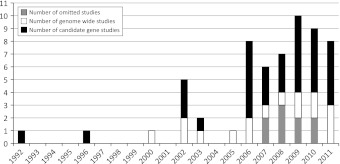
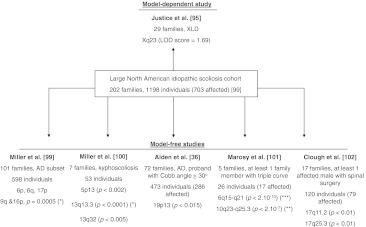
We identified and analyzed 50 studies matching our criteria. These consisted of 34 candidate gene studies (6 linkage, 28 association) and 16 genome-wide studies [14 pedigree-based linkage, 2 genome-wide association studies (GWAS)]. Findings involved genes related to connective tissue structure, bone formation/metabolism, melatonin signaling pathways, puberty and growth, and axon guidance pathways. Variability in results between studies suggested ethnic and/or genetic heterogeneity.
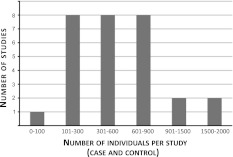
The major difficulty in idiopathic scoliosis research is phenotypic and genetic heterogeneity. Genetic research was overrepresented by underpowered studies. The use of biological endophenotypes, as well as restricted clinical definitions, may help to partition variation and increase the power of studies to detect or confirm an effect.
特发性脊柱侧凸是一种由脊柱结构异常弯曲定义的复杂发育综合征。高治疗费用、慢性疼痛/不适以及需要监测高危人群,导致这种肌肉骨骼疾病成为全球医疗保健的负担。尽管许多研究都致力于确定潜在的基因,但在理解病因发病机制方面几乎没有取得进展。本综述的目的是总结与特发性脊柱侧凸相关的遗传关联/连锁,并探讨每项研究的优缺点,以便为脊柱侧凸的未来遗传研究的设计和解释提供指导。
我们使用“基因和脊柱侧凸”的搜索词在 PubMed 和人类基因组流行病学(HuGE)导航器中进行搜索。进一步分析了以英语发表且可获得全文的连锁或关联研究,以了解其结果、实验设计和统计方法。
我们确定并分析了符合我们标准的 50 项研究。这些研究包括 34 项候选基因研究(6 项连锁,28 项关联)和 16 项全基因组研究[14 项基于家系的连锁,2 项全基因组关联研究(GWAS)]。研究结果涉及与结缔组织结构、骨形成/代谢、褪黑素信号通路、青春期和生长以及轴突导向途径相关的基因。研究结果之间的差异表明存在种族和/或遗传异质性。
特发性脊柱侧凸研究的主要困难是表型和遗传异质性。遗传研究主要由效力不足的研究代表。使用生物学内表型以及受限的临床定义,可能有助于划分变异并提高研究检测或确认效果的能力。