Department of Preventive Medicine, Madigan Healthcare System, Tacoma, WA 98431-1100, USA.
BMJ. 2012 Jun 13;344:e3782. doi: 10.1136/bmj.e3782.
To determine whether previous Himalayan experience is associated with a decreased risk of climbing death, and whether mountaineers participating in commercial expeditions differ in their risk of death relative to those participating in traditional climbs.
Retrospective cohort study.
Expeditions in the Nepalese Himalayan peaks, from 1 January 1970 to the spring climbing season in 2010.
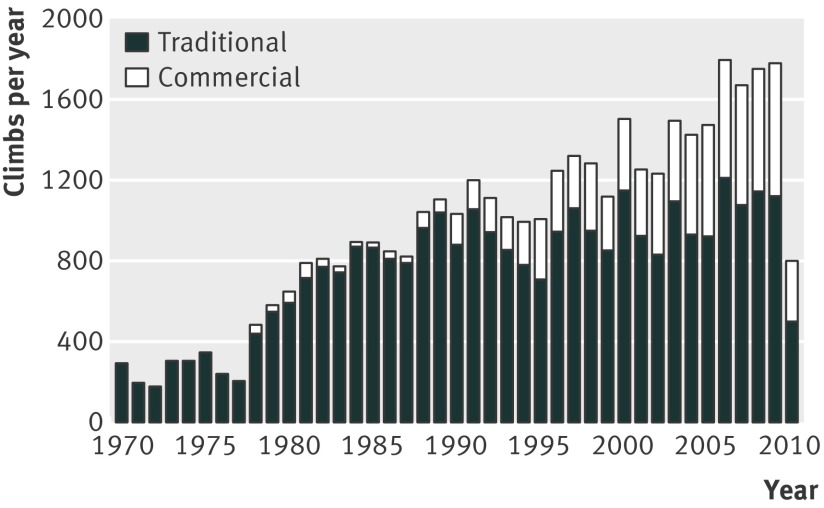
23,995 non-porters venturing above base camp on 39,038 climbs, 23,295 on 8000 m peaks.
Death.
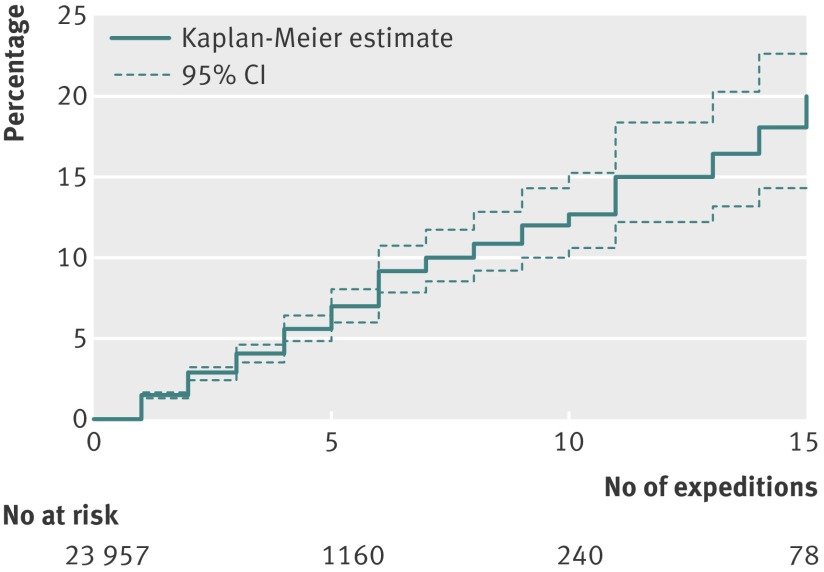
After controlling for use of standard route, peak, age, season, sex, summit success, and year of expedition, increased Himalayan experience was not associated with a change in the odds of death (odds ratio 1.00, 95% confidence interval 0.96 to 1.05, P = 0.904). Participation in a commercial climb was associated with a 37% lower odds of death relative to a traditional venture, although not significantly (0.63, 0.37 to 1.09, P = 0.100). Choice of peak was clearly associated with altered odds of death (omnibus P<0.001); year of expedition was associated with a significant trend toward reduced odds of death (0.98, 0.96 to 0.99, P = 0.011).
No net survival benefit is associated with increased Himalayan experience or participation in a traditional (versus commercial) venture. The incremental decrease in risk associated with calendar year suggests that cumulative, collective knowledge and general innovation are more important than individual experience in improving the odds of survival.
确定以往的喜马拉雅山登山经验是否与降低登山死亡风险相关,以及参加商业探险的登山者相对于传统登山者的死亡风险是否有所不同。
回顾性队列研究。
尼泊尔喜马拉雅山脉的探险活动,时间范围为 1970 年 1 月 1 日至 2010 年春季登山季。
23995 名非搬运工在 39038 次攀登中冒险进入大本营以上,23295 人攀登 8000 米以上的山峰。
死亡。
在控制标准路线、山峰、年龄、季节、性别、登顶成功率和探险年份的使用后,增加喜马拉雅山经验与死亡几率的变化无关(优势比 1.00,95%置信区间 0.96 至 1.05,P=0.904)。与传统探险相比,参加商业攀登与死亡几率降低 37%相关,尽管这并不显著(0.63,0.37 至 1.09,P=0.100)。选择山峰明显与改变的死亡几率相关(总体 P<0.001);探险年份与死亡几率显著降低的趋势相关(0.98,0.96 至 0.99,P=0.011)。
没有净生存获益与增加的喜马拉雅山经验或参加传统(与商业)探险相关。与日历年相关的风险递增下降表明,累积的、集体的知识和普遍的创新比个人经验更重要,能够提高生存几率。