Department of Medical Imaging, University of Toronto, Toronto General Hospital, NCSB 1C547, 585 University Avenue, Toronto, Ontario, M5G 2N2, Canada,
Insights Imaging. 2012 Aug;3(4):323-8. doi: 10.1007/s13244-012-0169-9. Epub 2012 May 1.
To compare two scanning protocols (free breathing versus breath-hold) for perfusion imaging using dynamic volume computed tomography (CT) and to evaluate their effects on image registration.
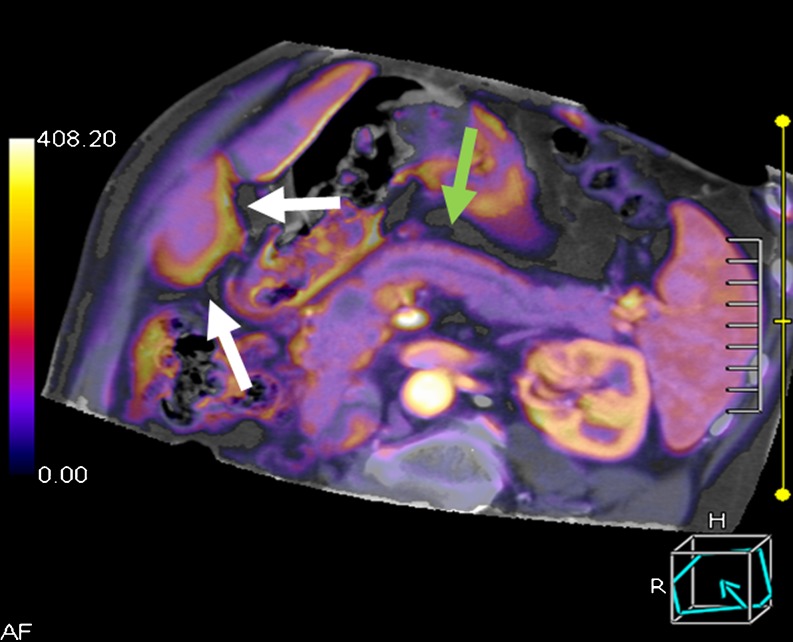
Forty patients underwent dynamic volume CT for pancreatic perfusion analysis and were randomly assigned to either a shallow-breathing (I) or breath-hold (II) group. Both dynamic CT protocols consisted of 17 low-dose volumetric scans. Rigid image registration was performed by using the volume with highest aortic attenuation as reference. All other volumes were visually matched with the pancreatic lesion serving as the volumetric region of interest. The overall demand for post-processing per patient was calculated as the median of three-dimensional vector lengths of all volumes in relation to the relative patient origin. The number of volumes not requiring registration was recorded per group.
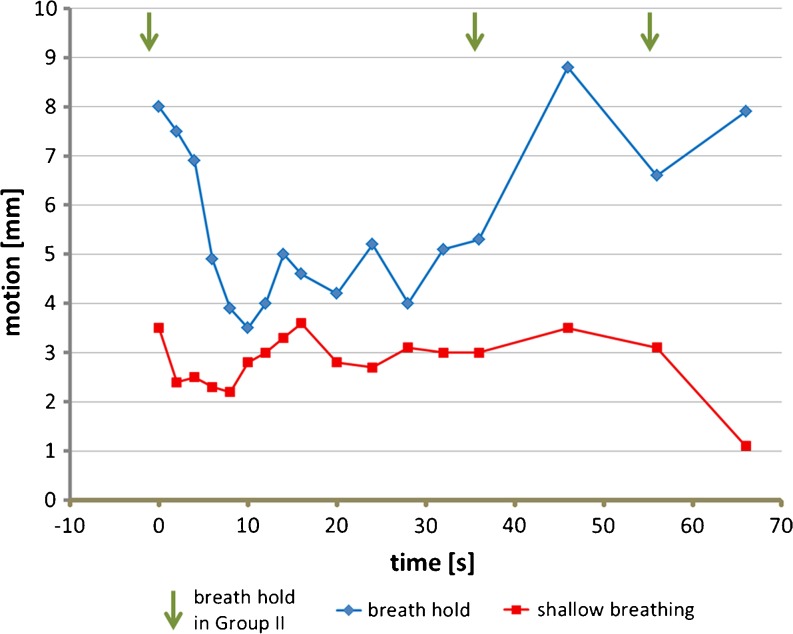
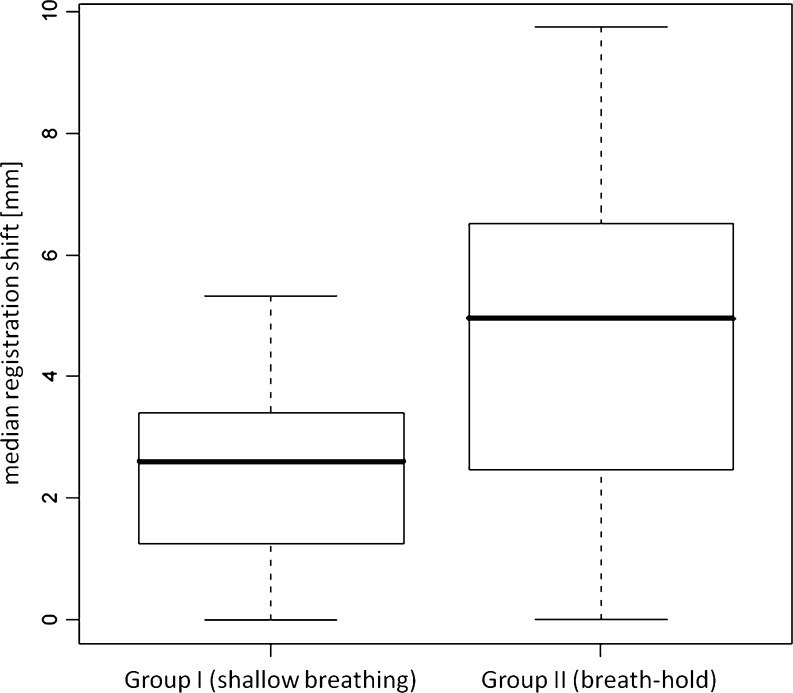
Registration mismatch for groups I and II was 2.61 mm (SD, 1.57) and 4.95 mm (SD, 2.71), respectively (P < 0.005). Twenty-eight volumes in group I (8.2%) and 47 volumes in group II (14.1%) did not require manual registration (P = 0.014).
Shallow breathing during dynamic volume CT scanning reduces the overall demand for motion correction and thus may be beneficial in perfusion imaging of the pancreas
• Shallow breathing during perfusion CT scanning reduces the overall demand for motion correction. • Shallow breathing may be beneficial in perfusion imaging of the pancreas. • Image registration is crucial for CT perfusion imaging.
比较两种扫描方案(自由呼吸与屏气)在使用动态容积 CT(CT)进行灌注成像时的效果,并评估其对图像配准的影响。
40 例患者行胰腺灌注动态容积 CT 检查,随机分为浅呼吸组(I 组)和屏气组(II 组)。两种动态 CT 方案均由 17 个低剂量容积扫描组成。采用主动脉衰减值最高的容积作为参考进行刚性图像配准。所有其他容积均与胰腺病变进行视觉匹配,作为容积感兴趣区。每位患者的后处理总需求计算为与患者原点相关的所有容积的三维向量长度的中位数。记录每组无需配准的容积数。
I 组和 II 组的配准不匹配分别为 2.61mm(SD,1.57)和 4.95mm(SD,2.71)(P<0.005)。I 组有 28 个容积(8.2%),II 组有 47 个容积(14.1%)无需手动配准(P=0.014)。
动态容积 CT 扫描时浅呼吸可减少运动校正的总体需求,因此可能对胰腺灌注成像有益。
• 灌注 CT 扫描时浅呼吸可减少运动校正的总体需求。• 浅呼吸可能对胰腺灌注成像有益。• 图像配准对 CT 灌注成像至关重要。