University of Heidelberg, Institute of Public Health, Heidelberg, Germany.
BMC Health Serv Res. 2012 Jun 14;12:159. doi: 10.1186/1472-6963-12-159.
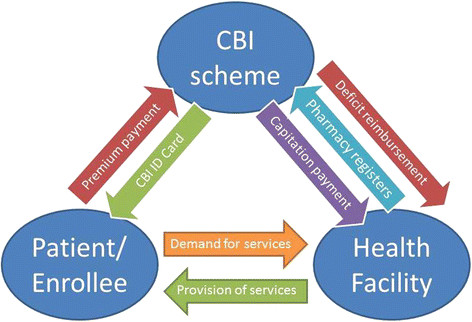
In 2004, a community-based health insurance scheme (CBI) was introduced in Nouna health district, Burkina Faso. Since its inception, coverage has remained low and dropout rates high. One important reason for low coverage and high dropout is that health workers do not support the CBI scheme because they are dissatisfied with the provider payment mechanism of the CBI.
A discrete choice experiment (DCE) was used to examine CBI provider payment attributes that influence health workers' stated preferences for payment mechanisms. The DCE was conducted among 176 health workers employed at one of the 34 primary care facilities or the district hospital in Nouna health district. Conditional logit models with main effects and interactions terms were used for analysis.
Reimbursement of service fees (adjusted odds ratio (aOR) 1.49, p < 0.001) and CBI contributions for medical supplies and equipment (aOR 1.47, p < 0.001) had the strongest effect on whether the health workers chose a given provider payment mechanism. The odds of selecting a payment mechanism decreased significantly if the mechanism included (i) results-based financing (RBF) payments made through the local health management team (instead of directly to the health workers (aOR 0.86, p < 0.001)) or (ii) RBF payments based on CBI coverage achieved in the health worker's facility relative to the coverage achieved at other facilities (instead of payments based on the numbers of individuals or households enrolled at the health worker's facility (aOR 0.86, p < 0.001)).
Provider payment mechanisms can crucially determine CBI performance. Based on the results from this DCE, revised CBI payment mechanisms were introduced in Nouna health district in January 2011, taking into consideration health worker preferences on how they are paid.
2004 年,布基纳法索努纳卫生区引入了一种基于社区的健康保险计划(CBI)。自成立以来,覆盖率一直很低,退保率很高。覆盖率低和退保率高的一个重要原因是,卫生工作者不支持 CBI 计划,因为他们对 CBI 的提供者支付机制不满意。
使用离散选择实验(DCE)来检查影响卫生工作者对支付机制的既定偏好的 CBI 提供者支付属性。DCE 在努纳卫生区的 34 个初级保健设施或区医院之一的 176 名卫生工作者中进行。使用具有主效应和交互项的条件逻辑回归模型进行分析。
服务费用的报销(调整后的优势比(aOR)1.49,p<0.001)和 CBI 对医疗用品和设备的供款(aOR 1.47,p<0.001)对卫生工作者选择特定提供者支付机制的影响最大。如果支付机制包括(i)通过当地卫生管理团队而不是直接向卫生工作者支付的基于结果的融资(RBF)付款(aOR 0.86,p<0.001),或者(ii)基于卫生工作者所在机构实现的 CBI 覆盖率而不是基于卫生工作者所在机构登记的个人或家庭数量的 RBF 付款(aOR 0.86,p<0.001),则选择支付机制的可能性显著降低。
提供者支付机制可以极大地决定 CBI 的绩效。基于本次 DCE 的结果,2011 年 1 月,努纳卫生区引入了修订后的 CBI 支付机制,考虑了卫生工作者对支付方式的偏好。