Institute of Public Health, University of Heidelberg, Germany.
BMC Health Serv Res. 2010 Jul 9;10:201. doi: 10.1186/1472-6963-10-201.
Human resource crises in developing countries have been identified as a critical aspect of poor quality and low accessibility in health care. Worker motivation is an important facet of this issue. Specifically, motivation among physicians, who are an important bridge between health systems and patients, should be considered. This study aimed to identify the determinants of job motivation among physicians, a neglected perspective, especially in developing countries.
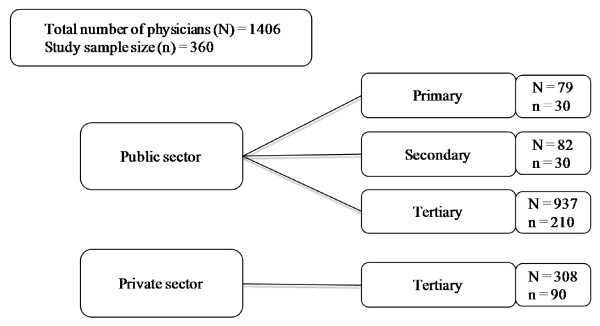
A stratified random sample of 360 physicians was selected from public primary, public secondary and public and private tertiary health facilities in the Lahore district, Pakistan. Pretested, semi-structured, self-administered questionnaires were used. For the descriptive part of this study, physicians were asked to report their 5 most important work motivators and demotivators within the context of their current jobs and in general. Responses were coded according to emergent themes and frequencies calculated. Of the 30 factors identified, 10 were classified as intrinsic, 16 as organizational and 4 as socio-cultural.
Intrinsic and socio-cultural factors like serving people, respect and career growth were important motivators. Conversely, demotivators across setups were mostly organizational, especially in current jobs. Among these, less pay was reported the most frequently. Fewer opportunities for higher qualifications was a demotivator among primary and secondary physicians. Less personal safety and poor working conditions were important in the public sector, particularly among female physicians. Among private tertiary physicians financial incentives other than pay and good working conditions were motivators in current jobs. Socio-cultural and intrinsic factors like less personal and social time and the inability to financially support oneself and family were more important among male physicians.
Motivational determinants differed across different levels of care, sectors and genders. Nonetheless, the important motivators across setups in this study were mostly intrinsic and socio-cultural, which are difficult to affect while the demotivators were largely organizational. Many can be addressed even at the facility level such as less personal safety and poor working conditions. Thus, in resource limited settings a good strategic starting point could be small scale changes that may markedly improve physicians' motivation and subsequently the quality of health care.
发展中国家的人力资源危机已被确定为医疗保健质量低下和可及性低的一个关键方面。员工激励是这个问题的一个重要方面。具体来说,应该考虑作为卫生系统和患者之间重要桥梁的医生的激励。本研究旨在确定医生工作动机的决定因素,这是一个被忽视的视角,特别是在发展中国家。
在巴基斯坦拉合尔地区,从公立初级、公立中级和公立及私立三级保健设施中抽取了 360 名医生进行分层随机抽样。使用了经过预测试的半结构式自我管理问卷。在本研究的描述部分,医生被要求报告他们在当前工作中和一般情况下的 5 个最重要的工作激励因素和减损因素。根据出现的主题对答复进行编码并计算频率。在所确定的 30 个因素中,有 10 个被归类为内在因素,16 个被归类为组织因素,4 个被归类为社会文化因素。
内在和社会文化因素,如为人民服务、尊重和职业发展,是重要的激励因素。相反,在各种情况下,减损因素主要是组织因素,尤其是在当前工作中。在这些因素中,薪酬较低是报告最多的因素。初级和中级医生的激励因素较少,是因为获得更高资格的机会较少。个人安全较少和工作条件较差是公共部门的重要因素,特别是对女医生而言。在私立三级医生中,薪酬以外的经济奖励和良好的工作条件是当前工作的激励因素。社会文化和内在因素,如较少的个人和社会时间,以及无法养活自己和家人,对男性医生来说更为重要。
不同层次的医疗保健、部门和性别之间的激励决定因素不同。尽管如此,在这项研究中,不同环境下的重要激励因素主要是内在和社会文化因素,这些因素很难影响,而减损因素主要是组织因素。许多因素甚至可以在设施层面得到解决,例如个人安全较少和工作条件较差。因此,在资源有限的环境中,一个良好的战略起点可以是进行小规模的改变,这可能会显著提高医生的积极性,进而提高医疗质量。