Division of Cardiothoracic Surgery, Department of Surgery, Emory University School of Medicine and Children's Healthcare of Atlanta at Egleston, Atlanta, GA 30322, USA.
J Thorac Cardiovasc Surg. 2012 Aug;144(2):383-9. doi: 10.1016/j.jtcvs.2012.05.015. Epub 2012 Jun 13.
Optimizing flow and diminishing power loss in the Fontan circuit can improve hemodynamic efficiency, potentially improving the long-term outcomes. Computerized modeling has predicted improved energetics with a Y-graft Fontan.
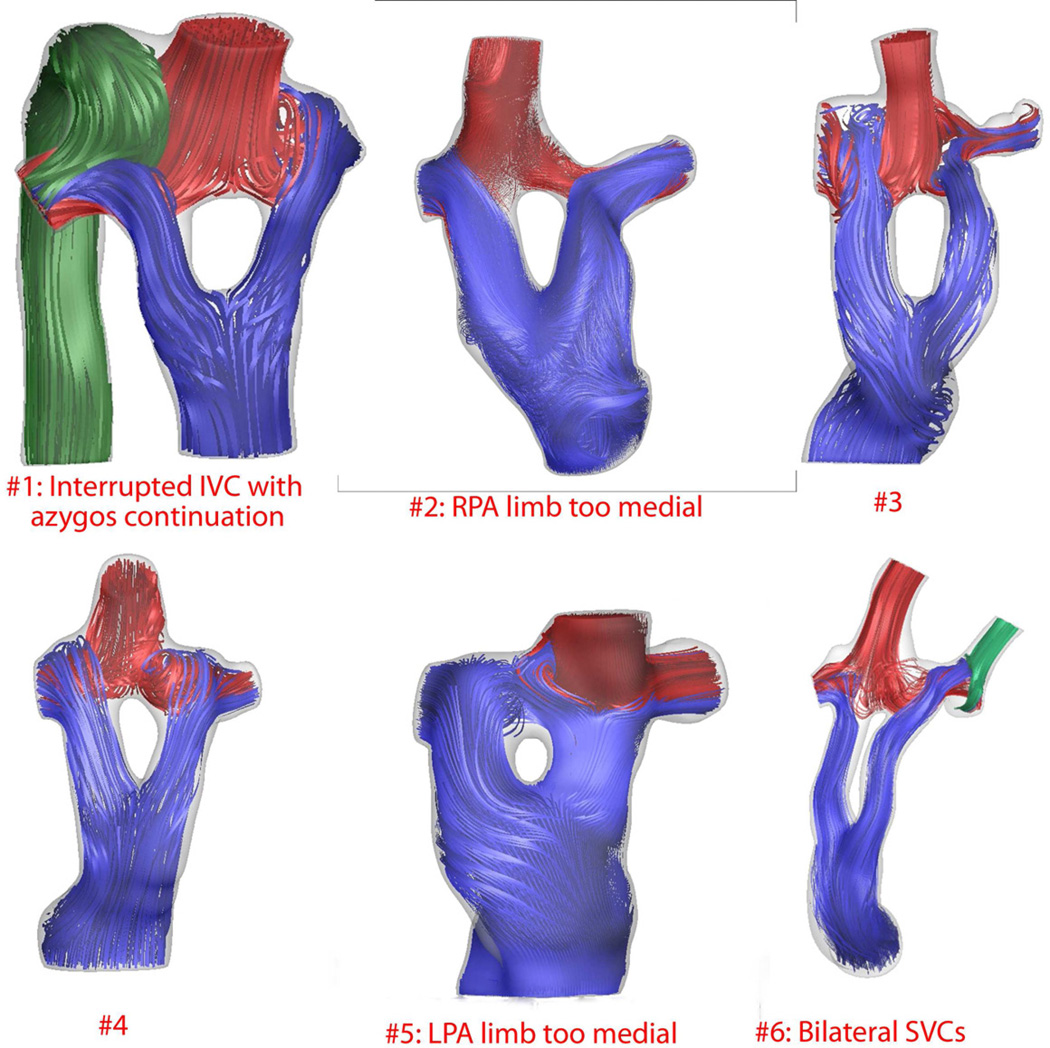
From August to December 2010, 6 consecutive children underwent completion Fontan (n=3) or Fontan revision (n=3) using a bifurcated polytetrafluoroethylene Y-graft (18×9×9 mm in 2, 20×10×10 mm in 4) connecting the inferior vena cava to the right and left pulmonary arteries with separate graft limbs. The patents underwent magnetic resonance imaging (n=5) or computed tomography (n=1). Computational fluid dynamics assessed Fontan hemodynamics, power loss, and inferior vena cava flow splits to the branch pulmonary arteries. The clinical parameters were compared with those from 12 patients immediately preceding the present series who had undergone a lateral Fontan procedure.
Despite longer crossclamp and bypass times (not statistically significant), the Y-graft Fontan patients had postoperative courses similar to those of the conventional Fontan patients. Other than 2 early readmissions for pleural effusions managed with diuretics, at 6 to 12 months of follow-up (mean, 8 months), all 6 patients had done well. Postoperative flow modeling demonstrated a balanced distribution of inferior vena cava flow to both pulmonary arteries with minimal flow disturbance. Improvements in hemodynamics and efficiency were noted when the Y-graft branches were anastomosed distally and aligned tangentially with the branch pulmonary arteries.
The present preliminary surgical experience has demonstrated the clinical feasibility of the bifurcated Y-graft Fontan. Computational fluid dynamics showed acceptable hemodynamics with low calculated power losses and a balanced distribution of inferior vena cava flow to the pulmonary arteries as long as the branch grafts were anastomosed distally.
优化 Fontan 环的血流并减少能量损耗可以提高血液动力学效率,从而潜在改善长期预后。计算机建模预测 Y 型移植物 Fontan 可改善能量学。
2010 年 8 月至 12 月,连续 6 例患儿接受了分叉聚四氟乙烯 Y 型移植物(2 例为 18×9×9mm,4 例为 20×10×10mm)连接下腔静脉与右肺动脉和左肺动脉的完成 Fontan(n=3)或 Fontan 修正术(n=3)。5 例患者接受了磁共振成像(n=5),1 例接受了计算机断层扫描(n=1)。计算流体动力学评估了 Fontan 血液动力学、能量损耗以及下腔静脉血流对分支肺动脉的分流。将临床参数与本系列前 12 例接受侧侧 Fontan 手术的患者进行了比较。
尽管体外循环和转流时间更长(无统计学意义),但 Y 型移植物 Fontan 患者的术后过程与传统 Fontan 患者相似。除了 2 例早期因胸腔积液需要利尿剂治疗而再次入院外,在 6 至 12 个月的随访(平均 8 个月)期间,所有 6 例患者均恢复良好。术后血流模型显示下腔静脉血流在两支肺动脉之间的分布均衡,血流干扰最小。当 Y 型移植物分支远端吻合并与分支肺动脉相切对齐时,血液动力学和效率得到改善。
目前的初步手术经验证明了分叉 Y 型移植物 Fontan 的临床可行性。计算流体动力学显示,只要分支移植物远端吻合,即可获得可接受的血液动力学,计算出的能量损耗低,下腔静脉血流均衡分布至肺动脉。