Department of Urology, Guangdong Key Laboratory of Clinical Molecular Medicine and Diagnostics, Guangzhou First Municipal People's Hospital, Affiliated Guangzhou Medical College, Guangzhou 510180, China.
BMC Cancer. 2012 Jun 15;12:248. doi: 10.1186/1471-2407-12-248.
SOX genes play an important role in a number of developmental processes. Potential roles of SOXs have been demonstrated in various neoplastic tissues as tumor suppressors or promoters depending on tumor status and types. The aim of this study was to investigate the involvement of SOXs in the progression and prognosis of human prostate cancer (PCa).
The gene expression changes of SOXs in human PCa tissues compared with non-cancerous prostate tissues was detected using gene expression microarray, and confirmed by real-time quantitative reverse transcriptase-polymerase chain reaction (QRT-PCR) analysis and immunohositochemistry. The roles of these genes in castration resistance were investigated in LNCaP xenograft model of PCa.
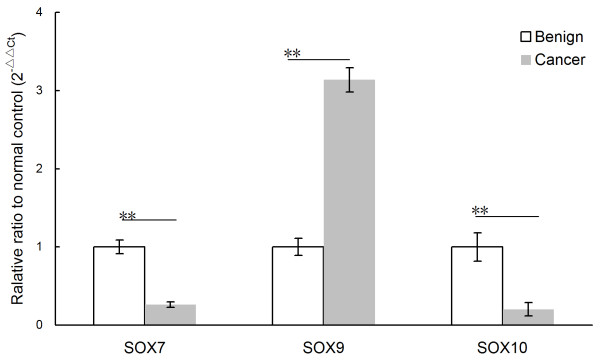
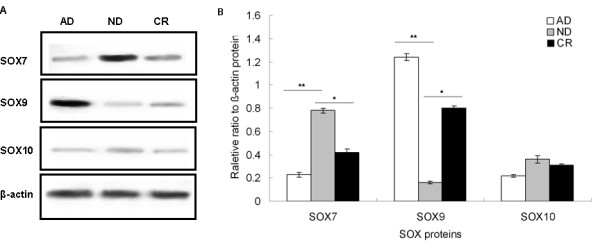
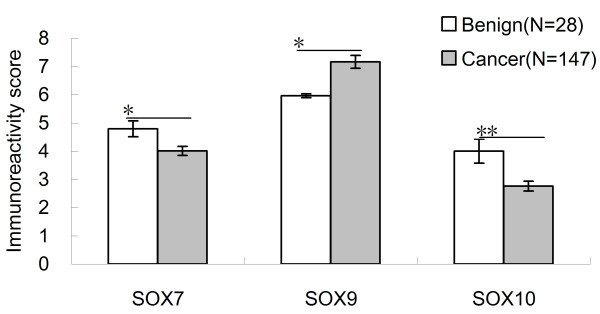
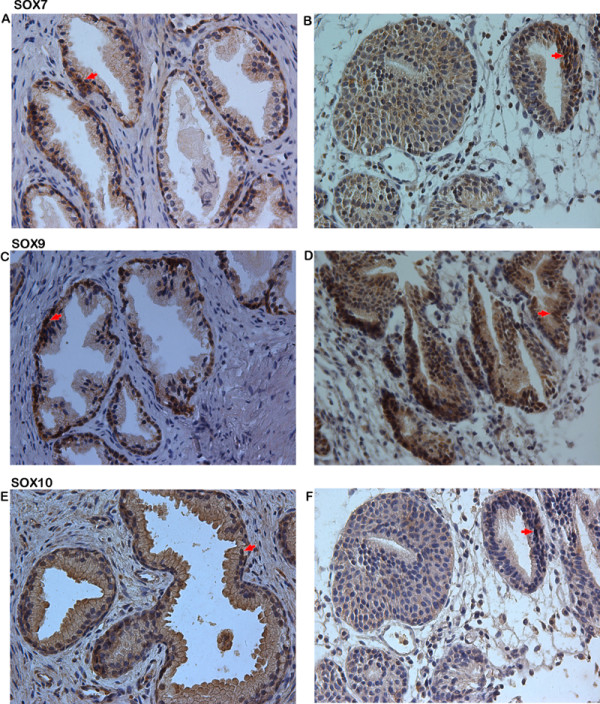
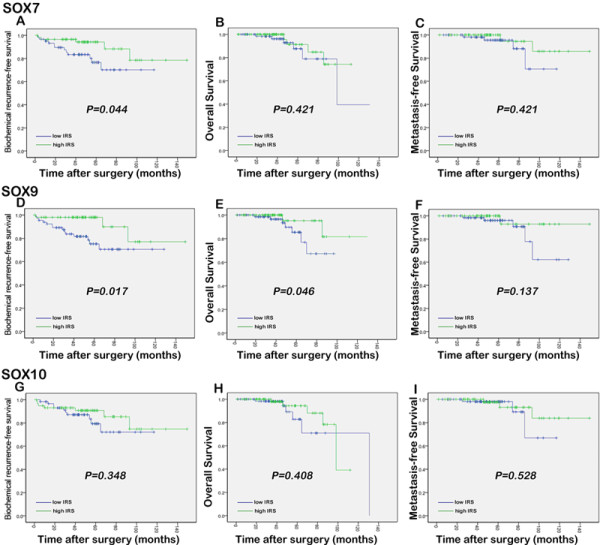
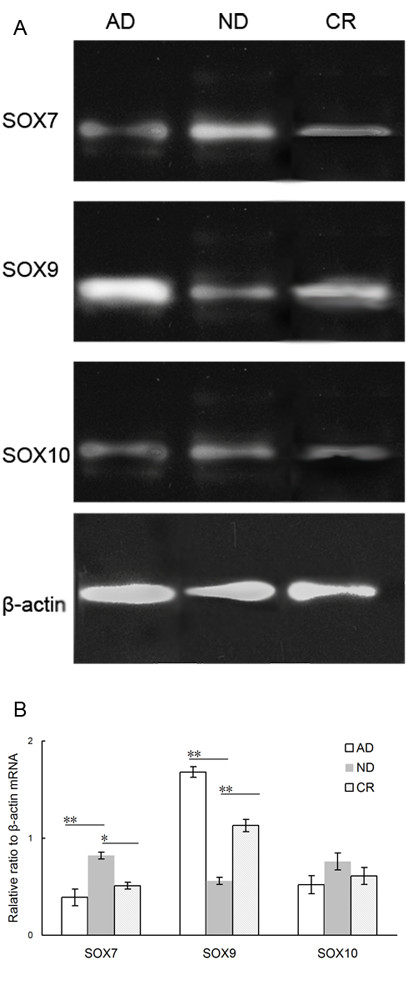
The microarray analysis identified three genes (SOX7, SOX9 and SOX10) of SOX family that were significantly dis-regulated in common among four PCa specimens. Consistent with the results of the microarray, differential mRNA and protein levels of three selected genes were found in PCa tissues by QRT-PCR analysis and immunohistochemistry. Additionally, we found that the immunohistochemical staining scores of SOX7 in PCa tissues with higher serum PSA level (P = 0.02) and metastasis (P = 0.03) were significantly lower than those with lower serum PSA level and without metastasis; the increased SOX9 protein expression was frequently found in PCa tissues with higher Gleason score (P = 0.02) and higher clinical stage (P < 0.0001); the down-regulation of SOX10 tend to be found in PCa tissues with higher serum PSA levels (P = 0.03) and advanced pathological stage (P = 0.01). Moreover, both univariate and multivariate analyses showed that the down-regulation of SOX7 and the up-regulation of SOX9 were independent predictors of shorter biochemical recurrence-free survival. Furthermore, we discovered that SOX7 was significantly down-regulated and SOX9 was significantly up-regulated during the progression to castration resistance.
Our data offer the convince evidence that the dis-regulation of SOX7, SOX9 and SOX10 may be associated with the aggressive progression of PCa. SOX7 and SOX9 may be potential markers for prognosis in PCa patients. Interestingly, the down-regulation of SOX7 and the up-regulation of SOX9 may be important mechanisms for castration-resistant progression of PCa.
SOX 基因在许多发育过程中发挥着重要作用。根据肿瘤状态和类型,SOX 在各种肿瘤组织中的潜在作用被证明是肿瘤抑制因子或促进因子。本研究旨在探讨 SOX 在人类前列腺癌(PCa)进展和预后中的作用。
采用基因表达微阵列检测 SOX 在人前列腺癌组织与非癌前列腺组织中的表达变化,并通过实时定量逆转录聚合酶链反应(QRT-PCR)分析和免疫组织化学进一步证实。在 PCa 的 LNCaP 异种移植模型中研究这些基因在去势抵抗中的作用。
微阵列分析确定了 SOX 家族中的三个基因(SOX7、SOX9 和 SOX10)在四个 PCa 标本中普遍失调。与微阵列结果一致,通过 QRT-PCR 分析和免疫组化发现,三个选定基因在 PCa 组织中的差异 mRNA 和蛋白水平。此外,我们发现,在 PSA 水平较高(P = 0.02)和转移(P = 0.03)的 PCa 组织中,SOX7 的免疫组化染色评分明显低于 PSA 水平较低且无转移的组织;在 Gleason 评分较高(P = 0.02)和临床分期较高(P < 0.0001)的 PCa 组织中,SOX9 蛋白表达升高更为常见;SOX10 的下调倾向于在 PSA 水平较高(P = 0.03)和晚期病理分期(P = 0.01)的 PCa 组织中发现。此外,单变量和多变量分析均表明,SOX7 的下调和 SOX9 的上调是生化无复发生存率较短的独立预测因子。此外,我们发现,在向去势抵抗进展过程中,SOX7 明显下调,SOX9 明显上调。
我们的数据提供了令人信服的证据,表明 SOX7、SOX9 和 SOX10 的失调可能与 PCa 的侵袭性进展有关。SOX7 和 SOX9 可能是 PCa 患者预后的潜在标志物。有趣的是,SOX7 的下调和 SOX9 的上调可能是 PCa 去势抵抗进展的重要机制。