Department of Radiotherapy, University Medical Center Utrecht, hp Q00,118, Heidelberglaan 100, 3584, CX, Utrecht, The Netherlands.
Radiat Oncol. 2012 Jun 15;7:91. doi: 10.1186/1748-717X-7-91.
The salivary mucin MUC5B, present in (sero)mucous secretions including submandibular gland (SMG) saliva, plays an important role in the lubrication of the oral mucosa and is thought to be related to the feeling of dry mouth. We investigated if MUC5B levels in SMG saliva could distinguish between the presence or absence of severe dry mouth complaints 12 months after radiotherapy (RT) for head-and-neck cancer (HNC).
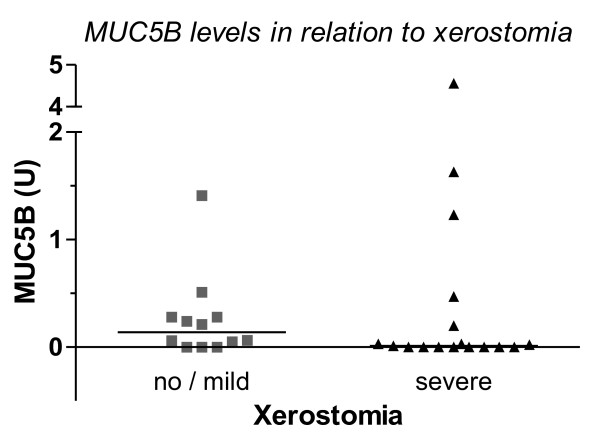
Twenty-nine HNC patients with a residual stimulated SMG secretion rate of ≥ 0.2 ml/10 min at 12 months after RT were analyzed. MUC5B (in U; normalized to 1) and total protein levels (mg/ml) were measured in SMG saliva at baseline and 12 months after RT using ELISA and BCA protein assay, respectively. Overall, median MUC5B levels decreased after RT from 0.12 to 0.03 U (p = 0.47). Patients were dichotomized into none/mild xerostomia (n = 12) and severe xerostomia (n = 17) based on a questionnaire completed at 12 months. SMG and whole saliva flow rates decreased after RT but were comparable in both groups. The median MUC5B level was higher in patients with no or mild xerostomia compared to patients with severe xerostomia (0.14 vs 0.01 U, p = 0.22). Half of the patients with severe xerostomia had no detectable MUC5B at 12 months after RT. No differences in total protein levels were observed.
Qualitative saliva parameters like MUC5B need further investigation in RT-induced xerostomia. This pilot study showed a trend towards lower MUC5B levels in the SMG saliva of patients with severe xerostomia 12 months after RT for HNC.
唾液黏蛋白 MUC5B 存在于颌下腺(SMG)唾液等(血清)黏液分泌物中,在口腔黏膜的润滑中发挥重要作用,被认为与口干的感觉有关。我们研究了颌面部癌症(HNC)放疗后 12 个月 SMG 唾液中 MUC5B 水平是否可以区分严重口干症状的存在或不存在。
对 29 例 HNC 患者进行分析,这些患者在放疗后 12 个月的残留刺激 SMG 分泌率≥0.2ml/10min。使用 ELISA 和 BCA 蛋白分析分别在基线和放疗后 12 个月测量 SMG 唾液中的 MUC5B(U;标准化为 1)和总蛋白水平(mg/ml)。总体而言,MUC5B 水平在放疗后从 0.12 降至 0.03 U(p=0.47)。根据 12 个月时完成的问卷,将患者分为无/轻度口干(n=12)和严重口干(n=17)两组。放疗后 SMG 和全唾液流量减少,但两组间无差异。无/轻度口干组患者的 MUC5B 中位数高于严重口干组(0.14 与 0.01 U,p=0.22)。放疗后 12 个月,一半严重口干患者的 MUC5B 无法检测到。总蛋白水平无差异。
定性唾液参数如 MUC5B 需要进一步研究以了解放疗引起的口干。本研究显示,HNC 放疗后 12 个月严重口干患者的 SMG 唾液中 MUC5B 水平呈下降趋势。