Programa de Pós-Graduação em Biotecnologia-RENORBIO-Rede Nordeste de Biotecnologia, Universidade Estadual do Ceará-UECE, Av. Paranjana, 1700, Campus do Itaperi, Fortaleza, CE 60740-000 Brasil.
Curr Protein Pept Sci. 2012 Sep;13(6):524-46. doi: 10.2174/138920312803582951.
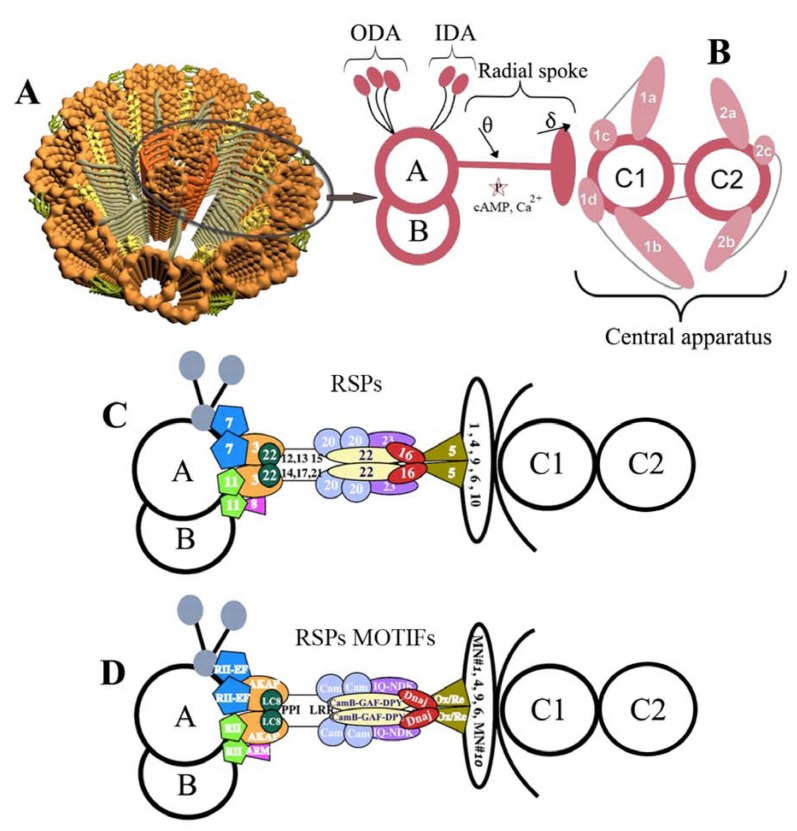
This review will summarize and discuss the current biological understanding of the motile eukaryotic flagellum, as posed out by recent advances enabled by post-genomics and proteomics approaches. The organelle, which is crucial for motility, survival, differentiation, reproduction, division and feeding, among other activities, of many eukaryotes, is a great example of a natural nanomachine assembled mostly by proteins (around 350-650 of them) that have been conserved throughout eukaryotic evolution. Flagellar proteins are discussed in terms of their arrangement on to the axoneme, the canonical "9+2" microtubule pattern, and also motor and sensorial elements that have been detected by recent proteomic analyses in organisms such as Chlamydomonas reinhardtii, sea urchin, and trypanosomatids. Such findings can be remarkably matched up to important discoveries in vertebrate and mammalian types as diverse as sperm cells, ciliated kidney epithelia, respiratory and oviductal cilia, and neuro-epithelia, among others. Here we will focus on some exciting work regarding eukaryotic flagellar proteins, particularly using the flagellar proteome of C. reinhardtii as a reference map for exploring motility in function, dysfunction and pathogenic flagellates. The reference map for the eukaryotic flagellar proteome consists of 652 proteins that include known structural and intraflagellar transport (IFT) proteins, less wellcharacterized signal transduction proteins and flagellar associated proteins (FAPs), besides almost two hundred unannotated conserved proteins, which lately have been the subject of intense investigation and of our present examination.
这篇综述总结并讨论了运动性真核鞭毛的当前生物学认识,这些认识是由后基因组学和蛋白质组学方法所带来的最新进展提出的。作为一种自然纳米机器,该细胞器对于许多真核生物的运动、生存、分化、繁殖、分裂和进食等活动至关重要,它主要由蛋白质(约 350-650 种)组装而成,这些蛋白质在真核生物进化过程中得到了保守。鞭毛蛋白根据其在轴丝上的排列方式、典型的“9+2”微管模式以及最近在衣滴虫、海胆和锥虫等生物的蛋白质组分析中检测到的运动和感觉元件进行了讨论。这些发现与从精子细胞、纤毛肾上皮、呼吸和输卵管纤毛到神经上皮等不同脊椎动物和哺乳动物类型中的重要发现惊人地吻合。在这里,我们将重点关注一些关于真核鞭毛蛋白的令人兴奋的工作,特别是使用莱茵衣藻的鞭毛蛋白质组作为参考图谱来探索功能、功能障碍和致病鞭毛虫的运动。真核鞭毛蛋白质组的参考图谱包括 652 种蛋白质,其中包括已知的结构和内鞭毛运输(IFT)蛋白、特征不太明显的信号转导蛋白和鞭毛相关蛋白(FAP),以及近 200 种未注释的保守蛋白,这些蛋白最近一直是研究的热点,也是我们目前研究的对象。