The Rockefeller University, New York, New York 10065, USA.
Emerg Infect Dis. 2012 Jul;18(7):1072-80. doi: 10.3201/eid1807.101371.
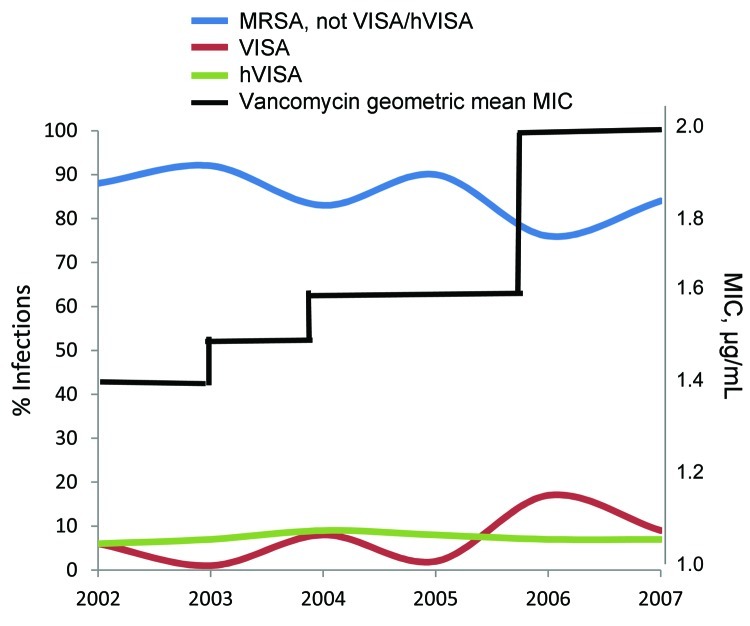
Methicillin-resistant Staphylococcus aureus (MRSA) bacteremia is often fatal. To determine predictors of risk for death, we conducted a retrospective cohort study. We examined 699 episodes of MRSA bacteremia involving 603 patients admitted to an academic medical center in New York City during 2002-2007. Data came from chart reviews, hospital databases, and recultured frozen MRSA specimens. Among the 699 episodes, 55 were caused by vancomycin-intermediate resistant S. aureus strains, 55 by heteroresistant vancomycin-intermediate S. aureus strains, and 589 by non-vancomycin-resistant strains; 190 (31.5%) patients died. We used regression risk analysis to quantify the association between clinical correlates and death. We found that older age, residence in a nursing home, severe bacteremia, and organ impairment were independently associated with increased risk for death; consultation with an infectious disease specialist was associated with lower risk for death; and MRSA strain types were not associated with risk for death.
耐甲氧西林金黄色葡萄球菌(MRSA)菌血症常常是致命的。为了确定死亡风险的预测因素,我们进行了一项回顾性队列研究。我们检查了 2002-2007 年期间在纽约市一家学术医疗中心住院的 603 名患者的 699 例 MRSA 菌血症病例。数据来自图表审查、医院数据库和重新培养的冷冻 MRSA 标本。在 699 例病例中,55 例由万古霉素中介耐药金黄色葡萄球菌菌株引起,55 例由异质性万古霉素中介耐药金黄色葡萄球菌菌株引起,589 例由非万古霉素耐药菌株引起;190 例(31.5%)患者死亡。我们使用回归风险分析来量化临床相关因素与死亡之间的关联。我们发现,年龄较大、居住在养老院、严重菌血症和器官损害与死亡风险增加独立相关;与传染病专家的咨询与较低的死亡风险相关;而 MRSA 菌株类型与死亡风险无关。