Department of Biostatistics, Gillings School of Global Public Health, University of North Carolina, Chapel Hill, NC, USA.
Caries Res. 2012;46(4):413-23. doi: 10.1159/000338992. Epub 2012 Jun 15.
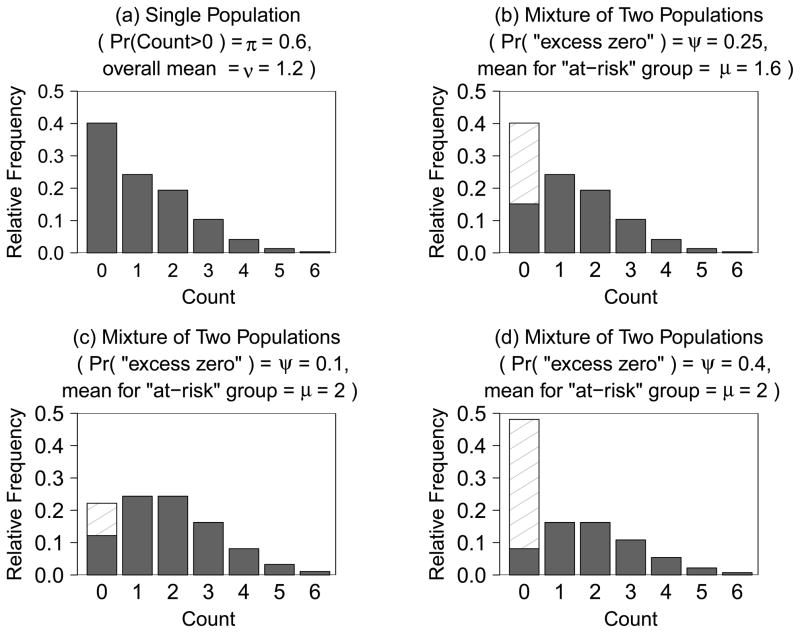
Over the past 5-10 years, zero-inflated (ZI) count regression models have been increasingly applied to the analysis of dental caries indices (e.g. DMFT, dfms). The main reason for that is linked to the broad decline in children's caries experience, such that dmf and DMF indices more frequently generate low or even zero counts. This article specifically reviews the application of ZI Poisson and ZI negative binomial regression models to dental caries, with emphasis on the description of the models and the interpretation of fitted model results given the study goals. The review finds that interpretations provided in the published caries research are often imprecise or inadvertently misleading, particularly with respect to failing to discriminate between inference for the class of susceptible persons defined by such models and inference for the sampled population in terms of overall exposure effects. Recommendations are provided to enhance the use as well as the interpretation and reporting of results of count regression models when applied to epidemiological studies of dental caries.
在过去的 5-10 年中,零膨胀(ZI)计数回归模型已越来越多地应用于龋齿指数(例如 DMFT、dfms)的分析。这主要与儿童龋齿发生率的广泛下降有关,使得 dmf 和 DMF 指数更频繁地产生低甚至零计数。本文专门回顾了 ZI 泊松和 ZI 负二项回归模型在龋齿中的应用,重点介绍了模型的描述以及根据研究目标对拟合模型结果的解释。综述发现,发表的龋齿研究中提供的解释往往不准确或无意中产生误导,特别是在未能区分此类模型定义的易感人群的推断和总体暴露效应方面的抽样人群推断。提供了建议,以增强当应用于龋齿的流行病学研究时,计数回归模型的使用以及结果的解释和报告。