Nielsen David A, Huang Wen, Hamon Sara C, Maili Lorena, Witkin Brian M, Fox Robert G, Cunningham Kathryn A, Moeller F Gerard
Menninger Department of Psychiatry and Behavioral Sciences, Baylor College of Medicine, and the Michael E. DeBakey Veterans Administration Medical Center Houston, TX, USA.
Front Psychiatry. 2012 Jun 14;3:60. doi: 10.3389/fpsyt.2012.00060. eCollection 2012.
Human cocaine abuse is associated with alterations in white matter integrity revealed upon brain imaging, an observation that is recapitulated in an animal model of continuous cocaine exposure. The mechanism through which cocaine may affect white matter is unknown and the present study tested the hypothesis that cocaine self-administration results in changes in DNA methylation that could result in altered expression of several myelin genes that could contribute to the effects of cocaine on white matter integrity.
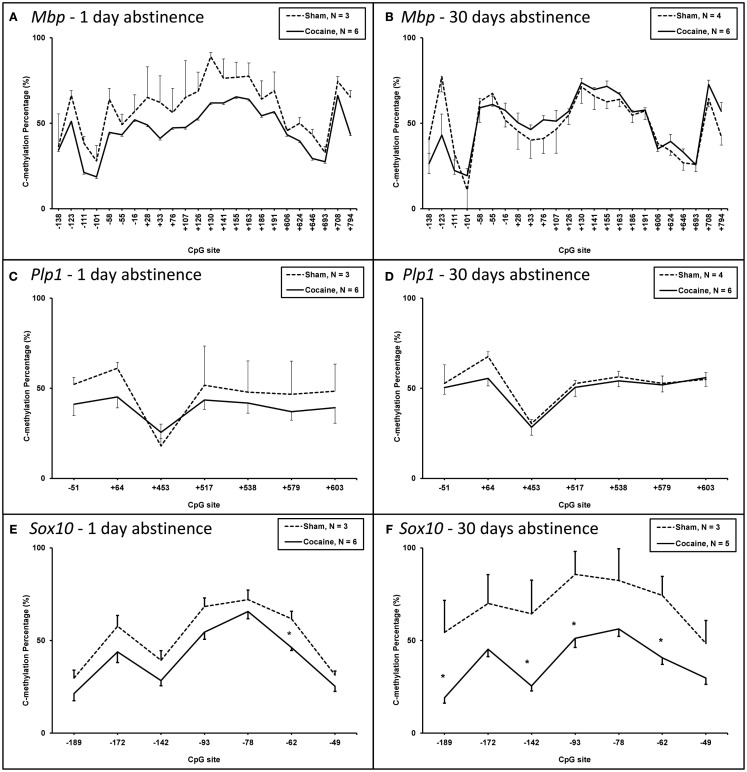
In the present study, we examined the impact of forced abstinence from cocaine self-administration on chromatin associated changes in white matter. To this end, rats were trained to self-administer cocaine (0.75 mg/kg/0.1 mL infusion) for 14 days followed by forced abstinence for 1 day (n = 6) or 30 days (n = 6) before sacrifice. Drug-free, sham surgery controls (n = 7) were paired with the experimental groups. Global DNA methylation and DNA methylation at specific CpG sites in the promoter regions ofmyelin basic protein (Mbp), proteolipid protein-1 (Plp1), and SRY-related HMG-box-10 (Sox10) genes were analyzed in DNA extracted from corpus callosum.
Significant differences in the overall methylation patterns of the Sox10 promoter region were observed in the corpus callosum of rats at 30 days of forced abstinence from cocaine self-administration relative to sham controls; the -189, -142, -93, and -62 CpG sites were significantly hypomethylated point-wise at this time point. After correction for multiple comparisons, no differences in global methylation or the methylation patterns of Mbp or Plp1 were found.
Forced abstinence from cocaine self-administration was associated with differences in DNA methylation at specific CpG sites in the promoter region of the Sox10 gene in corpus callosum. These changes may be related to reductions in normal age related changes in DNA methylation and could be a factor in white matter alterations seen after withdrawal from repeated cocaine self-administration. Further research is warranted examining the effects of cocaine on DNA methylation in white matter.
人类可卡因滥用与脑成像显示的白质完整性改变有关,这一观察结果在持续可卡因暴露的动物模型中也得到了重现。可卡因影响白质的机制尚不清楚,本研究检验了一个假设,即可卡因自我给药会导致DNA甲基化变化,进而可能导致几种髓磷脂基因表达改变,这可能是可卡因对白质完整性产生影响的原因。
在本研究中,我们研究了强制戒除可卡因自我给药对白质中染色质相关变化的影响。为此,训练大鼠自我给药可卡因(0.75毫克/千克/0.1毫升注射量)14天,然后在处死前强制戒除1天(n = 6)或30天(n = 6)。无药物的假手术对照组(n = 7)与实验组配对。分析从胼胝体提取的DNA中髓磷脂碱性蛋白(Mbp)、蛋白脂蛋白-1(Plp1)和SRY相关高迁移率族盒-10(Sox10)基因启动子区域的整体DNA甲基化和特定CpG位点的DNA甲基化情况。
与假手术对照组相比,在强制戒除可卡因自我给药30天的大鼠胼胝体中,观察到Sox10启动子区域的整体甲基化模式存在显著差异;在这个时间点,-189、-142、-93和-62 CpG位点逐点显著低甲基化。在进行多重比较校正后,未发现整体甲基化或Mbp或Plp1甲基化模式存在差异。
强制戒除可卡因自我给药与胼胝体中Sox10基因启动子区域特定CpG位点的DNA甲基化差异有关。这些变化可能与正常年龄相关的DNA甲基化变化减少有关,并且可能是反复可卡因自我给药戒断后白质改变的一个因素。有必要进一步研究可卡因对白质中DNA甲基化的影响。