
肽基精氨酸脱亚胺酶介导的组蛋白瓜氨酸化在植入前发育中的潜在作用。
Potential role for PADI-mediated histone citrullination in preimplantation development.
作者信息
Kan Rui, Jin Mei, Subramanian Venkataraman, Causey Corey P, Thompson Paul R, Coonrod Scott A
机构信息
Baker Institute for Animal Health, Cornell University, Ithaca, NY 14850, USA.
出版信息
BMC Dev Biol. 2012 Jun 19;12:19. doi: 10.1186/1471-213X-12-19.
BACKGROUND
The peptidylarginine deiminases (PADIs) convert positively charged arginine residues to neutrally charged citrulline on protein substrates in a process that is known as citrullination or deimination. Previous reports have documented roles for histone citrullination in chromatin remodeling and gene regulation in several tissue types, however, a potential role for histone citrullination in chromatin-based activities during early embryogenesis has not been investigated.
RESULTS
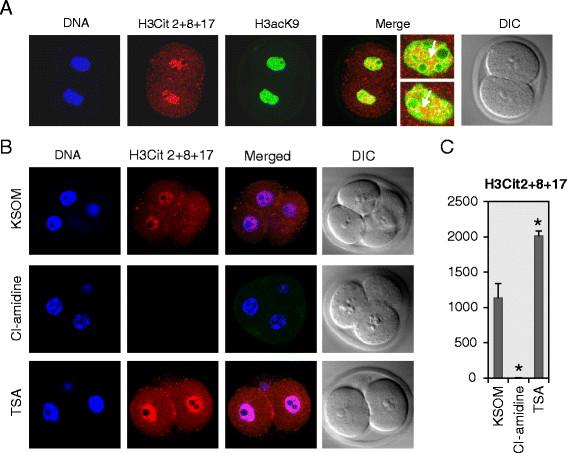
In the present study, we tested by laser scanning confocal indirect immunofluorescence microscopy whether specific arginine residues on the histone H3 and H4 N-terminal tails (H4R3, H3R2 + 8 + 17, and H3R26) were citrullinated in mouse oocytes and preimplantation embryos. Results showed that all of the tested residues were deiminated with each site showing a unique localization pattern during early development. Given these findings, we next tested whether inhibition of PADI activity using the PADI-specific inhibitor, Cl-amidine, may affect embryonic development. We found that treatment of pronuclear stage zygotes with Cl-amidine reduces both histone H3 and H4 tail citrullination and also potently blocks early cleavage divisions in vitro. Additionally, we found that the Cl-amidine treatment reduces acetylation at histone H3K9, H3K18, and H4K5 while having no apparent effect on the repressive histone H3K9 dimethylation modification. Lastly, we found that treatment of zygotes with trichostatin A (TSA) to induce hyperacetylation also resulted in an increase in histone citrullination at H3R2 + 8 + 17.
CONCLUSIONS
Given the observed effects of Cl-amidine on embryonic development and the well documented correlation between histone acetylation and transcriptional activation, our findings suggest that histone citrullination may play an important role in facilitating gene expression in early embryos by creating a chromatin environment that is permissive for histone acetylation.
背景
肽基精氨酸脱亚氨酶(PADIs)在一个被称为瓜氨酸化或脱亚氨基作用的过程中,将蛋白质底物上带正电荷的精氨酸残基转化为带中性电荷的瓜氨酸。先前的报道已证明组蛋白瓜氨酸化在几种组织类型的染色质重塑和基因调控中发挥作用,然而,组蛋白瓜氨酸化在早期胚胎发育过程中基于染色质的活动中的潜在作用尚未得到研究。
结果
在本研究中,我们通过激光扫描共聚焦间接免疫荧光显微镜检测了组蛋白H3和H4 N端尾巴上的特定精氨酸残基(H4R3、H3R2 + 8 + 17和H3R26)在小鼠卵母细胞和植入前胚胎中是否发生瓜氨酸化。结果表明,所有测试的残基均发生了脱亚氨基作用,并且每个位点在早期发育过程中都呈现出独特的定位模式。基于这些发现,我们接下来测试了使用PADI特异性抑制剂氯胺脒抑制PADI活性是否会影响胚胎发育。我们发现,用氯胺脒处理原核期受精卵会降低组蛋白H3和H4尾巴的瓜氨酸化,并且在体外也能有效阻断早期卵裂。此外,我们发现氯胺脒处理会降低组蛋白H3K9、H3K18和H4K5的乙酰化水平,而对抑制性组蛋白H3K9二甲基化修饰没有明显影响。最后,我们发现用曲古抑菌素A(TSA)处理受精卵以诱导超乙酰化也会导致H3R2 + 8 + 17处组蛋白瓜氨酸化增加。
结论
鉴于观察到氯胺脒对胚胎发育的影响以及组蛋白乙酰化与转录激活之间已充分记录的相关性,我们的研究结果表明,组蛋白瓜氨酸化可能通过创造一个有利于组蛋白乙酰化 的染色质环境,在促进早期胚胎中的基因表达方面发挥重要作用。


 Zotero 插件