Giolo Suely Ruiz, Krieger José Eduardo, Mansur Alfredo José, Pereira Alexandre Costa
Laboratory of Genetics and Molecular Cardiology, Heart Institute, University of Sao Paulo, Sao Paulo, Sao Paulo, Brazil.
PLoS One. 2012;7(6):e37392. doi: 10.1371/journal.pone.0037392. Epub 2012 Jun 8.
Several models have been designed to predict survival of patients with heart failure. These, while available and widely used for both stratifying and deciding upon different treatment options on the individual level, have several limitations. Specifically, some clinical variables that may influence prognosis may have an influence that change over time. Statistical models that include such characteristic may help in evaluating prognosis. The aim of the present study was to analyze and quantify the impact of modeling heart failure survival allowing for covariates with time-varying effects known to be independent predictors of overall mortality in this clinical setting.
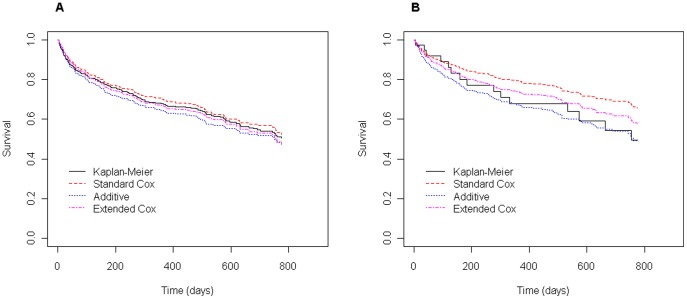
Survival data from an inception cohort of five hundred patients diagnosed with heart failure functional class III and IV between 2002 and 2004 and followed-up to 2006 were analyzed by using the proportional hazards Cox model and variations of the Cox's model and also of the Aalen's additive model.
One-hundred and eighty eight (188) patients died during follow-up. For patients under study, age, serum sodium, hemoglobin, serum creatinine, and left ventricular ejection fraction were significantly associated with mortality. Evidence of time-varying effect was suggested for the last three. Both high hemoglobin and high LV ejection fraction were associated with a reduced risk of dying with a stronger initial effect. High creatinine, associated with an increased risk of dying, also presented an initial stronger effect. The impact of age and sodium were constant over time.
The current study points to the importance of evaluating covariates with time-varying effects in heart failure models. The analysis performed suggests that variations of Cox and Aalen models constitute a valuable tool for identifying these variables. The implementation of covariates with time-varying effects into heart failure prognostication models may reduce bias and increase the specificity of such models.
已经设计了几种模型来预测心力衰竭患者的生存率。这些模型虽然可用且广泛用于个体层面的分层和决定不同的治疗方案,但存在一些局限性。具体而言,一些可能影响预后的临床变量的影响可能会随时间变化。包含此类特征的统计模型可能有助于评估预后。本研究的目的是分析和量化在考虑已知为该临床环境中总体死亡率独立预测因素的具有时间变化效应的协变量的情况下,对心力衰竭生存率进行建模的影响。
使用比例风险Cox模型以及Cox模型和Aalen加法模型的变体,对2002年至2004年期间诊断为心力衰竭功能分级III级和IV级并随访至2006年的500例患者的起始队列的生存数据进行分析。
188例患者在随访期间死亡。对于研究中的患者,年龄、血清钠、血红蛋白、血清肌酐和左心室射血分数与死亡率显著相关。后三者显示出时间变化效应的证据。高血红蛋白和高左心室射血分数均与死亡风险降低相关,且初始效应更强。高肌酐与死亡风险增加相关,也呈现出更强的初始效应。年龄和钠的影响随时间恒定。
当前研究指出了在心力衰竭模型中评估具有时间变化效应的协变量的重要性。所进行的分析表明,Cox模型和Aalen模型的变体是识别这些变量的有价值工具。将具有时间变化效应的协变量纳入心力衰竭预后模型可能会减少偏差并提高此类模型的特异性。