Sheehy Ann M, Erthal Julie
Department of Biology, College of the Holy Cross, Worcester, MA 01610, USA.
Mol Biol Int. 2012;2012:974924. doi: 10.1155/2012/974924. Epub 2012 Jun 6.
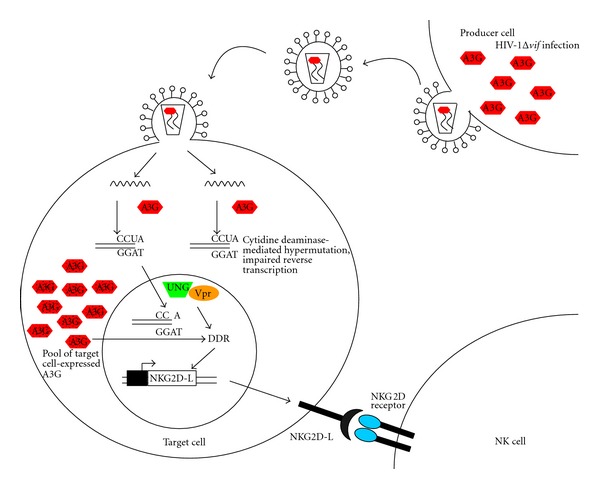
Since the identification of APOBEC3G (A3G) as a potent restriction factor of HIV-1, a tremendous amount of effort has led to a broadened understanding of both A3G and the APOBEC3 (A3) family to which it belongs. In spite of the fine-tuned viral counterattack to A3 activity, in the form of the HIV-1 Vif protein, enthusiasm for leveraging the Vif : A3G axis as a point of clinical intervention remains high. In an impressive explosion of information over the last decade, additional A3 family members have been identified as antiviral proteins, mechanistic details of the restrictive capacity of these proteins have been elucidated, structure-function studies have revealed important molecular details of the Vif : A3G interaction, and clinical cohorts have been scrutinized for correlations between A3 expression and function and viral pathogenesis. In the last year, novel and unexpected findings regarding the role of A3G in immunity have refocused efforts on exploring the potential of harnessing the natural power of this immune defense. These most recent reports allude to functions of the A3 proteins that extend beyond their well-characterized designation as restriction factors. The emerging story implicates the A3 family as not only defense proteins, but also as participants in the broader innate immune response.
自APOBEC3G(A3G)被鉴定为HIV-1的一种强效限制因子以来,大量的研究工作使得人们对A3G及其所属的APOBEC3(A3)家族有了更广泛的了解。尽管HIV-1通过Vif蛋白对A3活性进行了精细的病毒反击,但利用Vif:A3G轴作为临床干预靶点的热情依然高涨。在过去十年中,大量信息涌现,更多的A3家族成员被鉴定为抗病毒蛋白,这些蛋白限制能力的机制细节得到阐明,结构-功能研究揭示了Vif:A3G相互作用的重要分子细节,临床队列也被仔细研究以探寻A3表达与功能以及病毒发病机制之间的相关性。去年,关于A3G在免疫中的作用的新颖且意外的发现,使人们重新聚焦于探索利用这种免疫防御的自然力量的潜力。这些最新报告暗示了A3蛋白的功能超出了其作为限制因子的明确特征。新出现的情况表明,A3家族不仅是防御蛋白,也是更广泛的先天免疫反应的参与者。