Viral Mutation Section, HIV Dynamics and Replication Program, National Cancer Institute at Frederick, Frederick, MD 21702, USA.
Viruses. 2020 May 27;12(6):587. doi: 10.3390/v12060587.
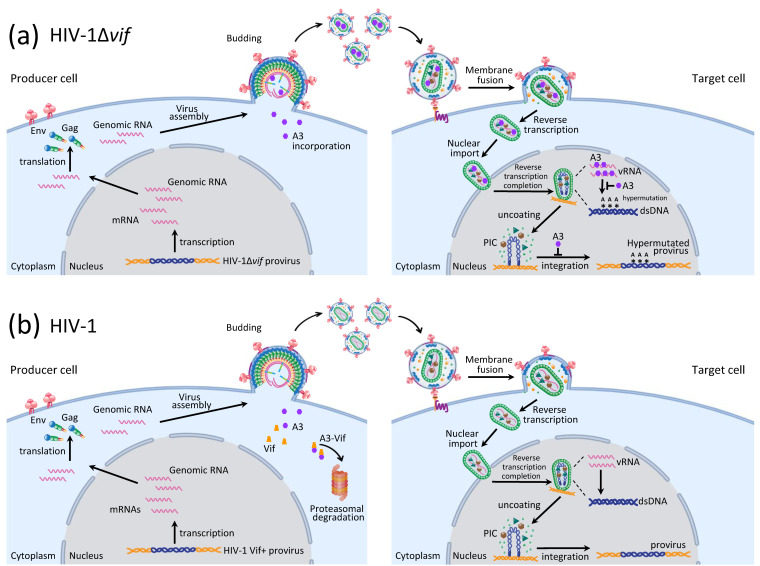
Mammals have developed clever adaptive and innate immune defense mechanisms to protect against invading bacterial and viral pathogens. Human innate immunity is continuously evolving to expand the repertoire of restriction factors and one such family of intrinsic restriction factors is the APOBEC3 (A3) family of cytidine deaminases. The coordinated expression of seven members of the A3 family of cytidine deaminases provides intrinsic immunity against numerous foreign infectious agents and protects the host from exogenous retroviruses and endogenous retroelements. Four members of the A3 proteins-A3G, A3F, A3H, and A3D-restrict HIV-1 in the absence of virion infectivity factor (Vif); their incorporation into progeny virions is a prerequisite for cytidine deaminase-dependent and -independent activities that inhibit viral replication in the host target cell. HIV-1 encodes Vif, an accessory protein that antagonizes A3 proteins by targeting them for polyubiquitination and subsequent proteasomal degradation in the virus producing cells. In this review, we summarize our current understanding of the role of human A3 proteins as barriers against HIV-1 infection, how Vif overcomes their antiviral activity, and highlight recent structural and functional insights into A3-mediated restriction of lentiviruses.
哺乳动物已经发展出了聪明的适应性和先天免疫防御机制,以抵御入侵的细菌和病毒病原体。人类的先天免疫在不断进化,以扩大限制因子的 repertoire,其中一类内在限制因子是 APOBEC3(A3)家族的胞嘧啶脱氨酶。A3 家族的七个成员的协调表达为机体提供了针对多种外来传染性病原体的固有免疫力,并保护宿主免受外源性逆转录病毒和内源性逆转录元件的侵害。A3 蛋白的四个成员(A3G、A3F、A3H 和 A3D)在没有病毒感染力因子(Vif)的情况下限制 HIV-1;它们被整合到子代病毒中是依赖于胞嘧啶脱氨酶和非依赖于胞嘧啶脱氨酶的活性所必需的,这些活性可以抑制宿主靶细胞中的病毒复制。HIV-1 编码 Vif,这是一种辅助蛋白,通过将 A3 蛋白靶向多泛素化和随后的病毒产生细胞中的蛋白酶体降解来拮抗 A3 蛋白。在这篇综述中,我们总结了我们目前对人类 A3 蛋白作为 HIV-1 感染屏障的作用、Vif 如何克服其抗病毒活性的理解,并强调了最近关于 A3 介导的慢病毒限制的结构和功能见解。