Advanced Science Research Laboratories, Pharmaceutical Research Division, Takeda Pharmaceutical Company Limited, Fujisawa, Kanagawa, Japan.
Islets. 2012 May-Jun;4(3):249-52. doi: 10.4161/isl.20856. Epub 2012 May 1.
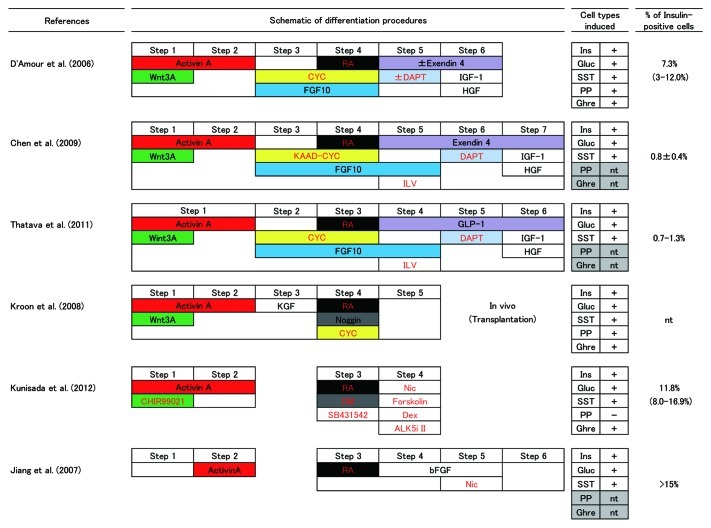
Human induced pluripotent stem (iPS) cells obtained from patients are expected to be a useful source for cell transplantation therapy, because many patients (including those with type 1 diabetes and severe type 2 diabetes) are on waiting lists for transplantation for a long time due to the shortage of donors. At present, many concerns related to clinical application of human iPS cells have been raised, but rapid development of methods for the establishment, culture, and standardization of iPS cells will lead autologous cell therapy to be realistic sooner or later. However, establishment of a method for preparing some of desired cell types is still challenging. Regarding pancreatic β-cells, there have been many reports about differentiation of these cells from human embryonic stem (ES)/iPS cells, but a protocol for clinical application has still not been established. Since there is clear proof that cell transplantation therapy is effective for diabetes based on the results of clinical islet transplantation, pancreatic β-cells prepared from human iPS cells are considered likely to be effective for reducing the burden on patients. In this article, the current status of procedures for preparing pancreatic β-cells from human ES/iPS cells, including effective use of small molecules, is summarized, and some of the problems that still need to be overcome are discussed.
从患者中获得的人类诱导多能干细胞(iPS 细胞)有望成为细胞移植治疗的有用来源,因为许多患者(包括 1 型糖尿病和严重 2 型糖尿病患者)由于供体短缺,长期等待移植。目前,已经提出了许多与人类 iPS 细胞临床应用相关的担忧,但 iPS 细胞的建立、培养和标准化方法的快速发展迟早会使自体细胞治疗成为现实。然而,建立一种制备某些所需细胞类型的方法仍然具有挑战性。关于胰腺β细胞,已经有很多关于从人胚胎干细胞(ES)/iPS 细胞中分化这些细胞的报道,但尚未建立临床应用的方案。由于基于临床胰岛移植的结果证明细胞移植治疗对糖尿病有效,因此,用人 iPS 细胞制备的胰腺β细胞被认为可能有效减轻患者的负担。本文总结了从人 ES/iPS 细胞制备胰腺β细胞的目前程序,包括小分子的有效利用,并讨论了仍需克服的一些问题。