Centre for Chromosome Biology, School of Natural Sciences, National University of Ireland, Galway, Ireland.
Epigenetics. 2012 Aug;7(8):806-10. doi: 10.4161/epi.20922. Epub 2012 Jun 22.
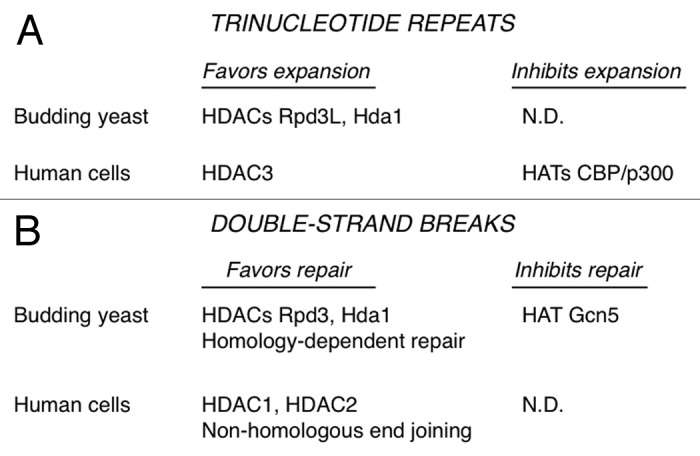
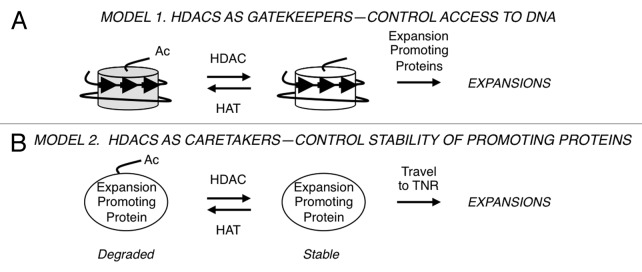
Histone deacetylase complexes (HDACs) are powerful regulators of the epigenome. It is now clear that a subset of HDACs also regulate the stability of the genome itself, but not primarily through transcription. Instead, these key HDACs control genome stability more directly by stabilizing enzymes important for DNA mutagenesis and repair, or by modifying histones at sites of DNA damage. Surprisingly, certain HDACs in budding yeast and human cells accelerate the pace of genetic expansions in trinucleotide repeats, the type of mutation that causes Huntington disease. In other words, HDACs promote mutagenesis in some settings. At double-strand breaks, however, the same HDACs in budding yeast help stabilize the genome by facilitating homology-dependent repair. Double-strand breaks can also be repaired without the requirement for homology, and two specific human HDACs are now known to promote this event. These new findings highlight certain HDACs as caretakers of genome stability, and also underscore the potential medical complexities in using HDAC inhibitors for treatment of disease.
组蛋白去乙酰化酶复合物(HDACs)是表观基因组的强大调节剂。现在已经清楚的是,HDACs 的一个亚类也调节基因组本身的稳定性,但不是主要通过转录。相反,这些关键的 HDACs 通过稳定对 DNA 突变和修复很重要的酶,或者通过在 DNA 损伤部位修饰组蛋白,更直接地控制基因组稳定性。令人惊讶的是,芽殖酵母和人类细胞中的某些 HDAC 会加速三核苷酸重复的遗传扩展,这是导致亨廷顿病的突变类型。换句话说,在某些情况下,HDAC 会促进突变。然而,在双链断裂处,芽殖酵母中的相同 HDACs 通过促进同源依赖性修复来帮助稳定基因组。双链断裂也可以在不需要同源性的情况下修复,现在已知两种特定的人类 HDAC 可以促进这一事件。这些新发现强调了某些 HDAC 作为基因组稳定性的守护者,也强调了使用 HDAC 抑制剂治疗疾病的潜在医学复杂性。