Department of Medicine, University of California, San Francisco, California, United States of America.
PLoS Med. 2012;9(6):e1001244. doi: 10.1371/journal.pmed.1001244. Epub 2012 Jun 19.
Private sector healthcare delivery in low- and middle-income countries is sometimes argued to be more efficient, accountable, and sustainable than public sector delivery. Conversely, the public sector is often regarded as providing more equitable and evidence-based care. We performed a systematic review of research studies investigating the performance of private and public sector delivery in low- and middle-income countries.
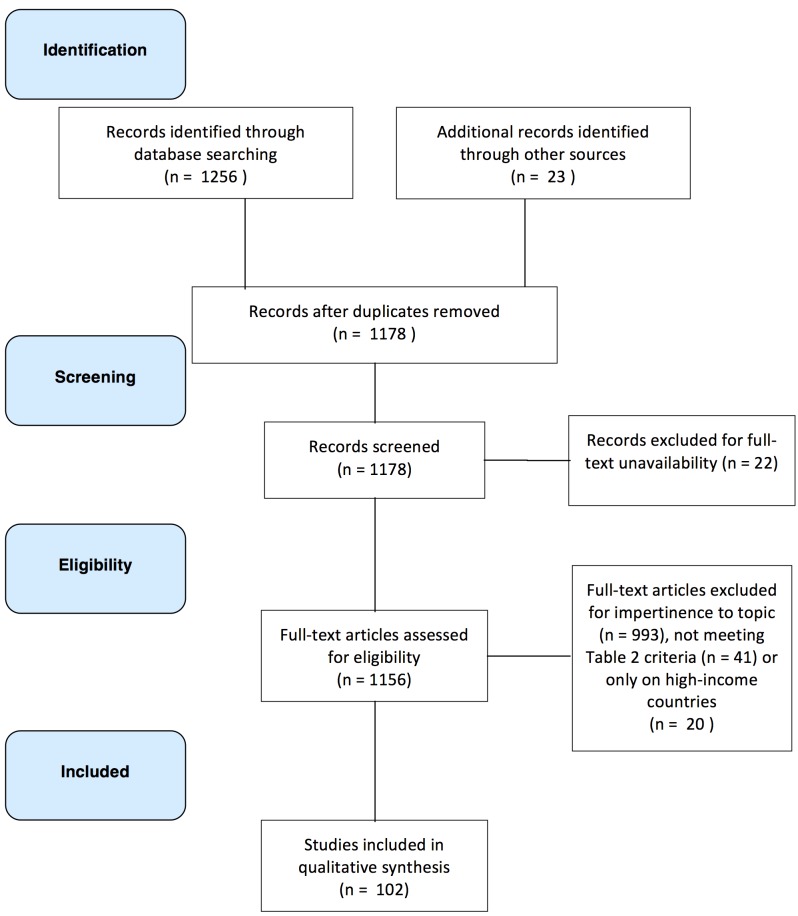
Peer-reviewed studies including case studies, meta-analyses, reviews, and case-control analyses, as well as reports published by non-governmental organizations and international agencies, were systematically collected through large database searches, filtered through methodological inclusion criteria, and organized into six World Health Organization health system themes: accessibility and responsiveness; quality; outcomes; accountability, transparency, and regulation; fairness and equity; and efficiency. Of 1,178 potentially relevant unique citations, data were obtained from 102 articles describing studies conducted in low- and middle-income countries. Comparative cohort and cross-sectional studies suggested that providers in the private sector more frequently violated medical standards of practice and had poorer patient outcomes, but had greater reported timeliness and hospitality to patients. Reported efficiency tended to be lower in the private than in the public sector, resulting in part from perverse incentives for unnecessary testing and treatment. Public sector services experienced more limited availability of equipment, medications, and trained healthcare workers. When the definition of "private sector" included unlicensed and uncertified providers such as drug shop owners, most patients appeared to access care in the private sector; however, when unlicensed healthcare providers were excluded from the analysis, the majority of people accessed public sector care. "Competitive dynamics" for funding appeared between the two sectors, such that public funds and personnel were redirected to private sector development, followed by reductions in public sector service budgets and staff.
Studies evaluated in this systematic review do not support the claim that the private sector is usually more efficient, accountable, or medically effective than the public sector; however, the public sector appears frequently to lack timeliness and hospitality towards patients.
在中低收入国家,私营部门提供医疗服务有时被认为比公共部门更有效率、更负责任和更可持续。相反,公共部门通常被认为提供更公平和基于证据的护理。我们对调查中低收入国家私营和公共部门提供服务的表现的研究进行了系统回顾。
通过大型数据库搜索系统地收集了同行评议的研究,包括案例研究、荟萃分析、综述和病例对照分析,以及非政府组织和国际机构发布的报告,通过方法学纳入标准进行筛选,并组织成六个世界卫生组织卫生系统主题:可及性和响应性;质量;结果;问责制、透明度和监管;公平和公平;以及效率。在 1178 篇可能相关的独特引用文献中,有 102 篇文章的数据来自于在中低收入国家进行的研究,这些文章描述了研究。比较队列和横断面研究表明,私营部门的提供者更频繁地违反医疗实践标准,患者的结果更差,但对患者的及时性和热情更高。报告的效率往往低于私营部门,部分原因是不必要的检测和治疗的不当激励。公共部门服务的设备、药物和经过培训的医疗工作者的供应更有限。当“私营部门”的定义包括无证和未经认证的提供者,如药店老板时,大多数患者似乎在私营部门接受护理;然而,当无证医疗提供者不包括在分析中时,大多数人则在公共部门接受护理。公共部门和私营部门之间似乎存在资金的“竞争动态”,公共资金和人员被重新引导到私营部门的发展,随后公共部门服务预算和人员减少。
本系统评价中评估的研究并不支持私营部门通常比公共部门更有效率、更负责任或更具医学效果的说法;然而,公共部门似乎经常缺乏对患者的及时性和热情。