University of Vermont, Burlington, VT, USA.
BMC Pediatr. 2012 Jun 22;12:84. doi: 10.1186/1471-2431-12-84.
In 2006, the Vermont Oxford Network (VON) established the Neonatal Encephalopathy Registry (NER) to characterize infants born with neonatal encephalopathy, describe evaluations and medical treatments, monitor hypothermic therapy (HT) dissemination, define clinical research questions, and identify opportunities for improved care.
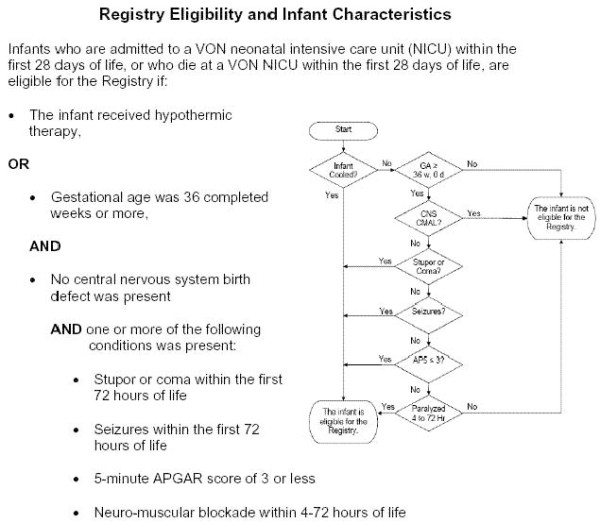
Eligible infants were ≥ 36 weeks with seizures, altered consciousness (stupor, coma) during the first 72 hours of life, a 5 minute Apgar score of ≤ 3, or receiving HT. Infants with central nervous system birth defects were excluded.
From 2006-2010, 95 centers registered 4232 infants. Of those, 59% suffered a seizure, 50% had a 5 minute Apgar score of ≤ 3, 38% received HT, and 18% had stupor/coma documented on neurologic exam. Some infants experienced more than one eligibility criterion. Only 53% had a cord gas obtained and only 63% had a blood gas obtained within 24 hours of birth, important components for determining HT eligibility. Sixty-four percent received ventilator support, 65% received anticonvulsants, 66% had a head MRI, 23% had a cranial CT, 67% had a full channel encephalogram (EEG) and 33% amplitude integrated EEG. Of all infants, 87% survived.
The VON NER describes the heterogeneous population of infants with NE, the subset that received HT, their patterns of care, and outcomes. The optimal routine care of infants with neonatal encephalopathy is unknown. The registry method is well suited to identify opportunities for improvement in the care of infants affected by NE and study interventions such as HT as they are implemented in clinical practice.
2006 年,佛蒙特州牛津网络(Vermont Oxford Network,VON)成立了新生儿脑病注册(Neonatal Encephalopathy Registry,NER),以描述患有新生儿脑病的婴儿的特征,描述评估和医疗治疗,监测低温治疗(Hypothermia therapy,HT)的传播,定义临床研究问题,并确定改善护理的机会。
合格的婴儿需满足胎龄≥36 周、出生后 72 小时内有癫痫发作、意识改变(昏迷、昏迷)、出生时 5 分钟 Apgar 评分≤3 分或接受 HT。中枢神经系统出生缺陷的婴儿被排除在外。
2006 年至 2010 年,95 个中心登记了 4232 名婴儿。其中,59%有癫痫发作,50%出生时 5 分钟 Apgar 评分≤3,38%接受 HT,18%在神经检查中记录有昏迷/昏迷。一些婴儿符合多项入选标准。只有 53%获得了脐带血气,只有 63%在出生后 24 小时内获得了血气,这是确定 HT 适应证的重要组成部分。64%接受了呼吸机支持,65%接受了抗惊厥药物治疗,66%进行了头部 MRI,23%进行了头颅 CT,67%进行了全通道脑电图(EEG),33%进行了振幅整合脑电图(aEEG)。所有婴儿中,87%存活。
VON NER 描述了患有 NE 的婴儿的异质性人群、接受 HT 的亚组、他们的护理模式和结局。新生儿脑病患儿的最佳常规治疗方法尚不清楚。该注册方法非常适合识别改善 NE 患儿护理的机会,并研究 HT 等干预措施,因为它们在临床实践中的实施情况。