Division of Gastroenterology, The University of Southern California, Los Angeles, CA, USA.
Dig Dis Sci. 2012 Dec;57(12):3092-7. doi: 10.1007/s10620-012-2275-4. Epub 2012 Jun 24.
Rapid onsite evaluation (ROSE) has been demonstrated to correlate with final cytologic interpretations and improves the diagnostic yield of endoscopic ultrasound (EUS)-fine needle aspiration (FNA); however, its availability is variable across centers. The aim of this prospective study was to evaluate whether remote telecytology can substitute for ROSE.
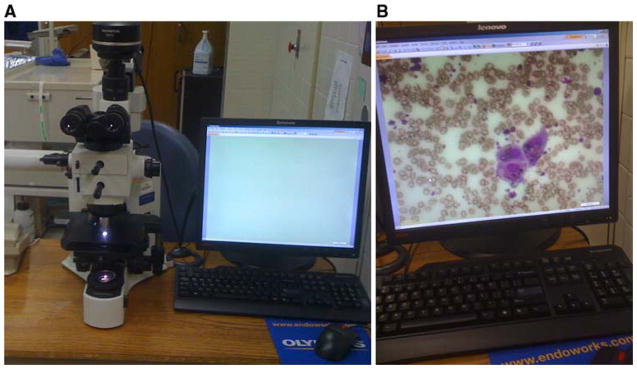
Consecutive patients who underwent EUS-FNA for diverse indications at a high volume referral center were enrolled and all samples were prospectively evaluated by three methods. ROSE was performed by a cytopathologist in the procedure room; simultaneously dynamic telecytology was done by a different cytopathologist in a remote location at our institution. The third method, final cytologic interpretation in the laboratory, was the gold standard. Telecytology was performed using an Olympus microscope system (BX) which broadcasts live images over the Internet. Accuracy of telecytology and agreement with other methods were the principle outcome measurements.
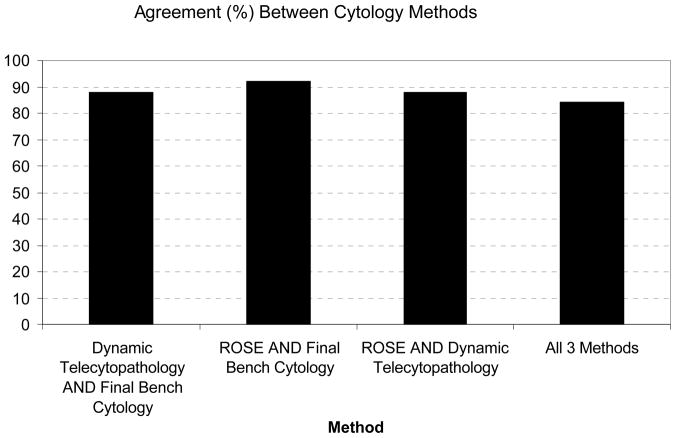
Twenty-five consecutive samples were obtained from participants 40-87 years old (median age 63, 48 % male). There was 88 % agreement between telecytology and final cytology (p < 0.001) and 92 % agreement between ROSE and final cytology (p < 0.001). There was consistency between telecytology and ROSE (p value for McNemar's χ(2) = 1.0). Cohen's kappa for agreement for telecytology and ROSE was 0.80 (SE = 0.11), confirming favorable correlation.
Dynamic telecytology compares favorably to ROSE in the assessment of EUS acquired fine needle aspirates. If confirmed by larger trials, this system might obviate the need for onsite interpretation of EUS-FNA specimens.
快速现场评估(ROSE)已被证明与最终细胞学解释相关,并提高了内镜超声(EUS)-细针抽吸(FNA)的诊断产量;然而,其可用性因中心而异。本前瞻性研究旨在评估远程远程细胞学是否可以替代 ROSE。
在一个高容量转诊中心,连续纳入因各种适应症接受 EUS-FNA 的患者,所有样本均通过三种方法进行前瞻性评估。在手术室内由细胞病理学家进行 ROSE;同时,由我们机构远程的另一位细胞病理学家进行动态远程细胞学检查。第三种方法是实验室中的最终细胞学解释,作为金标准。远程细胞学检查使用 Olympus 显微镜系统(BX)进行,该系统通过互联网实时转播图像。远程细胞学的准确性和与其他方法的一致性是主要的结果测量。
从 40-87 岁的参与者中获得了 25 个连续样本(中位年龄 63 岁,48%为男性)。远程细胞学与最终细胞学之间有 88%的一致性(p < 0.001),ROSE 与最终细胞学之间有 92%的一致性(p < 0.001)。远程细胞学与 ROSE 之间存在一致性(McNemar χ(2)检验的 p 值为 1.0)。远程细胞学和 ROSE 之间的 Cohen's kappa 为 0.80(SE = 0.11),证实了良好的相关性。
在评估 EUS 获得的细针抽吸物时,动态远程细胞学与 ROSE 相比具有优势。如果更大规模的试验得到证实,该系统可能会避免对 EUS-FNA 标本进行现场解释的需要。