Department of Neurology, Northwestern University, Chicago, IL 60611, USA.
J Neural Eng. 2012 Aug;9(4):046006. doi: 10.1088/1741-2560/9/4/046006. Epub 2012 Jun 25.
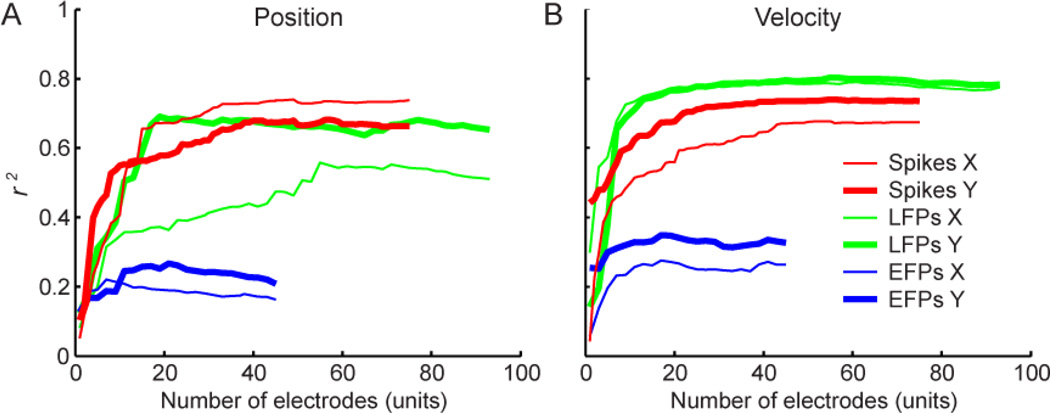
The recent explosion of interest in brain-machine interfaces (BMIs) has spurred research into choosing the optimal input signal source for a desired application. The signals with highest bandwidth--single neuron action potentials or spikes--typically are difficult to record for more than a few years after implantation of intracortical electrodes. Fortunately, field potentials recorded within the cortex (local field potentials, LFPs), at its surface (electrocorticograms, ECoG) and at the dural surface (epidural, EFPs) have also been shown to contain significant information about movement. However, the relative performance of these signals has not yet been directly compared. Furthermore, while it is widely postulated, it has not yet been demonstrated that these field potential signals are more durable than spike recordings. The aim of this study was to address both of these questions. We assessed the offline decoding performance of EFPs, LFPs and spikes, recorded sequentially, in primary motor cortex (M1) in terms of their ability to decode the target of reaching movements, as well as the endpoint trajectory. We also examined the decoding performance of LFPs on electrodes that are not recording spikes, compared with the performance when they did record spikes. Spikes were still present on some of the other electrodes throughout this study. We showed that LFPs performed nearly as well as spikes in decoding velocity, and slightly worse in decoding position and in target classification. EFP performance was slightly inferior to that reported for ECoG in humans. We also provided evidence demonstrating that movement-related information in the LFP remains high regardless of the ability to record spikes concurrently on the same electrodes. This is the first study to provide evidence that LFPs retain information about movement in the absence of spikes on the same electrodes. These results suggest that LFPs may indeed remain informative after spike recordings are lost, thereby providing a robust, accurate signal source for BMIs.
近年来,脑机接口(BMI)的研究兴趣迅速增长,这促使研究人员开始选择最适合特定应用的最优输入信号源。在皮层内电极植入后,带宽最高的信号——单个神经元动作电位或尖峰——通常很难记录超过几年。幸运的是,在皮层内记录的场电位(局部场电位,LFPs)、皮层表面(脑电图,ECoG)和硬脑膜表面(硬膜下,EFPs)也被证明包含有关运动的重要信息。然而,这些信号的相对性能尚未直接比较。此外,尽管人们广泛推测,但尚未证明这些场电位信号比尖峰记录更持久。本研究旨在解决这两个问题。我们评估了原发性运动皮层(M1)中依次记录的 EFPs、LFPs 和尖峰的离线解码性能,以评估它们解码目标运动的能力,以及端点轨迹。我们还检查了在不记录尖峰的电极上 LFPs 的解码性能,与记录尖峰时的性能进行了比较。在整个研究过程中,一些其他电极上仍然存在尖峰。我们表明,LFPs 在解码速度方面的表现几乎与尖峰一样好,而在解码位置和目标分类方面的表现略差。EFP 的性能略低于人类 ECoG 的报告结果。我们还提供了证据证明,无论是否能够同时在同一电极上记录尖峰,LFP 中的运动相关信息仍然很高。这是第一项提供证据表明在同一电极上失去尖峰后 LFPs 仍保留运动信息的研究。这些结果表明,LFPs 在失去尖峰记录后可能仍然具有信息性,从而为 BMI 提供了一种稳健、准确的信号源。