Children's Hospital Informatics Program at Harvard-MIT Health Sciences and Technology, Children's Hospital Boston, Boston, MA 02115, USA.
J Am Med Inform Assoc. 2013 Jan 1;20(1):172-9. doi: 10.1136/amiajnl-2012-001042. Epub 2012 Jun 25.
Registries are a well-established mechanism for obtaining high quality, disease-specific data, but are often highly project-specific in their design, implementation, and policies for data use. In contrast to the conventional model of centralized data contribution, warehousing, and control, we design a self-scaling registry technology for collaborative data sharing, based upon the widely adopted Integrating Biology & the Bedside (i2b2) data warehousing framework and the Shared Health Research Information Network (SHRINE) peer-to-peer networking software.
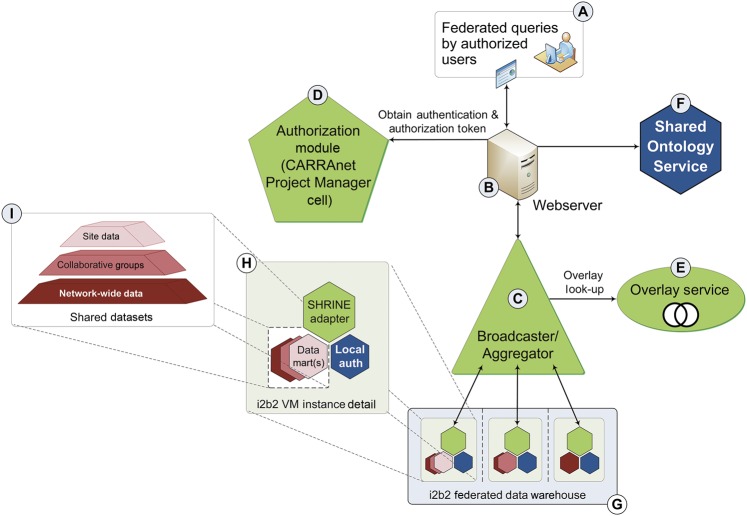
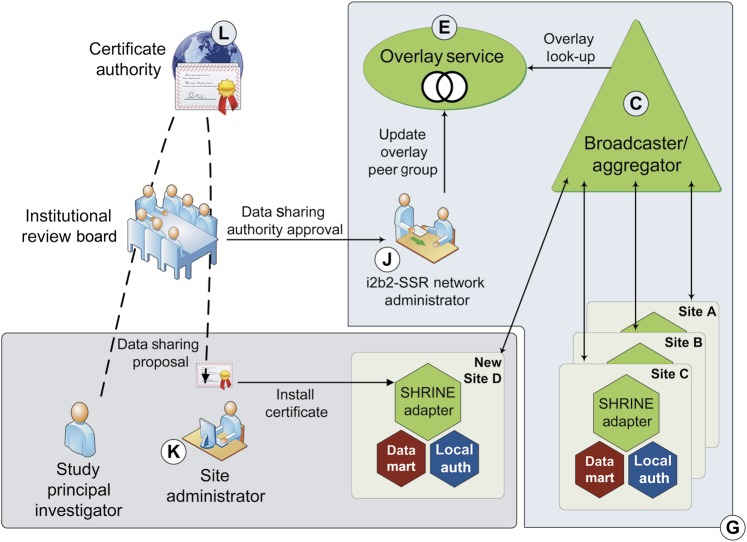
Focusing our design around creation of a scalable solution for collaboration within multi-site disease registries, we leverage the i2b2 and SHRINE open source software to create a modular, ontology-based, federated infrastructure that provides research investigators full ownership and access to their contributed data while supporting permissioned yet robust data sharing. We accomplish these objectives via web services supporting peer-group overlays, group-aware data aggregation, and administrative functions.
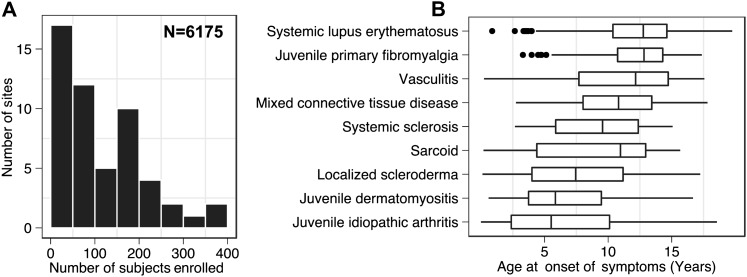
The 56-site Childhood Arthritis & Rheumatology Research Alliance (CARRA) Registry and 3-site Harvard Inflammatory Bowel Diseases Longitudinal Data Repository now utilize i2b2 self-scaling registry technology (i2b2-SSR). This platform, extensible to federation of multiple projects within and between research networks, encompasses >6000 subjects at sites throughout the USA.
We utilize the i2b2-SSR platform to minimize technical barriers to collaboration while enabling fine-grained control over data sharing.
The implementation of i2b2-SSR for the multi-site, multi-stakeholder CARRA Registry has established a digital infrastructure for community-driven research data sharing in pediatric rheumatology in the USA. We envision i2b2-SSR as a scalable, reusable solution facilitating interdisciplinary research across diseases.
注册是获取高质量、特定于疾病的数据的成熟机制,但在设计、实施和数据使用政策方面通常具有高度的项目特定性。与集中数据贡献、仓储和控制的传统模式相比,我们基于广泛采用的整合生物学和床边 (i2b2) 数据仓库框架和共享健康研究信息网络 (SHRINE) 对等网络软件,为协作数据共享设计了一种自扩展的注册技术。
我们专注于围绕创建多站点疾病注册中心内协作的可扩展解决方案进行设计,利用 i2b2 和 SHRINE 开源软件创建一个模块化、基于本体的联邦基础架构,为研究人员提供对其贡献数据的完全所有权和访问权限,同时支持许可但强大的数据共享。我们通过支持对等组覆盖、组感知数据聚合和管理功能的 Web 服务来实现这些目标。
现在,56 个站点的儿童关节炎和风湿病研究联盟 (CARRA) 注册中心和 3 个站点的哈佛炎症性肠病纵向数据存储库都利用了 i2b2 自扩展注册技术 (i2b2-SSR)。该平台可扩展到研究网络内和之间的多个项目联合,在美国各地的站点涵盖了>6000 名受试者。
我们利用 i2b2-SSR 平台来最小化协作的技术障碍,同时实现对数据共享的细粒度控制。
为多站点、多利益相关者的 CARRA 注册中心实施 i2b2-SSR 在美国建立了一个用于儿科风湿病社区驱动研究数据共享的数字基础设施。我们设想 i2b2-SSR 是一种可扩展、可重复使用的解决方案,可促进跨疾病的跨学科研究。