Hiroi1 Noriko, Klann Michael, Iba Keisuke, Heras Ciechomski Pablo de, Yamashita Shuji, Tabira Akito, Okuhara Takahiro, Kubojima Takeshi, Okada Yasunori, Oka Kotaro, Mange Robin, Unger Michael, Funahashi Akira, Koeppl Heinz
Department of BioSciences and Informatics, Keio University, Yokohama, Kanagawa, Japan.
EURASIP J Bioinform Syst Biol. 2012 Jun 26;2012(1):7. doi: 10.1186/1687-4153-2012-7.
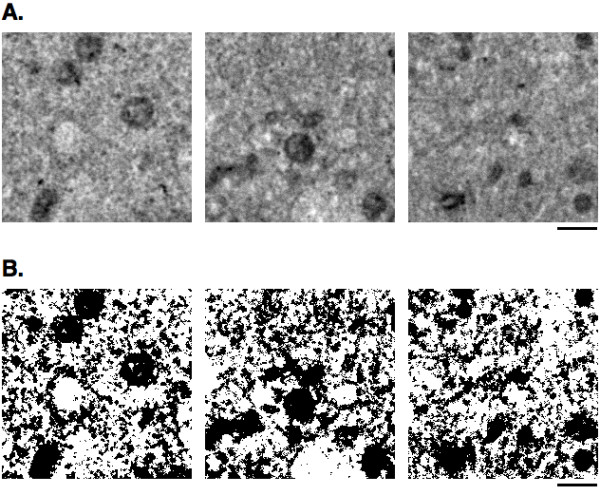
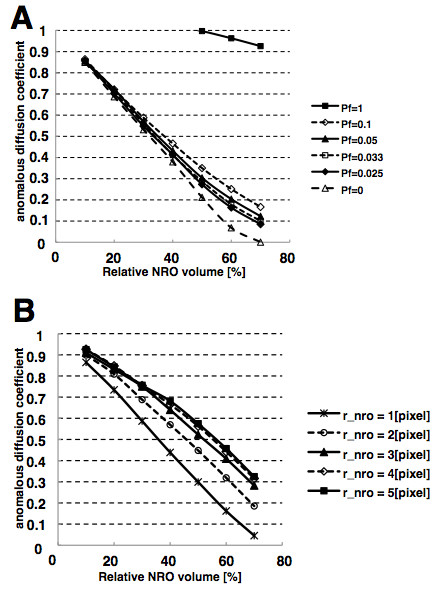
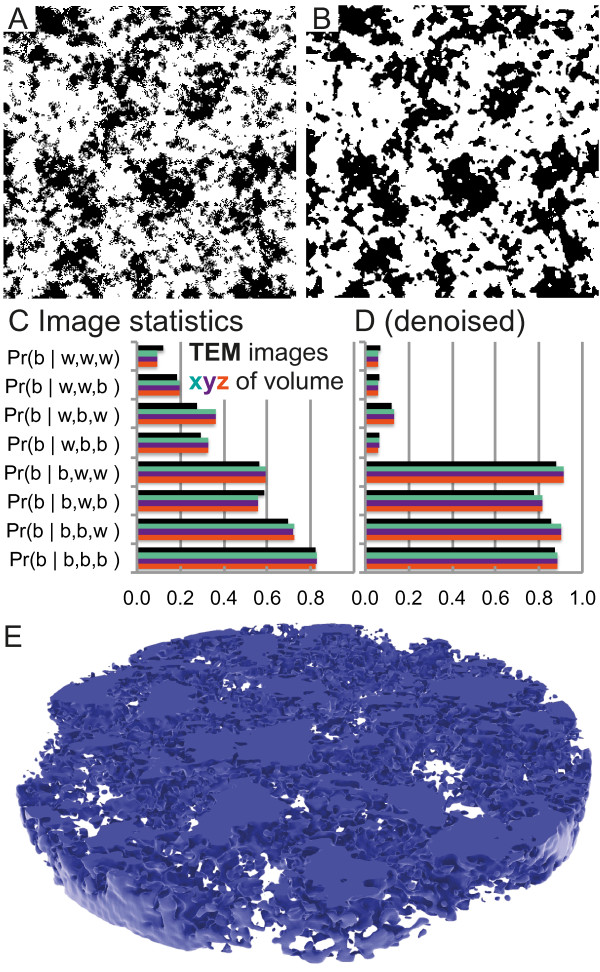
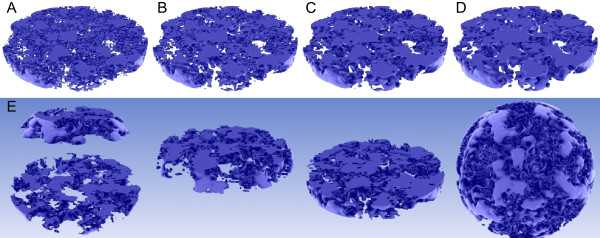
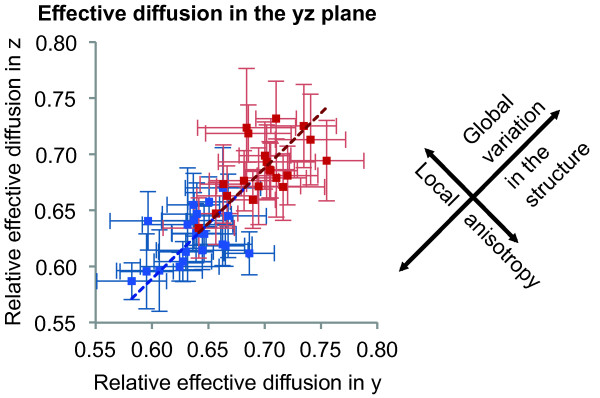
: In our previous study, we introduced a combination methodology of Fluorescence Correlation Spectroscopy (FCS) and Transmission Electron Microscopy (TEM), which is powerful to investigate the effect of intracellular environment to biochemical reaction processes. Now, we developed a reconstruction method of realistic simulation spaces based on our TEM images. Interactive raytracing visualization of this space allows the perception of the overall 3D structure, which is not directly accessible from 2D TEM images. Simulation results show that the diffusion in such generated structures strongly depends on image post-processing. Frayed structures corresponding to noisy images hinder the diffusion much stronger than smooth surfaces from denoised images. This means that the correct identification of noise or structure is significant to reconstruct appropriate reaction environment in silico in order to estimate realistic behaviors of reactants in vivo. Static structures lead to anomalous diffusion due to the partial confinement. In contrast, mobile crowding agents do not lead to anomalous diffusion at moderate crowding levels. By varying the mobility of these non-reactive obstacles (NRO), we estimated the relationship between NRO diffusion coefficient (Dnro) and the anomaly in the tracer diffusion (α). For Dnro=21.96 to 44.49 μm2/s, the simulation results match the anomaly obtained from FCS measurements. This range of the diffusion coefficient from simulations is compatible with the range of the diffusion coefficient of structural proteins in the cytoplasm. In addition, we investigated the relationship between the radius of NRO and anomalous diffusion coefficient of tracers by the comparison between different simulations. The radius of NRO has to be 58 nm when the polymer moves with the same diffusion speed as a reactant, which is close to the radius of functional protein complexes in a cell.
在我们之前的研究中,我们引入了荧光相关光谱(FCS)和透射电子显微镜(TEM)的组合方法,该方法对于研究细胞内环境对生化反应过程的影响非常有效。现在,我们基于TEM图像开发了一种逼真模拟空间的重建方法。对该空间进行交互式光线追踪可视化可以让人感知整体三维结构,而这是二维TEM图像无法直接获取的。模拟结果表明,在这种生成的结构中的扩散强烈依赖于图像后处理。与噪声图像对应的磨损结构比去噪图像中的光滑表面对扩散的阻碍要大得多。这意味着正确识别噪声或结构对于在计算机上重建合适的反应环境以估计体内反应物的实际行为具有重要意义。静态结构由于部分限制会导致反常扩散。相比之下,在适度拥挤水平下,移动拥挤剂不会导致反常扩散。通过改变这些非反应性障碍物(NRO)的迁移率,我们估计了NRO扩散系数(Dnro)与示踪剂扩散异常(α)之间的关系。对于Dnro = 21.96至44.49μm²/s,模拟结果与从FCS测量获得的异常情况相符。模拟得到的这个扩散系数范围与细胞质中结构蛋白的扩散系数范围相符。此外,我们通过不同模拟之间的比较研究了NRO半径与示踪剂反常扩散系数之间的关系。当聚合物以与反应物相同的扩散速度移动时,NRO的半径必须为58nm,这与细胞中功能蛋白复合物的半径相近。