Cousins Center for Psychoneuroimmunology, Semel Institute for Neuroscience and Human Behavior, University of California, Los Angeles, CA 90095, USA.
Brain Behav Immun. 2012 Oct;26(7):1066-71. doi: 10.1016/j.bbi.2012.06.009. Epub 2012 Jun 23.
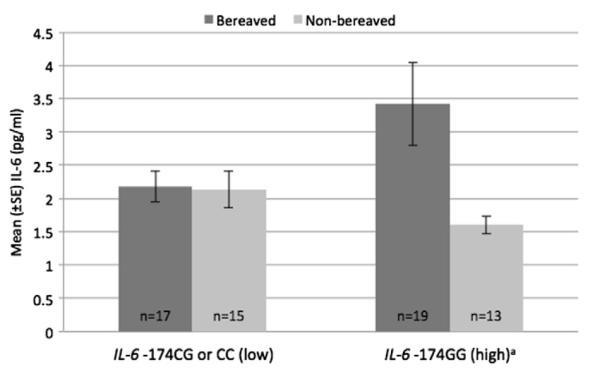
Although bereavement is associated with increased morbidity and mortality in the surviving spouse, some widow(er)s remain healthy. Genetic variability in expression of inflammatory markers in response to stress may be the key to this observation. The present study compares bereaved vs. married/partnered older adults, investigating the impact of bereavement status, pro-inflammatory cytokine single nucleotide polymorphisms (SNPs) on circulating markers of inflammation and hypothesizing a gene by environment (GxE) effect. The study sample included 64 older adults, of which 36 were widow(er)s. Circulating levels of inflammatory markers IL-6, IL-1RA and sTNFRII were measured. Participants were genotyped for SNPs in the IL-6 gene (IL-6 -174 and -572), the IL-1β gene (IL-1β -511), and TNF-α gene (TNF-α -308). Grief severity was assessed with the Inventory of Complicated Grief. Bereaved participants had higher circulating levels of IL-1RA and IL-6. This increase could not be explained by pro-inflammatory genotype frequency differences, or Complicated Grief diagnosis. However, a GxE effect with the IL-6 -174 SNP moderated individual vulnerability to higher circulating levels of inflammation resulting from bereavement exposure. These results suggest a possible mechanism for the increase in morbidity and mortality in the surviving spouse. Genetic variability interacts with an environmental stressor, leading to increased inflammatory markers in genetically susceptible subjects only. For these patients, clinical interventions for bereavement-related stressor reduction might be crucial for overall health.
尽管丧偶与幸存配偶的发病率和死亡率增加有关,但有些寡妇(夫)仍然健康。应对压力时炎症标志物表达的遗传变异性可能是这一观察结果的关键。本研究比较了丧偶和已婚/有伴侣的老年人,调查了丧偶状态、促炎细胞因子单核苷酸多态性(SNP)对循环炎症标志物的影响,并假设了基因与环境(GxE)效应。研究样本包括 64 名老年人,其中 36 名是寡妇(夫)。测量了循环炎症标志物 IL-6、IL-1RA 和 sTNFRII 的水平。对 IL-6 基因(IL-6 -174 和 -572)、IL-1β 基因(IL-1β -511)和 TNF-α 基因(TNF-α -308)中的 SNP 进行了基因分型。用复杂性悲伤量表评估悲伤严重程度。丧偶参与者的循环 IL-1RA 和 IL-6 水平较高。这种增加不能用促炎基因型频率差异或复杂性悲伤诊断来解释。然而,IL-6 -174 SNP 的 GxE 效应调节了个体因丧偶而暴露于更高水平炎症的易感性。这些结果表明了幸存配偶发病率和死亡率增加的一个可能机制。遗传变异性与环境应激源相互作用,仅使遗传易感个体的炎症标志物增加。对于这些患者,针对丧亲相关应激源减少的临床干预可能对整体健康至关重要。