Rambhade Sujit, Chakarborty Anup, Shrivastava Anand, Patil Umesh K, Rambhade Ashish
Department of Pharmacology, Peoples Institute of Pharmacy & Research Center, Peoples Group, Bhopal, Madhya Pradesh, India.
Toxicol Int. 2012 Jan;19(1):68-73. doi: 10.4103/0971-6580.94506.
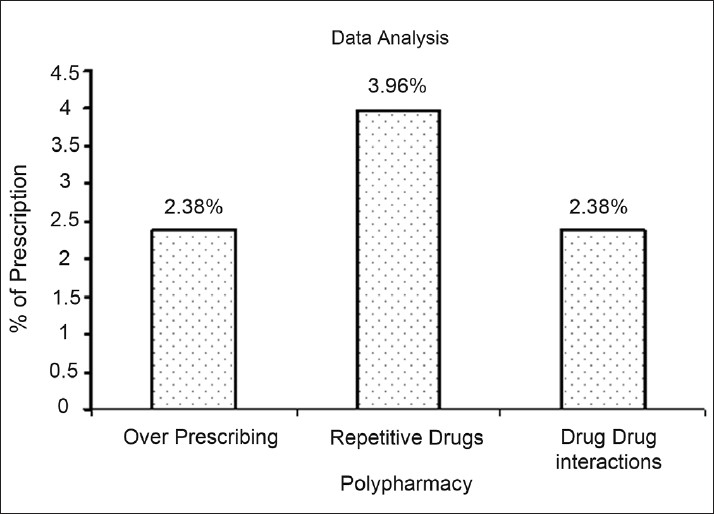
In the past, polypharmacy was referred to the mixing of many drugs in one prescription. Today polypharmacy implies to the prescription of too many medications for an individual patient, with an associated higher risk of adverse drug reactions (ADRs) and interactions. Situations certainly exist where the combination therapy or polytherapy is the used for single disease condition. Polypharmacy is a problem of substantial importance, in terms of both direct medication costs and indirect medication costs resulting from drug-related morbidity. Polypharmacy increases the risk of side effects and interactions. Moreover it is a preventable problem. A retrospective study was carried out at Bhopal district (Capital of Madhya Pradesh, India) in the year of September-November 2009 by collecting prescriptions of consultants at various levels of health care. The tendency of polypharmacy was studied and analyzed under the various heads in the survey. Available data suggests that polypharmacy is a widespread problem, and physician, clinical pharmacists and patients are all responsible. These risks can be minimized through identifying the prevalence of this potential problem in a high-risk population and by increasing awareness among patients and healthcare professionals. Physicians and clinical pharmacists have the potential to combating this problem through a variety of interventions such as reducing the number of medications taken, reducing the number of doses taken, increasing patient adherence, preventing ADRs, improving patient quality of life and decreasing facility and drug costs.
过去,多药联用是指在一张处方中混合使用多种药物。如今,多药联用意味着给个体患者开具过多药物,随之而来的是药物不良反应(ADR)和相互作用的风险更高。当然,在单一疾病状况下使用联合治疗或多药治疗的情况确实存在。多药联用是一个非常重要的问题,无论是直接的药物成本还是因药物相关发病率导致的间接药物成本。多药联用会增加副作用和相互作用的风险。此外,这是一个可预防的问题。2009年9月至11月在印度中央邦首府博帕尔地区进行了一项回顾性研究,收集了各级医疗保健机构中会诊医生的处方。在调查中,按照不同类别对多药联用的趋势进行了研究和分析。现有数据表明,多药联用是一个普遍存在的问题,医生、临床药师和患者都有责任。通过识别高危人群中这一潜在问题的患病率,并提高患者和医疗保健专业人员的认识,可以将这些风险降至最低。医生和临床药师有潜力通过多种干预措施来应对这一问题,例如减少用药数量、减少服药剂量、提高患者依从性、预防药物不良反应、改善患者生活质量以及降低医疗设施和药物成本。